


Quick Answer
The Toyota Celica GT-Four ST205 is worth taking seriously if you want a real rally-homologation Toyota with 3S-GTE character, permanent four-wheel drive, and a shape that still feels different from the usual Impreza, Lancer Evolution, or European homologation choices. It is not the right answer if you need a cheap only car, instant parts support, or a risk-free import.
Use the UK launch specification as the clean baseline for this article: a 1,998 cc turbocharged 3S-GTE inline-four, permanent 4WD, a five-speed E154 manual, 1,400 kg kerb weight, and a 239 bhp rating. Japan-market ST205 cars are commonly discussed around 255 hp, so keep that as a market caveat rather than mixing it into every spec claim. The UK on-sale context runs through 1994-1999, while individual imported cars need their exact market, trim, paperwork, and WRC equipment verified.
The short buying decision is simple. Buy one only after the car proves its identity, rust condition, service history, Superstrut condition, rear differential mount, turbo health, chargecooler circulation, and parts plan. A sorted ST205 can be comfortable, quick, technical, and genuinely special. A neglected one can turn into weeks of downtime, expensive diagnosis, and a hunt for market-specific parts before the fun starts.
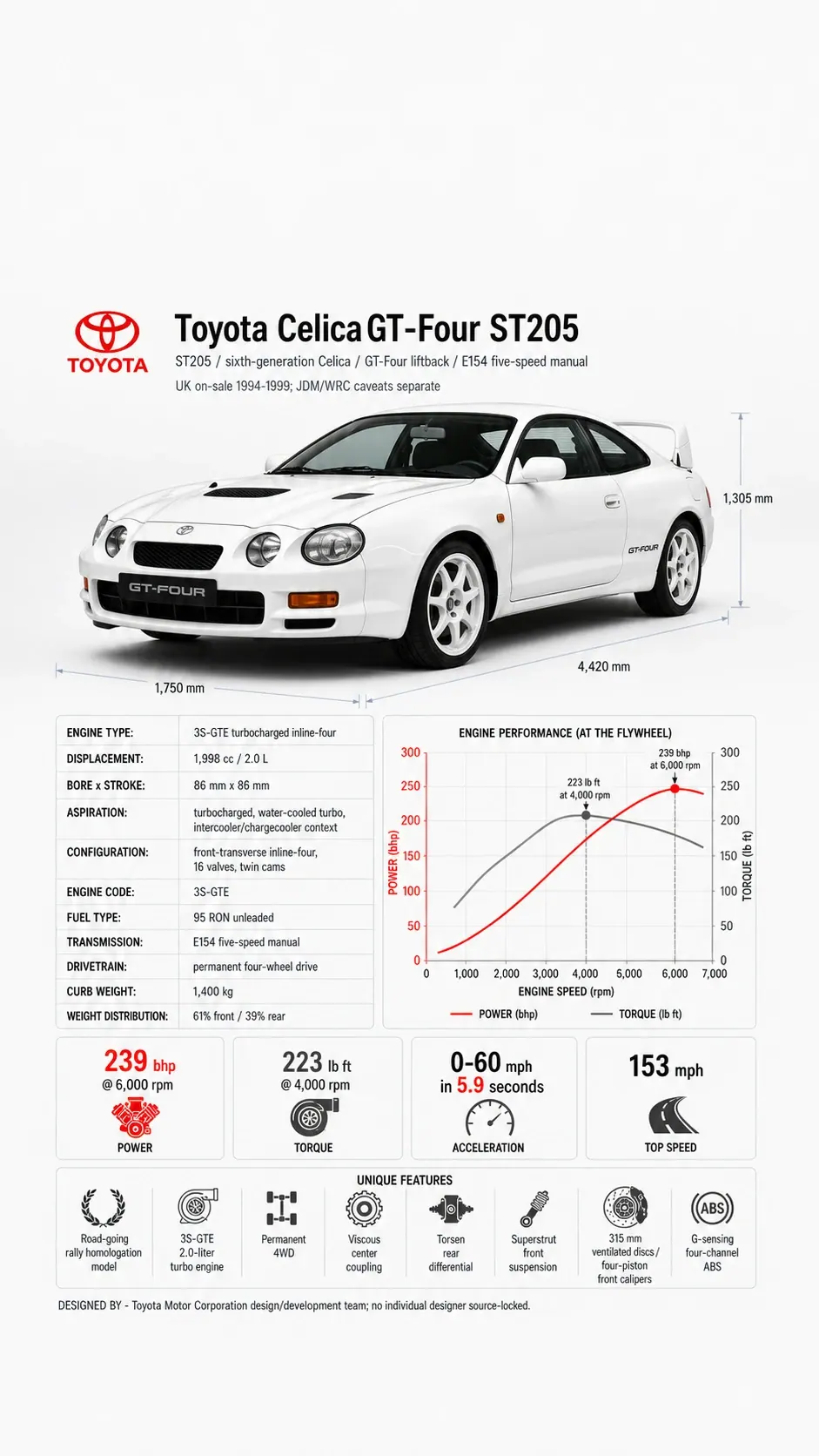
Key Specs And Locked Baseline
This package uses the Toyota UK launch technical data as the locked baseline because it keeps the engine, drivetrain, dimensions, weight, weight distribution, and performance figures in one traceable source set. Treat other market claims as caveats until the target car is identified.
| Item | Locked baseline |
|---|---|
| Model | Toyota Celica GT-Four ST205 |
| Body | 3-door sixth-generation Celica liftback coupe |
| Engine | 3S-GTE 1,998 cc turbocharged inline-four |
| Layout | Front-transverse engine, permanent four-wheel drive |
| Transmission | E154 five-speed manual |
| Center / rear drive hardware | Viscous center coupling, Torsen rear differential |
| Power | 239 bhp at 6,000 rpm for the UK launch baseline |
| Torque | 223 lb ft at 4,000 rpm |
| Acceleration | 0-60 mph in 5.9 seconds, with period summaries also landing around six seconds |
| Top speed | 153 mph |
| Kerb weight | 1,400 kg |
| Weight distribution | 61 percent front / 39 percent rear |
| Dimensions | 4,420 mm long, 1,750 mm wide, 1,305 mm high |
| Wheelbase | 2,540 mm |
The most important boundary is power. A UK-market ST205 GT-Four and a Japan-market ST205 GT-Four are not always described with the same output figure. This guide discusses the JDM 255 hp caveat, but the main specs stay with the source-locked UK 239 bhp baseline unless the exact car being evaluated is a verified JDM example.
The same rule applies to WRC cars. WRC equipment can matter for provenance and collector interest, but it should not be treated as automatic proof of a faster or better road car. Verify the equipment, check what is still present, and separate market identity from performance mythology.
Why The ST205 Matters
The ST205 matters because it was Toyota’s final GT-Four generation and one of the last road-going Celicas tied directly to the company’s rally era. It is not just a badge package. The hardware list is serious: 3S-GTE turbo power, permanent four-wheel drive, Superstrut front suspension, large 315 mm ventilated brake discs, multi-piston calipers, G-sensing four-channel ABS, an aluminum bonnet, and a compact coupe body.
That engineering gives the ST205 a different appeal from simpler Japanese performance cars. It feels like a system car. The engine, transmission, center coupling, rear Torsen differential, suspension geometry, braking package, cooling, and chargecooler all have to work together. When they do, owners describe a car that can feel stable, comfortable, rewarding on back roads, and special enough to justify the extra work.
The catch is that condition matters more than the story. Rally lineage does not fix corrosion, deferred service, worn Superstrut parts, a smoky turbo, weak chargecooler circulation, or an undocumented import history. The best ST205 is a verified, maintained road car with a clear parts plan. The worst one is a legend-shaped bill.
Best For / Not Best For
| Best for | Not best for |
|---|---|
| Buyers who want a real Toyota rally-homologation road car | Buyers who mainly want cheap speed |
| Enthusiasts who can inspect imports carefully | Buyers who cannot verify paperwork, trim, and service history |
| Owners with specialist support or strong DIY ability | Owners who need local same-day parts support |
| Drivers who accept right-hand-drive and import friction | Drivers who need an easy daily commute car |
| Collectors who care about provenance and condition | Buyers chasing WRC badges without checking equipment |
| Toyota fans who value 3S-GTE and permanent AWD character | Buyers who want a simple rear-drive drift or track base |
The ST205 works best as a deliberate enthusiast purchase. It can be a rewarding weekend car, rally-era collectible, light touring car, or careful tuning base, but it asks more planning than a common local performance car. North American owners in the evidence set repeatedly point to a backup car, parts waiting time, cross-referencing, and specialist knowledge as part of the ownership reality.
That does not make the car fragile by default. A sorted ST205 can be usable and satisfying. The problem is downtime risk. If a rare import breaks and the needed part is market-specific, the car may sit while you confirm fitment, wait for shipping, or find a shop that understands the platform. If that would break your commute or your budget, the car is probably the wrong choice even if the asking price looks tempting.
What Goes Bad And What To Check
Start with identity and paperwork. Confirm the car is really an ST205 GT-Four, identify whether it is UK, Japan-market, WRC, or another import-market configuration, and make sure the title, import records, mileage trail, and chassis details agree. If a seller charges a premium for WRC equipment, verify what equipment is present instead of accepting the label.

Then inspect the body like the purchase depends on it, because it does. Check sills, arches, underside, brake pipes, frame rails, bumper cavities, door drains, repaired areas, and any hidden seams where old corrosion work can disappear under fresh underseal. The aluminum bonnet should also be inspected carefully because dents and replacement difficulty can matter more than buyers expect.
The mechanical inspection should be just as strict:
- Cold-start the 3S-GTE and watch for smoke, misfire, oil leaks, and rough running.
- Check boost behavior, turbo smoke on boost, and evidence of poor boost control or mapping.
- Confirm timing-belt history, oil-change history, coolant condition, and fluid records.
- Verify chargecooler pump operation and fluid circulation before trusting sustained boost.
- Listen for Superstrut front-end knocks, especially figure-eight bush wear and related link wear.
- Inspect the rear differential mount, driveline noises, clutch operation, gearbox feel, and differential fluids.
- Check heater operation and passenger carpet condition, because heater-matrix work can become expensive.
- Inspect tires, alignment, brakes, wheel fitment, and signs of accident repair.
Current market pricing, live product ratings, discounts, and affiliate recommendations are intentionally left out because they move quickly and were not part of the verified source package.
Technical Systems And Reliability

The ST205 is durable only when its systems are kept healthy. The 3S-GTE is a 1,998 cc turbocharged inline-four with twin cams, 16 valves, and a front-transverse layout. It is the center of the car’s appeal, but the engine should be judged by service history, oil changes, timing-belt evidence, cooling condition, chargecooler function, boost control, and tune quality.
The drivetrain is more complex than a simple front-drive Celica. The E154 five-speed manual, permanent four-wheel drive, viscous center coupling, and Torsen rear differential are part of what makes the GT-Four feel special. They also create inspection work. Gearbox feel, clutch behavior, transmission and differential fluids, driveline noise, and rear differential mount condition all matter before purchase.
Superstrut front suspension is another defining feature. It helps the car’s front end do more than a normal strut setup, but worn links and bushes can make a cheap car expensive. Front-end knocking should not be brushed off as harmless age. Inspect it, price it, and confirm whether replacement parts are actually available for the market you are buying in.
The brake package is serious for the era, with 315 mm ventilated discs and multi-piston calipers. That does not remove the need for normal checks. Look for uneven wear, tired hoses, sticking calipers, poor fluid history, mismatched tires, and alignment problems. A GT-Four that drives well should feel cohesive; if the engine, suspension, brakes, and AWD system all feel like separate problems, walk away or price the car as a project.
Ownership, Mods, Imports, And WRC Caveats

Ownership starts with the reality that most readers are dealing with a 30-year-old import. Right-hand drive can be livable, but owners call out visibility, passing, tolls, drive-throughs, insurance, registration, and shop familiarity as practical frictions. Parts are often obtainable, but the route may involve waiting, cross-referencing MR2 Turbo or Celica GT-S items, and checking fitment part by part.
Modification history deserves extra suspicion. The 3S-GTE responds to tuning, but an ST205 with more boost, unknown ECU work, mismatched hardware, or poor maintenance is not automatically better than a stock car. Owner evidence flags cars run above roughly 1.1 bar on standard internals as needing closer scrutiny, not as proof of a universal limit. The right question is whether the build, fuel, cooling, mapping, maintenance, and documentation support what the car is doing.
The WRC version needs the same discipline. Treat WRC equipment as a provenance and hardware question, not a shortcut to value or performance. Anti-lag or water-injection plumbing may be present, inactive, incomplete, or misunderstood. Verify what the car has, what still works, and whether the premium is tied to documented equipment rather than seller mythology.
First-service planning should come before cosmetics or boost. Budget for fluids, timing-belt evidence, oil service, chargecooler checks, rust protection, Superstrut inspection, rear diff mount inspection, brake service, tires, alignment, and baseline diagnostics. A clean ST205 rewards that approach. A rushed one punishes it.
Next Action
Use this order before paying a premium:
- Verify the car’s exact identity, market, trim, paperwork, mileage trail, and WRC claims.
- Inspect rust before falling in love with the engine bay or rally story.
- Confirm 3S-GTE service history, timing-belt evidence, oil history, cooling, chargecooler circulation, turbo health, and boost behavior.
- Inspect Superstrut, rear differential mount, gearbox, clutch, driveline, brakes, tires, and alignment.
- Price first-service work and parts availability before pricing modifications.
- Decide whether you can live with right-hand drive, import downtime, specialist labor, and a backup transportation plan.
If the car passes those checks, the ST205 can be one of the more interesting Toyota performance buys: compact, technical, rally-connected, and different from the usual alternatives. If it fails them, do not let the GT-Four badge hide ordinary old-car problems.
FAQ
Is the ST205 Celica GT-Four legal to import to the United States?
Many ST205s are now old enough for 25-year import eligibility, but legality still depends on the exact build date, paperwork, title path, state rules, and compliance details. Verify the specific car, not just the model name.
Is the WRC version faster or better than a regular ST205?
Not automatically. WRC equipment can matter for provenance, but owner evidence warns against treating the badge as proof of a better road car. Check which WRC parts are present, whether they are active, and whether the car is actually better maintained.
What are the biggest ST205 buying risks?
Rust, Superstrut wear, rear differential mount condition, turbo smoke, chargecooler circulation, timing-belt history, clutch labor, import paperwork, RHD practicality, and parts downtime are the recurring checks.
Is the 3S-GTE reliable in an ST205?
It can be, but only if maintenance and tune quality are there. Oil history, timing belt, cooling, chargecooler function, boost control, and mapping matter more than mileage alone.
Can an ST205 be a daily driver?
It can function as one for the right owner, but it is a risky only car in markets where it was never sold new. A backup car, specialist support, and a parts plan make ownership much more realistic.
Why does this guide use 239 bhp when some ST205s are listed around 255 hp?
The 239 bhp figure is the source-locked UK launch baseline used for this package. Japan-market ST205 output is commonly treated as a 255 hp caveat, so the article keeps those market contexts separate instead of mixing them into one generic spec.
FAQ
Common questions
Is the ST205 Celica GT-Four legal to import to the United States?
Many ST205s are now old enough for 25-year import eligibility, but legality still depends on exact build date, paperwork, title path, state rules, and compliance details.
Is the WRC version faster or better than a regular ST205?
Not automatically. WRC equipment can matter for provenance, but buyers should verify which WRC parts are present, whether they are active, and whether the car is actually better maintained.
What are the biggest ST205 buying risks?
Rust, Superstrut wear, rear differential mount condition, turbo smoke, chargecooler circulation, timing-belt history, clutch labor, import paperwork, RHD practicality, and parts downtime are recurring checks.
Is the 3S-GTE reliable in an ST205?
It can be, but only if maintenance and tune quality are there. Oil history, timing belt, cooling, chargecooler function, boost control, and mapping matter more than mileage alone.
Can an ST205 be a daily driver?
It can function as one for the right owner, but it is a risky only car in markets where it was never sold new. A backup car, specialist support, and a parts plan make ownership much more realistic.
Why does this guide use 239 bhp when some ST205s are listed around 255 hp?
The 239 bhp figure is the source-locked UK launch baseline used for this package. Japan-market ST205 output is treated as a separate 255 hp caveat.
Sources and references
- Toyota UK: Celica GT-Four Archive (1994-1999)Reference for homologation framing, UK on-sale period, 239 bhp, 0-60 summary, and 2.0-liter turbo context.
- Toyota UK: Celica Gen6 GT-Four UK launch packReference for dimensions, kerb weight, weight distribution, 3S-GTE engine data, E154 transmission, drivetrain, suspension, brakes, top speed, acceleration, and fuel figures.
- Toyota UK Magazine: Toyota Celica historyReference for Celica lineage and rally/motorsport background.
- Toyota Gazoo Racing: GR-FOUR from GT-FOUR to GR-FOURReference for Toyota all-wheel-drive rally lineage context.
- PistonHeads: Toyota Celica GT-Four ST205 SpottedReference for JDM-versus-European output context, Group A homologation framing, and import-market interest.
- Fast Car: Toyota Celica GT-Four ST205 Buyer's GuideReference for drivetrain summary, top speed cross-check, and recurring buyer inspection risks.
- Toyota Owners Club: Toyota Celica GT4 ST205Reference for owner/forum buyer risks, WRC-model caveats, suspension, turbo, oil service, and boost-tuning caution.
- Reddit r/Celica: ST205 GT-Four dailyReference for owner/user evidence around daily use, parts access, reliability, mechanic skill, and downtime caveats.
- Reddit r/Celica: Looking to get a GT Four in the USAReference for North American import ownership, RHD use, parts wait time, insurance/registration, repair complexity, and backup-car advice.
- Reddit r/Celica: Entered the GT4 Owner ClubReference for recent owner advice on maintenance, rust protection, fluids, timing belt, Superstrut, and rear diff mount checks.
Topic hubs
Tags

