


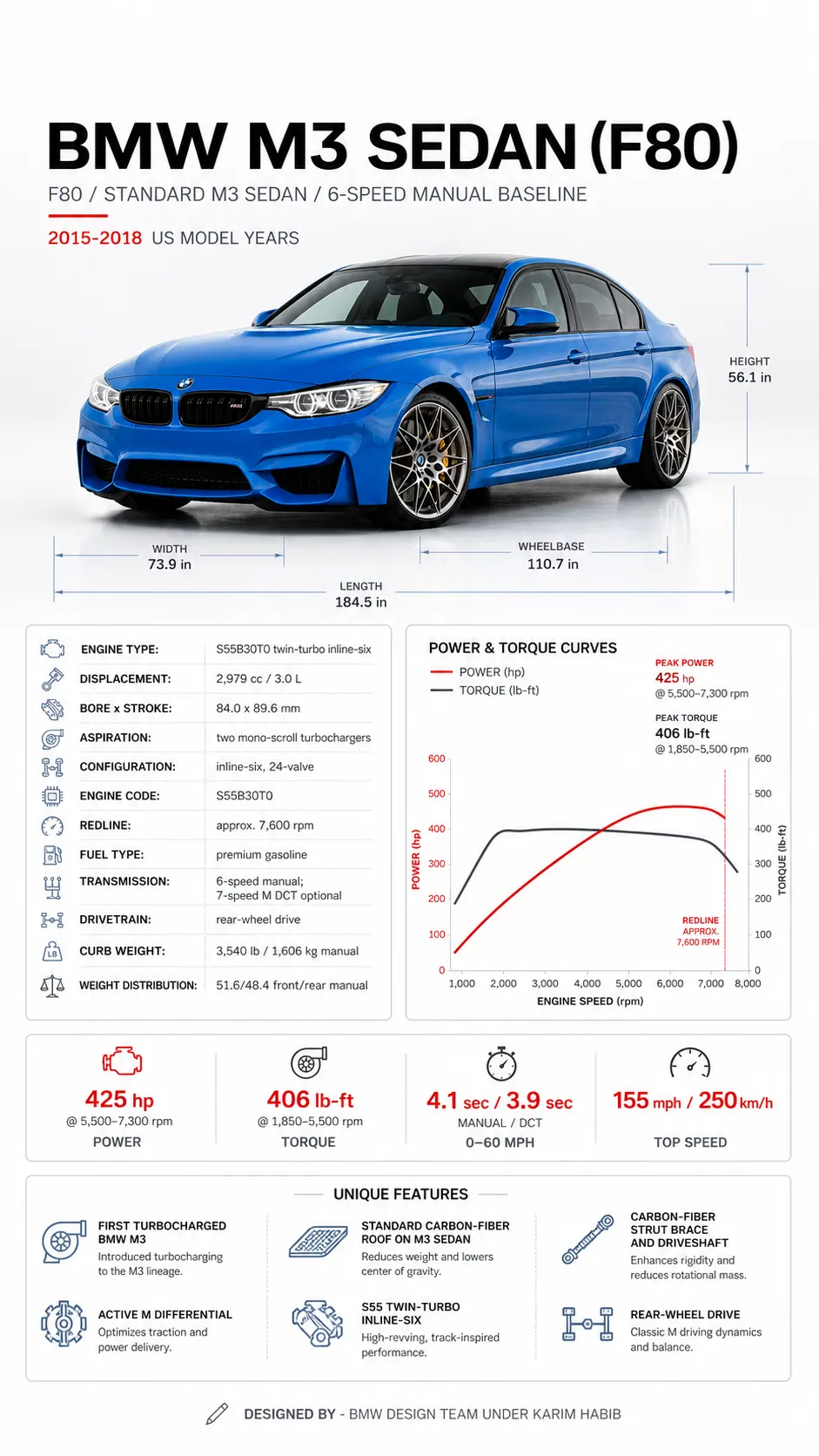
The BMW F80 M3 is worth shortlisting if you want a fast, usable, rear-drive M sedan with a strong S55 twin-turbo six, a real manual option, and enough modern pace to feel serious today. It is the wrong shortcut if you want cheap consumables, a soft ride, or a car where tune history and inspection evidence do not matter.
This guide is for a used-car shopper deciding whether a 2015-2018 BMW F80 M3 Sedan belongs on the list. The useful question is not only whether the car is quick. It is whether a specific example has the service history, tune record, tire setup, leak check, and crank-hub risk profile to justify the price.
What Version This Guide Covers
The locked baseline is the US-market standard BMW F80 M3 Sedan sold for model years 2015-2018. The car uses the S55B30T0 3.0-liter twin-turbo inline-six, rear-wheel drive, Active M Differential, a standard 6-speed manual, and optional 7-speed M DCT.
That scope matters because F80 shopping discussions often blend versions. Competition Package cars add power and chassis/equipment changes. The 30 Jahre and CS are separate special models. F82 and F83 cars are M4 coupes and convertibles, not the sedan baseline. Tuned cars can be excellent, but their inspection standard changes because torque, heat, launch use, and crank-hub risk become part of the purchase.
Key Specs
| Item | US-market standard F80 M3 Sedan baseline |
|---|---|
| Model years | 2015-2018 in the US |
| Engine | S55B30T0 3.0-liter twin-turbo inline-six |
| Displacement | 2,979 cc |
| Output | 425 hp at 5,500-7,300 rpm in US BMW material |
| Global output context | 431 hp / 317 kW in BMW M material |
| Torque | 406 lb-ft / 550 Nm at 1,850-5,500 rpm |
| Transmission | 6-speed manual; optional 7-speed M DCT |
| Drivetrain | Rear-wheel drive with Active M Differential |
| Weight | 3,540 lb manual; 3,595 lb M DCT in BMW US technical data |
| 0-60 mph | 4.1 sec manual; 3.9 sec M DCT in BMW US material |
| Top speed | 155 mph / 250 km/h, electronically limited |
The horsepower split is not a mistake. BMW M global material uses 431 hp / 317 kW, while BMW US technical data uses 425 hp for the standard car. For a US buyer guide, the table uses 425 hp and states the global value where helpful.
Why The F80 M3 Still Matters
The F80 changed the M3 formula without abandoning the useful part of the formula. It brought turbocharging to the M3 for the first time, split coupe and convertible naming into M4, and kept the M3 name on the four-door sedan. BMW also leaned into lightweight details: a carbon-fiber roof, carbon-fiber strut brace, carbon-fiber driveshaft, aluminum hood, and wider M bodywork.
The result is not as theatrical as the E92 M3’s naturally aspirated V8, but it is much faster in normal driving. The S55 makes its 406 lb-ft early, which means the car feels urgent without needing to live near redline. That is also why rear traction, tire quality, alignment, and throttle discipline matter. A neglected F80 can feel nervous. A sorted one feels like a compact supersedan.
That is the reason to buy one. It is not the lowest-risk used sedan answer for every buyer.
Best For And Wrong For
| Best for | Wrong for |
|---|---|
| A buyer who wants one fast daily sedan | A buyer expecting normal sedan running costs |
| Manual buyers who still want modern turbo power | Anyone ignoring tire, brake, and fluid costs |
| Tuners who will document the build correctly | Buyers who cannot verify tune or crank-hub history |
| BMW owners with a trusted specialist | Shoppers choosing only the cheapest example |
| Track-day users willing to maintain it | Drivers who will run old tires and skip inspections |
Editorial judgment: a clean standard F80 with records can be the smarter buy than a tired Competition car. The badge and option list matter less than evidence: service history, diagnostic behavior, tire quality, modification records, and seller cooperation for inspection.
Owner Evidence And Real-World Themes
The source package includes 20 owner/user review records from owner discussions, maintenance-cost reports, and forum reliability threads. These records are not a formal reliability study, but they are useful because they show what owners keep paying for and what shoppers keep worrying about after the excitement fades.
The positive themes are consistent. Owners describe the S55 as strong when maintained, the sedan body as genuinely usable, and the platform as capable of daily driving, winter use with proper tires, back-road pace, and track work.
The negative themes are just as consistent. Owners and buyers talk about tire and brake costs, oil and gasket leaks, plugs, differential service, DCT service, sensors, bushings, cheap tire choices, warning lights, and tune history. Crank hub comes up often, but the useful question is not whether the phrase appears on a forum. It is whether the specific car’s torque, tune, launch use, and maintenance evidence make the risk acceptable.
The useful lesson is not that every F80 M3 is fragile. The useful lesson is that proof matters before you pay M-car money.
Common Failures And Pre-Purchase Checks
Crank hub slip is the headline issue, but the right way to treat it is as a risk question, not a panic slogan. Stock cars can fail, but the risk conversation gets louder around tuned cars, high-torque setups, aggressive DCT kickdown use, launch-heavy driving, ethanol blends, and upgraded turbos. If the car is modified, ask who tuned it, what torque limits were used, whether the hub was addressed, and what evidence exists.
The everyday inspection is broader than crank hub. Look for oil leaks around the valve cover, oil filter housing, oil pan, and related seals. Inspect charge-air and boost plumbing, J-pipe connections, heat exchanger condition, coolant traces, and clamps. Scan for wheel-speed sensor faults and other electronic warnings.
| Area | What to ask or check | Why it matters |
|---|---|---|
| Tune and crank hub | Stock or tuned, tuner name, torque target, ethanol use, launch use, hub work evidence | Tune history changes the risk profile and should change inspection depth. |
| Oil leaks | Valve cover, oil filter housing, oil pan, front and rear main areas | Owner evidence repeatedly flags age-related leaks and gasket work. |
| Boost and cooling | Charge pipes, J-pipe, heat exchanger, coolant tank, clamps, boost leaks | The S55 is strong, but plumbing and cooling details matter on modified or high-mile cars. |
| Tires and brakes | Tire brand, date codes, matching setup, even wear, rotor and pad life | Cheap or old tires are a major warning sign on a high-torque rear-drive M car. |
| Chassis | Differential bushings, engine mounts, dampers, control arms, wheel bearings | The car feels much worse when the support hardware is tired. |
| Electronics | BMW-capable diagnostic scan, warning lights, wheel-speed sensor faults | A clean test drive can miss stored codes and intermittent faults. |
| Body and modifications | Paint-depth readings, panel gaps, underside, accident history, tune and part receipts | Mystery tuning and crash repair are not the same risk as documented reversible work. |
Under the car, look at differential bushings, engine mounts, control arms, dampers, alignment, uneven tire wear, brake life, and signs of accident repair. Cheap front tires with expensive rears, mismatched brands, odd wear, or old date codes are a warning sign because the F80 puts real torque through the rear tires.
Technical Systems And Reliability

The S55 is the core reason to buy the car. It is an M-developed twin-turbo inline-six with direct injection, Valvetronic, Double VANOS, two mono-scroll turbochargers, strong midrange torque, and a 7,600 rpm ceiling. In stock form, owner feedback is generally positive when oil service, plugs, cooling, boost plumbing, and leak checks are kept in order.
Manual versus M DCT is a taste and use-case decision. The manual is simpler and more engaging. M DCT is faster and suits the car’s torque, but buyers should check service history, launch use, tune behavior, and smooth operation at low speed. Neither gearbox rescues a weak car.
The Active M Differential, wide tires, and stiff chassis are major strengths, but they also reveal neglect. A car with tired dampers, sloppy bushings, poor alignment, and worn tires will feel much worse than the platform deserves.
Ownership Costs And First Mods
The sensible first spend is not power. It is inspection, fluids, tires, brakes, plugs, and documentation. Budget for a BMW-capable scan, a pre-purchase inspection by a specialist, and a reserve for immediate service. If you plan to tune, inspect the crank-hub question first, then cooling and charge-air reliability, then tires and brakes.
The best first mods are boring because they make the car trustworthy: quality tires, alignment, fresh fluids, pads and rotors suited to use, plugs, and a conservative tune only after the car is mechanically known. Cosmetic carbon and noise can wait.

Inspection discipline matters because the F80 M3 can hide cost behind speed. A strong example should make its story easy to follow: ownership history, service receipts, clean diagnostic behavior, sensible tires, coherent modifications, and enough seller cooperation for a proper inspection.
Rivals And Generation Trade-Offs
The W205 Mercedes-AMG C63 has the more dramatic V8 personality. It feels more muscle-car than precision tool and can be the more emotional choice if sound matters most. The F80 wins if you want a sharper, lighter, more tune-friendly sedan.
The Alfa Romeo Giulia Quadrifoglio is the romantic pick: steering, chassis feel, and drama are excellent. The F80 is the calmer used buy when you value parts availability, BMW specialist knowledge, and a larger owner base.
The E92 M3 is the heart car. Its S65 V8 is special, but it brings older-car concerns and its own expensive preventative-maintenance culture. The F80 is quicker, torquier, more practical, and usually easier to daily.
The G80 M3 is faster and newer, especially with M xDrive, but it is larger, more expensive, and less subtle. The F80 still has the cleaner size and simpler rear-drive identity.
Final Verdict
The BMW F80 M3 is worth buying when you want the S55 turbo M3 sedan for the right reasons: compact modern pace, real usability, rear-drive balance, a manual option, and tuning headroom that can be documented rather than guessed.
The right car is serviced, inspectable, scanned clean, running proper tires, free of unresolved warning lights, and honest about tune or crank-hub history. The wrong car is the one with vague records, mystery modifications, old tires, unexplained leaks, seller pressure, or a price that leaves no room to fix what the inspection finds.
Shortlist the car for the S55 and chassis. Buy it only for the evidence.
FAQ
Common questions
Is the BMW F80 M3 reliable?
Yes, by used performance-car standards, a maintained stock or lightly modified F80 can be reliable. The mistake is treating it like a normal sedan. Tires, brakes, fluids, plugs, sensors, bushings, and leak checks matter.
Is F80 M3 crank hub failure common?
It is common enough to inspect and budget around, especially for tuned or hard-driven cars, but not every stock car should be treated as doomed. Tune history, torque, driving use, and evidence matter.
Should I buy the manual or M DCT?
Buy the manual if involvement and simplicity matter most. Buy M DCT if acceleration, track consistency, and launch performance matter. Condition and records matter more than the gearbox label.
Is the Competition Package worth paying more for?
Sometimes. Competition brings extra power, chassis tuning, wheels, and equipment, but a cleaner standard car can be the smarter buy than a tired Competition car.
What should I check before buying?
Start with history, diagnostic scan, oil leaks, boost and cooling plumbing, crank-hub and tune history, brakes, tires, suspension, differential bushings, engine mounts, warning lights, accident repair, and service records.
Sources and references
- BMW M: BMW M3 F80 and BMW M4 F82Reference for F80 and F82 generation context, S55B30, global output, turbo M3 framing, design notes, and Competition output.
- BMW M: The BMW M3 generations at a glanceReference for F80 generation facts, four-door sedan body, output range, carbon roof, and lightweight construction context.
- BMW Group PressClub USA: The all-new BMW M3 Sedan and BMW M4 CoupeReference for 2015 launch context, 425 hp, 406 lb-ft, 0-60 mph, weight reduction, and carbon-fiber-reinforced plastic use.
- BMW Group PressClub USA: Technical Data 2015 BMW M3 SedanReference for dimensions, curb weight, weight distribution, engine code, bore/stroke, output, top speed, 0-60 mph, and tires.
- BMW Group PressClub USA: New Competition Package Amps Up The BMW M3 And M4Reference for the Competition Package distinction from the standard F80 baseline.
- BMW Group PressClub USA: The First-Ever BMW M3 CSReference for CS as a separate special-edition context.
- BMW Technical Training: F80/F82 Complete VehicleReference for technical cross-checks and S55 vehicle package context.
- Car and Driver: Tested 2015 BMW M3 with DCT AutomaticReference for independent performance and curb-weight context.
- ReDriven: Used BMW M3 (F80) reviewReference for used-buyer risk framing and crank-hub caution context.
- F80 Bimmerpost: M3 F80 long-term reliabilityReference for long-term owner reliability and daily-driver discussion.
Topic hubs
Tags


