


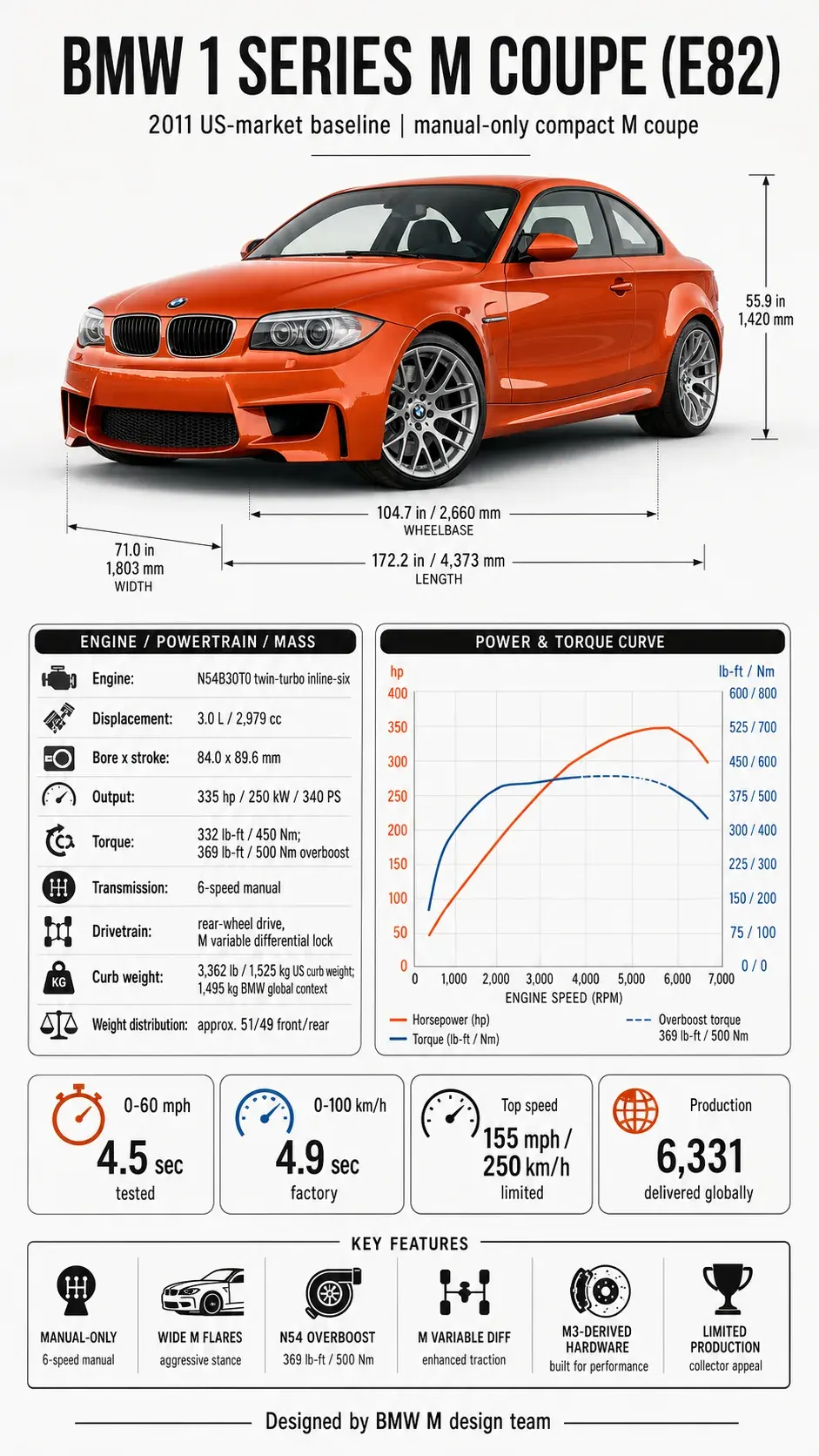
The BMW 1M Coupe is worth the premium only if you are buying the whole recipe: manual-only rarity, compact rear-drive feel, M3-derived hardware, documented originality, and a clean N54 history.
That is the useful starting point because the 1M is easy to over-romanticize. It is not just an expensive 135i with flares, but it is also not a car to buy on badge energy alone. The smart path is records first: service history, tune evidence, body originality, N54 fault patterns, and a specialist pre-purchase inspection.
Quick Answer
The BMW 1 Series M Coupe is a short-run BMW M parts-bin special with the right parts in the right places: a 6-speed manual gearbox, rear-wheel drive, the N54B30T0 twin-turbo inline-six, an M variable differential, wide bodywork, M3-derived chassis hardware, serious brakes, and a compact attitude that still feels different from newer M cars.
Buy one if you want a rare driver car that feels physical, slightly unruly, and collectible for reasons beyond straight-line speed. Skip it if you mostly want cheap power, low maintenance risk, or a car you can modify heavily without hurting value.
Key Specs
| Item | BMW 1 Series M Coupe |
|---|---|
| Chassis | E82 |
| Model-year focus | 2011 US-market baseline |
| Engine | N54B30T0 3.0-liter twin-turbo inline-six |
| Output | 335 hp / 250 kW / 340 PS |
| Torque | 332 lb-ft / 450 Nm, with short overboost to 369 lb-ft / 500 Nm |
| Transmission | 6-speed manual only |
| Drivetrain | Front-engine, rear-wheel drive |
| Differential | M variable differential lock |
| Wheelbase | 104.7 in / 2,660 mm |
| Dimensions | 172.2 in / 4,373 mm long, 71.0 in / 1,803 mm wide, 55.9 in / 1,420 mm high |
| Curb weight | 3,362 lb US reference; BMW M also cites 1,495 kg in global context |
| 0-60 / 0-100 | 4.5 sec 0-60 mph in Car and Driver testing; 4.9 sec 0-100 km/h factory context |
| Top speed | 155 mph / 250 km/h limited |
| Production | 6,331 delivered globally per BMW M profile |
The curb-weight line needs a caveat because published values depend on market and measurement convention. This article keeps the US consumer value and the BMW M global reference visible instead of pretending there is one universal number.
Why This Car Matters
The 1M matters because it arrived almost accidentally perfect. BMW M did not give it an exotic engine or a long production runway. Instead, it compressed proven hardware into the smallest, angriest package it could sell: turbo inline-six torque, manual-only control, a short wheelbase, wide flares, M3-derived chassis pieces, and a limited run that ended before the car could become ordinary.
That combination is why the market treats it differently from a 135i. A good 135i can be fast and fun, but the 1M has the factory body, chassis hardware, M differential, stance, brakes, and scarcity baked in. The visual package matters too: the front apron, air curtains, swollen arches, 19-inch wheels, short coupe greenhouse, and quad exhaust make the small car look like it is bracing itself against its own torque.
Best For And Wrong For
| Best for | Wrong for |
|---|---|
| Buyers who value rarity and originality | Buyers who want the cheapest N54 speed |
| Manual-only driver-car collectors | Owners planning heavy modifications |
| People who like compact, short-wheelbase dynamics | People who want soft daily comfort |
| BMW M fans who want something stranger than an M2 | Buyers who need low running-cost certainty |
| Drivers who will preserve records and stock parts | Anyone unwilling to inspect N54 fault history |
The 1M is a car where the wrong example can erase the point. Modified, accident-repaired, poorly documented cars may still be exciting, but the collector premium belongs to clean, original, well-serviced examples.
Compared With Rivals
The E92 M3 gives you the drama of a naturally aspirated V8 and a more traditional M-car engine story. The 1M answers with torque, compactness, rarity, and a more playful edge.
The later M2 is easier to find and easier to live with, but it is less unusual and less limited. A Cayman R or 987 Cayman S can feel more precise, but it does not carry the same BMW M compact-muscle identity. An Audi TT RS brings five-cylinder turbo character and all-wheel drive, while the 1M stays more analog and rear-drive.
The strongest value comparison is the 135i or 335is. Those cars can share N54 family appeal for far less money, but they do not have the factory 1M package. If you only want power, buy the cheaper car. If you want the factory-built object with the story, scarcity, stance, and chassis mix, the 1M is the one.
What Goes Bad And What To Check

Start with documentation. You want service records, stock parts, clear ownership history, paint and body consistency, and evidence that the car has not been casually tuned and returned to stock before sale.
The N54 is the center of the inspection. Ask about high-pressure fuel pump history, injector index and replacement records, turbo wastegate rattle, boost leaks, vacuum lines, charge pipe condition, electric water pump and thermostat age, valve cover and oil filter housing leaks, oil pan seepage, and carbon buildup. None of those automatically ruins the car, but hiding them does.
Then inspect the expensive driver-car parts: clutch engagement, flywheel noise, differential behavior, rear bushings, control arms, tire wear, brake rotor and pad condition, wheel damage, alignment evidence, and underbody marks. A 1M used as intended may be healthy, but it should not be priced like a museum car unless its condition supports that story.
Technical Systems And Reliability

The N54B30T0 is the reason the 1M feels so muscular. Its twin turbos give the car low-rpm shove that a high-revving naturally aspirated engine cannot match, and the overboost function is part of why the car feels stronger than its 335 hp headline suggests. For buyers, that same engine is also the reason to slow down and verify the service trail.
The chassis is the part that makes the engine feel legitimate. BMW M used major hardware ideas from the M3 playbook, including aluminum-intensive suspension hardware, serious brakes, and the M differential. That is why the 1M feels broader, more planted, and more purposeful than the normal 1 Series Coupe. Check those systems like expensive M-car hardware, not like economy-car consumables.
Ownership Notes
The 1M is now a collector car with a driver-car tax. Low miles, original paint, Valencia Orange, stock hardware, complete records, and clean provenance matter. So does restraint. A tuned N54 can be wonderful, but the more modified the car is, the more the buyer should discount the collector story or demand exceptional documentation.
Useful next steps are practical, not flashy: a vehicle-history report, a specialist PPI, a saved inspection checklist, and a maintenance budget for N54 age items. Do not let rarity rush the process. The right 1M is worth waiting for because the wrong one can be expensive in a way ordinary buyer-guide math does not soften.
Next Action
Before chasing a listing, build your inspection packet: service records, VIN and history report, paint and body review, N54-specific maintenance checklist, and a specialist PPI. If the car is modified, require receipts and assume the price should reflect the risk. If it is stock, documented, and clean, then the 1M premium finally starts to make sense.


