


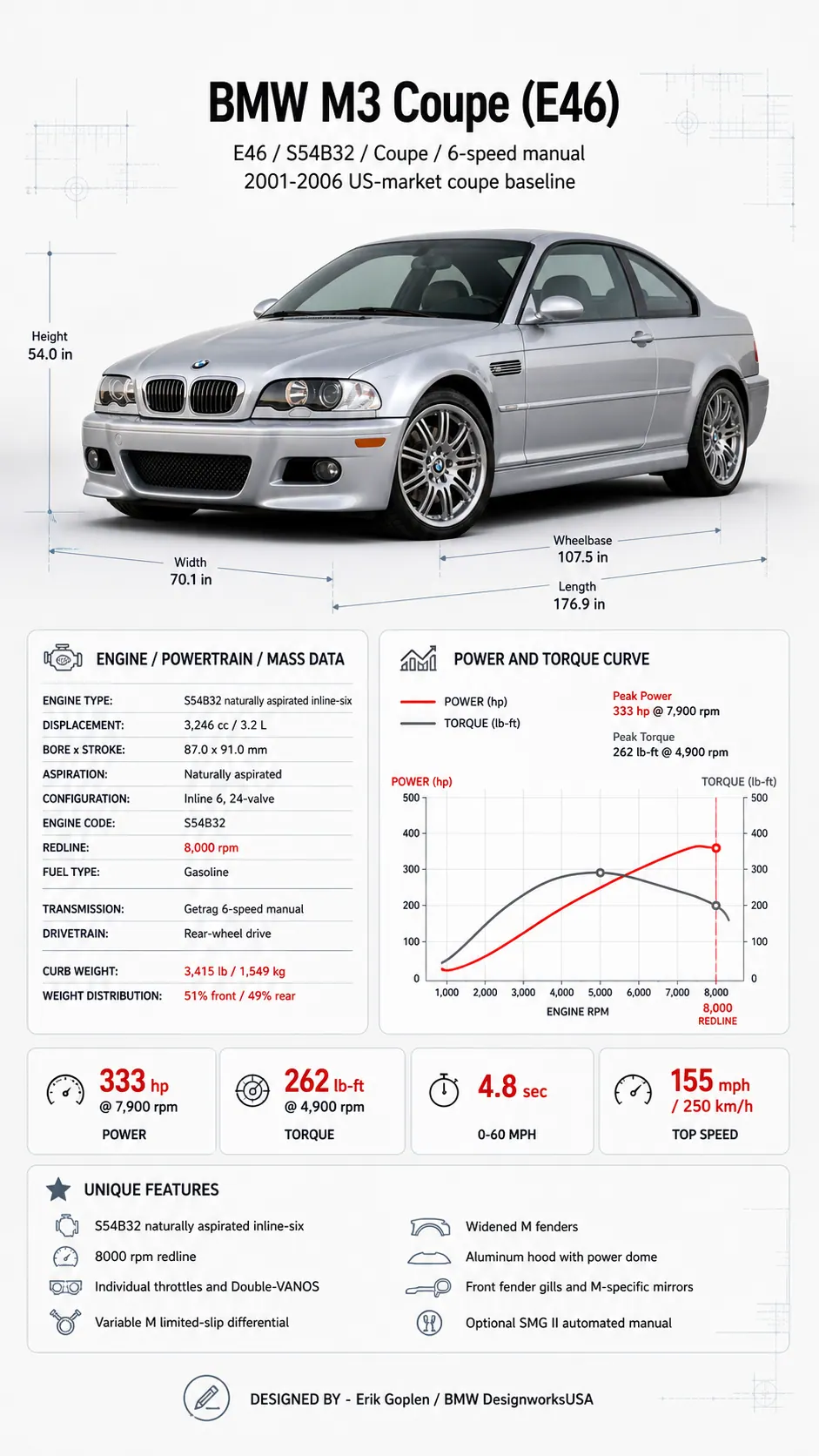
The BMW E46 M3 is still one of the easiest M cars to understand emotionally and one of the easiest to buy badly. It has the right ingredients: a high-revving naturally aspirated S54 inline-six, rear-wheel drive, compact coupe proportions, hydraulic-era feedback, and M bodywork that still looks purposeful without shouting.
That appeal is exactly why the buying process has to be disciplined. A strong E46 M3 feels coherent in a way many faster cars do not. A tired one can turn the same spec sheet into a list of overdue repairs.
Quick Spec Snapshot
The locked baseline for this guide is the US-market E46 M3 Coupe with the 6-speed manual. Global output is mentioned separately because BMW M global material and BMW USA material use different figures.
| Detail | BMW E46 M3 Coupe baseline |
|---|---|
| Generation | E46 |
| US model years | 2001-2006 |
| Engine | S54B32 naturally aspirated inline-six |
| Displacement | 3,246 cc |
| Bore x stroke | 87.0 mm x 91.0 mm |
| Power | 333 hp at 7,900 rpm, US |
| Torque | 262 lb-ft / 355 Nm at 4,900 rpm, US |
| Global output context | 343 hp / 365 Nm |
| Redline | 8,000 rpm |
| Transmission | 6-speed manual; SMG II optional |
| Drivetrain | rear-wheel drive |
| Top speed | 155 mph / 250 km/h, electronically limited |
| Curb weight | 3,415 lb / 1,549 kg, US manual value |
| Weight distribution | 51% front / 49% rear |
| Dimensions | 176.9 in L / 70.1 in W / 54.0 in H |
| Wheelbase | 107.5 in |
The curb-weight figure deserves a note. BMW’s US owner’s manual lists 3,415 lb / 1,549 kg, while BMW USA Classic Collection lists 3,450 lb for a 2006 collection car. The article locks the owner’s-manual value and keeps the conflict visible instead of pretending every source agrees.
Why The S54 Defines The Car
The S54 is the reason the E46 M3 still has such a strong pull. It is not a modern turbo engine that gives everything away early. It wants revs, throttle, and commitment. The reward is response and mechanical texture rather than effortless low-rpm torque.
That engine character makes the car feel special even when newer performance cars are objectively quicker. The E46 M3 is fast enough, but the point is not only speed. The point is how the car asks to be driven: build revs, place the front end, trust the rear-drive balance, and let the engine do its work near the top of the tachometer.
It also means the cheapest car is rarely the smartest one. The S54, cooling system, driveline, suspension, brakes, and body all need evidence. Maintenance history is not a bonus detail. It is part of the car.

The Design Still Works
The E46 M3 is separate from a normal E46 without becoming cartoonish. The wider arches, front apron, aluminum hood power dome, fender gills, M mirrors, quad exhaust layout, and small rear lip all communicate the same idea: more serious than a regular 3 Series, cleaner than many later performance coupes.
That restraint helps the car age well. A stock-looking E46 M3 still photographs cleanly because the proportions do not need explanation. The body is compact by modern standards, the glasshouse is simple, and the M-specific details are integrated rather than pasted on.
It is also why modification quality matters. Wheels, ride height, exterior pieces, and interior changes can either preserve the car’s character or bury it. A modified car is not automatically a bad car, but the work needs to be reversible, documented, and mechanically sensible.
Manual Or SMG II
The 6-speed manual is the simple enthusiast answer. It gives the driver a direct relationship with the S54 and avoids the extra ownership questions that come with the electrohydraulic SMG II system.
SMG II is not a normal automatic. It is an automated manual shifting system based around the manual gearbox family. Some drivers like its period-correct personality and shift drama. Others never get past the low-speed behavior. The right answer depends on the buyer, but the inspection process changes with the gearbox.
For a manual car, check clutch feel, flywheel behavior, shifter wear, synchro behavior, driveline vibration, and differential noise. For SMG II, check pump behavior, actuator history, adaptation records, warning lights, conversion claims, and whether the seller can explain the system honestly.
Best Buyer Fit
The E46 M3 fits someone who wants engine character, compact size, rear-drive balance, and a car that still feels analog without being primitive. It can be a weekend car, a careful daily, a long-term keeper, or a tasteful OEM-plus build.
It is less ideal for someone chasing the lowest cost per horsepower. Modern turbo cars can be faster, easier to tune, and cheaper to extract straight-line performance from. The E46 M3 makes sense when the experience matters as much as the number.
The best examples are usually not the cheapest listings. They are the cars with coherent records, consistent ownership history, clean body condition, sensible tires, good suspension behavior, and no vague story around major work.

Inspection Priorities
Treat service history as a specification. The first pass should cover records, ownership timeline, VIN consistency, body condition, paintwork, accident repair, tire age, brake condition, suspension wear, cooling-system history, and whether modifications were done with care.
Then go deeper on M-specific areas. The engine should start cleanly, idle properly, pull hard, and show no signs of overheating, smoke, warning lights, or rough behavior. A knowledgeable pre-purchase inspection should include the subframe and rear floor area, differential mounts, bushings, oil leaks, VANOS-related history, valve-adjustment records, and evidence of regular fluids.
Cosmetics matter, but only after structure and mechanical condition. A shiny car with weak records is not safer than a higher-mile car with proof. The right buyer mindset is simple: buy documentation and condition first, color and options second.
Verdict
The BMW E46 M3 remains compelling because the whole car has a clear identity. The S54 gives it a reason to exist, the chassis gives it balance, and the design gives it staying power.
It should be bought with patience. A sorted E46 M3 can still feel like one of BMW M’s most complete modern classics. A neglected one can be expensive before it becomes enjoyable. If the records, inspection access, and body condition are weak, keep looking.
FAQ
Common questions
Is the BMW E46 M3 still worth buying?
Yes, for the right buyer. It is worth buying when condition, documentation, inspection access, and maintenance budget support the price. It is not a low-risk bargain performance car.
How much power does the US-market E46 M3 make?
BMW USA sources list the E46 M3 Coupe at 333 hp and 262 lb-ft of torque. BMW M global material lists 343 hp and 365 Nm, so market context matters.
What engine is in the E46 M3?
The E46 M3 uses the S54B32, a 3.2-liter naturally aspirated inline-six with individual-throttle character, Double-VANOS, and an 8,000 rpm redline.
Is SMG II the same as an automatic?
No. SMG II is an automated manual shifting system based around the manual gearbox family. It removes the clutch pedal and adds electrohydraulic shifting control.
What should buyers inspect first?
Start with service history, engine and driveline health, body and paint evidence, suspension and bushing condition, brakes, tires, electronics, and signs of poor modifications or deferred maintenance.
Sources and references
- BMW M: The BMW M3 E46Reference for E46 M3 identity, S54B32 context, global output, SMG option, design cues, and CSL context.
- BMW USA Classic Collection: BMW M3 (E46) Coupe 2001-2006 Spec SheetReference for US output, dimensions, wheelbase, track, transmissions, drivetrain, and 51/49 weight distribution.
- BMW M GmbH: BMW E46 M3 Coupe Owner's Manual, US English VIII/03Reference for US horsepower, torque, displacement, bore/stroke, and curb-weight table.
- BMW Group Classic: BMW M3 (E46)Reference for production-date context and six-cylinder engine framing.
- BMW Group PressClub USA: The new M3 convertibleReference for US output confirmation and electronically limited top-speed context.
- BMW Group PressClub USA: BMW Designworks/USA history attachmentReference for Erik Goplen / BMW DesignworksUSA E46 exterior design credit.
Topic hubs
Tags


