


The BMW E92 M3 is worth shortlisting if you specifically want the naturally aspirated V8 M3 and the car has records, inspection access, recall proof, and money left for sorting. It is the wrong shortcut if the goal is cheap speed, low-maintenance daily transport, or a car that can be bought safely from photos and seller confidence alone.
This guide is for a used-car shopper deciding whether a 2008-2013 BMW E92 M3 Coupe belongs on the list. The useful question is not only whether the car is special. It is whether a specific example has enough evidence behind it to justify the risk.
What Version This Guide Covers
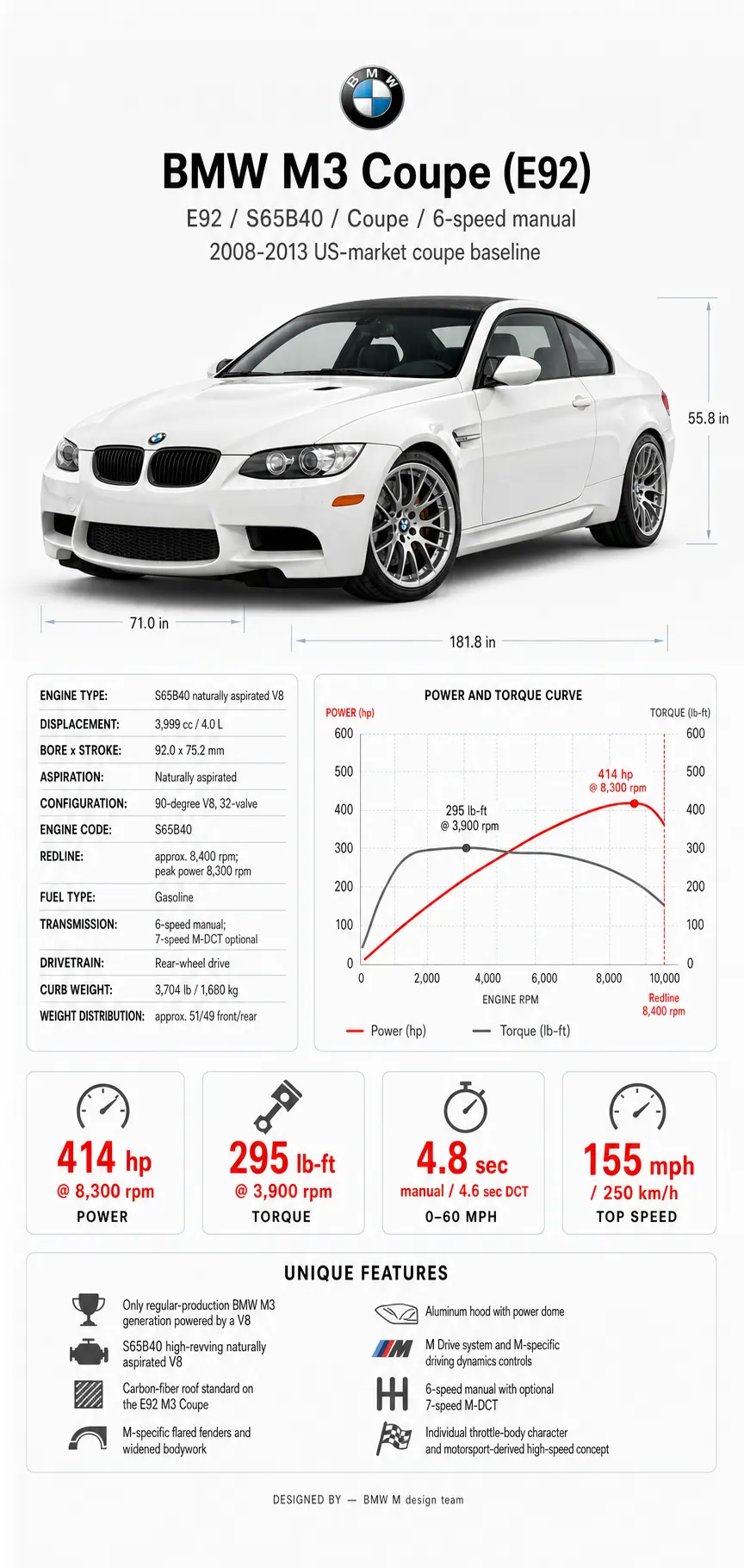
The locked baseline is the US-market BMW E92 M3 Coupe sold for model years 2008-2013. The car uses the S65B40 naturally aspirated V8, rear-wheel drive, a standard 6-speed manual, and optional 7-speed M-DCT.
That scope matters because E9x M3 conversations often blur body styles. The E90 sedan is the practical four-door. The E93 convertible adds open-top drama, weight, and roof complexity. The E92 coupe is the cleanest baseline for a buyer who wants the classic two-door M-car shape, carbon-fiber roof context, and the strongest emotional link to the poster-car version of this generation.
Key Specs
| Item | US-market E92 M3 Coupe baseline |
|---|---|
| Model years | 2008-2013 in the US |
| Engine | S65B40 4.0-liter naturally aspirated V8 |
| Displacement | 3,999 cc |
| Output | 414 hp at 8,300 rpm in US BMW material |
| Global output context | 309 kW / 420 hp in BMW M material |
| Torque | 295 lb-ft / 400 Nm at 3,900 rpm |
| Transmission | 6-speed manual; optional 7-speed M-DCT |
| Drivetrain | Rear-wheel drive with Variable M Differential Lock |
| Weight | 3,704 lb unladen coupe value in BMW NA material |
| 0-60 mph | Approximate and transmission-dependent; published values vary |
| Top speed | 155 mph / 250 km/h, electronically limited |
The horsepower split is not a mistake. BMW M global material uses 309 kW / 420 hp, while BMW North America material uses 414 hp SAE. For a US buyer guide, the table uses 414 hp and states the global value where helpful.
Why The E92 M3 Still Matters
The E92 M3 is the only regular-production M3 generation built around a naturally aspirated V8. That single fact explains most of its appeal and much of its risk. The S65 is not about effortless turbo torque. It wants revs, heat, oil, and mechanical sympathy. When it is healthy, the reward is throttle response, sound, and a top-end character later turbo M cars do not copy.
The car also sits at a useful point in BMW M history. Compared with the E46 M3, the E92 is heavier and more complex, but the V8 makes it feel more exotic. Compared with the F80 M3 and F82 M4, it gives up low-rpm torque and modern speed, but it feels more naturally connected to revs, sound, and rear-drive balance.
That is the reason to buy one. It is not the rational spreadsheet answer for every buyer.
Best For And Wrong For
| Best for | Wrong for |
|---|---|
| A buyer who wants the only V8 production M3 | A buyer chasing cheapest horsepower |
| An enthusiast who values sound, revs, and response | Someone who wants modern turbo torque |
| A shopper who will pay for a BMW M-aware inspection | Anyone trying to skip a pre-purchase inspection to win a deal |
| A buyer with records, recall proof, and sorting budget | Someone expecting normal used-3-Series costs |
| A patient shopper who can wait for the right car | Someone buying mostly for color, wheels, or seller story |
Editorial judgment: a sorted E92 M3 is worth considering when the car’s condition supports the premium. A thin-record car is not automatically bad, but it should be priced and treated like a risk project until a specialist inspection proves otherwise.
Owner Evidence And Real-World Themes
The source package includes owner and forum evidence from Kelley Blue Book, Cars.com, Edmunds, Reddit E92M3/BMW/BmwTech discussions, and M3Post. These records are not a formal reliability study, but they are useful because they show what owners and shoppers keep worrying about after the excitement fades.
The positive themes are consistent. Owners praise the S65 sound, high-rpm pull, steering and chassis balance, and the sense that a low-mile, documented car is a special last-of-its-kind machine. Manual buyers often talk about involvement. M-DCT buyers often like how the gearbox suits the revvy engine.
The negative themes are just as consistent. Owners and buyers talk about fuel use, tires, oil, expensive parts, dealer diagnostics, warning lights, DCT leak or service concerns, rod-bearing uncertainty, throttle actuators, and the anxiety created by poor service records.
The useful lesson is not that every E92 M3 is unreliable. The useful lesson is that proof matters before you pay enthusiast money.
Common Failures And Pre-Purchase Checks

The S65 is the reason to buy the car, so it is the first place to verify the car. Do not let a smooth test drive replace paperwork. The better workflow is records first, VIN history next, diagnostic scan, paint and body check, BMW M-aware pre-purchase inspection, then price discussion.
| Area | What to ask or check | Why it matters |
|---|---|---|
| Rod bearings | Invoices, mileage when done, parts used, shop name, oil history, warm-up and use pattern | Specialist sources and owner discussions treat rod-bearing wear as a known S65 risk, but mileage alone does not predict every car. |
| Throttle actuators | Scan for codes, limp-mode history, warning lights, one-bank vs both-bank work, receipt quality | Owner and repair-source evidence repeatedly flags actuators as a real buyer-check item. |
| Recalls | Run a VIN recall check and verify completion | NHTSA model-year data is useful as a risk flag, but it is not VIN-specific proof. |
| DCT or clutch | Cold and hot shift behavior, leaks, service records, adaptation or fault codes | Manual and M-DCT can both be good buys, but records and behavior matter more than forum preference. |
| Idle, ignition, leaks, cooling | Cold start, warm idle, misfires, oil leaks, coolant age, fan behavior | These are age and use checks that can become sorting bills if ignored. |
| Suspension, brakes, tires | Tire date and brand, alignment wear, brake condition, bushings, dampers, wheel damage | Consumables are part of the real purchase price on a performance M car. |
| Body and modifications | Paint-depth readings, panel gaps, underbody, accident history, tune or exhaust documentation | A cheap-looking modified car with weak records is not the same risk as a documented reversible car. |

Inspection discipline matters because the E92 M3 can hide cost behind charm. A strong example should make its story easy to follow: ownership history, recall completion, service receipts, clean diagnostic behavior, sensible tires, coherent modifications, and enough seller cooperation for a proper inspection.
Manual, M-DCT, Competition Package, And Body Styles
The 6-speed manual is the emotional choice for buyers who want involvement and lower transmission complexity. The 7-speed M-DCT is the faster and more natural partner for some drivers because it keeps the S65 in its power band. Neither transmission rescues a bad car. Buy the better-documented car first, then choose the gearbox that fits your use.
The Competition Package is desirable, but it is not a different engine. It changes the stance and chassis/electronics setup and tends to matter to enthusiasts and resale-minded buyers. It does not turn a neglected car into a good one.
The E90 sedan, E92 coupe, and E93 convertible share the S65 story, but they are not the same buyer decision. The sedan is more practical, the convertible brings roof complexity and extra weight, and the coupe is the cleanest baseline for this guide. If you are shopping the convertible, add roof operation, water ingress, added weight, and top-specific service checks.
Competitors And Generation Trade-Offs
Against the E46 M3, the E92 feels bigger and more expensive to run, but the V8 gives it a more special engine identity. Against the F80 M3 or F82 M4, it is slower in normal turbo-era terms but more naturally aspirated and more sound-led.
Against a W204 C63 AMG, it trades torque and muscle for revs and chassis balance. Against a B8 RS5, it gives up AWD polish for rear-drive M-car feel. Against a Cayman or 911, it is less pure sports car but more usable as a coupe with real grand-touring bandwidth.
That comparison is why the E92 M3 has to be bought for the right reason. If the reason is fast used car, the market offers easier answers. If the reason is last high-rev V8 M3 with a real cabin, real usability, and a real inspection story, the E92 still has a strong case.
Final Verdict
The BMW E92 M3 is worth buying when you are honest about why you want it. It is the V8 M3, and that makes it emotionally strong. It is also an aging M car built around a specialist engine, and that makes proof more important than enthusiasm.
The right car is documented, inspectable, mechanically warm and clean, recall-checked, and priced with a realistic reserve for age-related sorting. The wrong car is the one with vague records, seller pressure, unexplained modifications, warning lights, weak history, or a price that leaves no room to fix what the inspection finds.
Shortlist the car for the engine and chassis. Buy it only for the evidence.
FAQ
Common questions
Is the BMW E92 M3 worth buying?
Yes, if you specifically want the naturally aspirated V8 M3 and the example has records, inspection access, recall proof, and budget room for sorting. It is not the best choice for cheap speed or low-maintenance daily use.
What engine is in the E92 M3?
The E92 M3 uses the S65B40, a 3,999 cc naturally aspirated V8. US BMW material lists 414 hp at 8,300 rpm and 295 lb-ft at 3,900 rpm, while BMW M global material lists 309 kW / 420 hp and 400 Nm.
What problems should I check before buying?
Start with rod-bearing evidence, throttle-actuator history, recall completion, oil and service history, DCT or clutch behavior, fault codes, leaks, cooling system, suspension, brakes, tires, paint/body condition, and modification quality.
Is the manual or DCT better?
The manual is more tactile and simpler in concept. M-DCT is quicker and suits the high-rev engine. The better choice is the better-documented car with the transmission you actually want to live with.
Should I trust mileage or records more?
Records. Mileage matters, but owner evidence repeatedly shows buyers valuing proof of rod-bearing work, throttle-actuator history, oil and service records, recall completion, and specialist inspection over mileage alone.
Sources and references
- BMW M: BMW M3 E90, E92 and E93Reference for E9x M3 family context, V8 identity, carbon roof, bodywork notes, manual and M DKG context, GTS and motorsport halo.
- BMW Group PressClub USA: The new BMW M3 Coupe and SedanReference for North American launch context, S65 V8, 414 hp, 295 lb-ft, 6-speed manual, rear-wheel drive, and Variable M Differential Lock.
- BMW of North America: 2013 M3 brochure mirrorReference for US coupe model-year context, M-DCT availability, Competition Package context, dimensions, and weight.
- BMW US Media: 2012 M3 Coupe technical dataReference for technical data cross-checks.
- NHTSA Recalls API: 2013 BMW M3Reference for model-year recall-risk reminder; real buyers still need VIN-specific recall checks.
- Edmunds: 2013 BMW M3 expert reviewReference for period review context and buyer comparison framing.
- Kelley Blue Book: 2013 BMW M3 consumer reviewsReference for owner-signal context.
- Cars.com: 2013 BMW M3 consumer reviewsReference for owner-signal context.
- Car and Driver: 2008 BMW M3 first driveReference for period driving context.
- MotorTrend: 2008 BMW M3 testReference for period driving context and generation trade-off framing.
- Road & Track: 2008 BMW M3 Coupe testReference for period coupe context and driving-character cross-check.
- FCP Euro: E9x M3 technical and parts contextReference for specialist maintenance and parts context.
- ECS Tuning: Common E92 M3 problemsReference for common inspection topics such as rod bearings, throttle actuators, leaks, and age-related checks.
- BimmerWorld: S65 rod bearing package contextReference for S65 rod-bearing service context.
- Buildjournal: E90/E92/E93 M3 maintenance guideReference for maintenance-priority and inspection-context cross-check.
- TrueCar: Used buying guide 2008-2013 BMW M3Reference for used-buyer framing and model-year scope.
Topic hubs
Tags


