


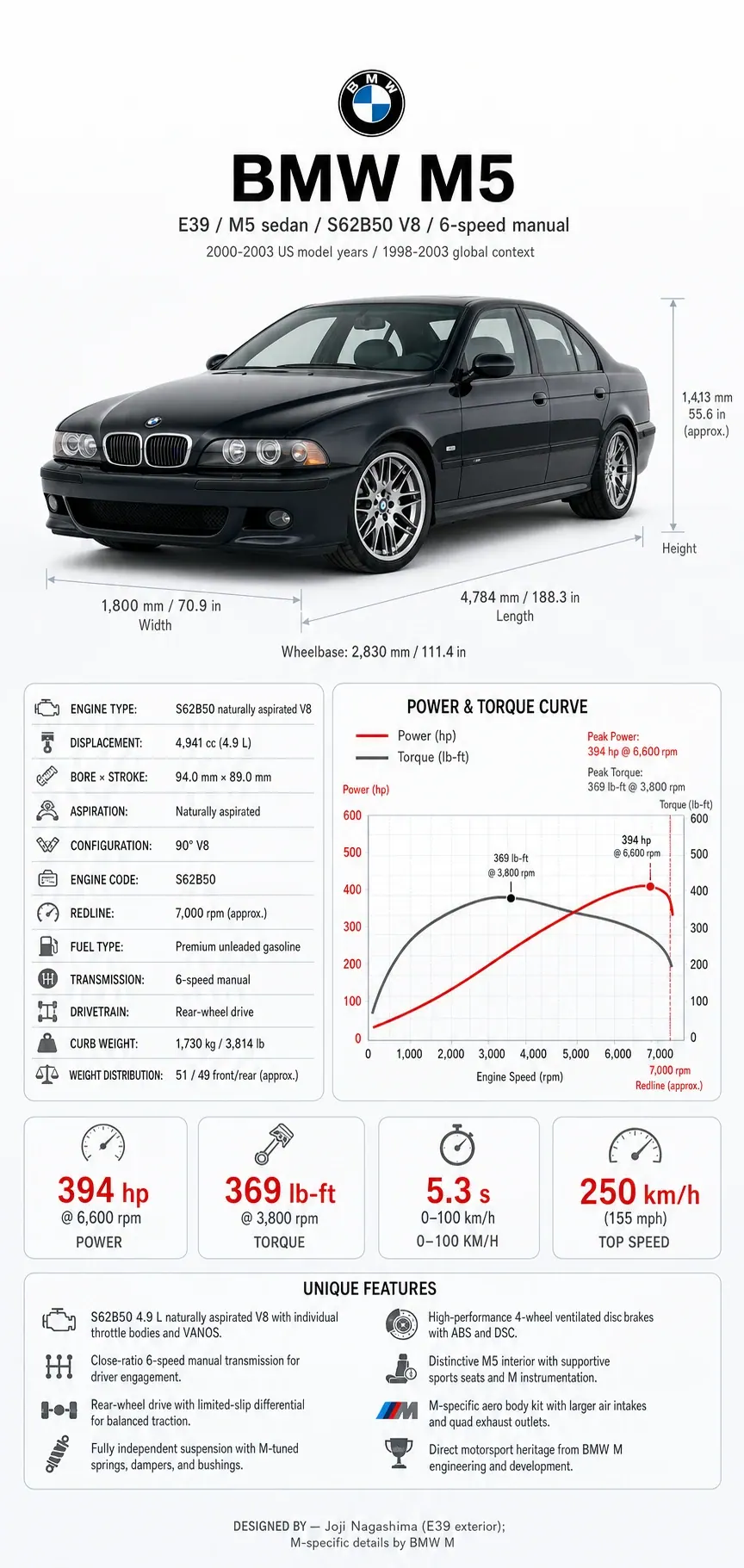
The BMW E39 M5 is still worth chasing if you want the old supersedan formula in one clean shape: a naturally aspirated V8, 6-speed manual, rear-wheel drive, hydraulic steering feel, usable sedan space, and M hardware that does not need a huge visual warning label.
That appeal also makes it easy to buy the wrong car. A cheap E39 M5 is rarely cheap after the first inspection. The right car has records for cooling work, suspension refreshes, VANOS or timing-chain-guide attention when needed, clutch history, clean electronics, and body structure that has not been hiding rust or crash repair.
What This Guide Covers
This guide locks the baseline to the US-market 2000-2003 BMW E39 M5 sedan. Global history can point back to the 1998/1999 launch, but the buyer checks here are aimed at the cars most US readers are likely to compare.
The goal is not to predict the price of every listing. Values move with mileage, color, originality, records, and buyer mood. The durable question is simpler: does the specific car have enough evidence to justify M5 money?
Key Specs
| Item | BMW E39 M5 baseline |
|---|---|
| US model years | 2000-2003 |
| Body | Four-door sedan |
| Engine | S62B50 4,941 cc naturally aspirated DOHC 32-valve V8 |
| Bore x stroke | 94.0 mm x 89.0 mm |
| Compression | 11.0:1 |
| Output | 394 hp SAE / 400 PS / 294 kW at 6,600 rpm |
| Torque | 369 lb-ft / 500 Nm at 3,800 rpm |
| Transmission | 6-speed manual |
| Drivetrain | Rear-wheel drive with limited-slip differential |
| Curb weight | About 4,024 lb / 1,825 kg |
| Wheelbase | 111.4 in / 2,830 mm |
| Character | S62 V8, manual gearbox, understated M sedan bodywork |
The curb-weight value is treated as approximate because published figures vary by market, source convention, and equipment. The source package cross-checks about 4,024 lb / 1,825 kg and keeps the value in that context rather than pretending every listing is identical.
Why The E39 M5 Still Matters
The E39 M5 sits in the rare zone where the numbers are still quick, but the experience is the point. Later M5s are faster and more complex. Earlier M5s feel more delicate and old-world. The E39 gives you a broad-shouldered sedan with real long-distance comfort, a high-revving S62 V8, a manual gearbox, and a chassis that still talks through the steering.
It also looks normal enough to use. That is part of the appeal. The M hardware hides inside a clean business-sedan shape: subtle bumpers, quad exhausts, correct wheels, and enough restraint that the car does not look like it is trying to explain itself at every stoplight.
The best example feels expensive because the expensive fundamentals are intact: body, interior, wiring, suspension, cooling system, engine health, and records.
Best For And Wrong For
| Best for | Wrong for |
|---|---|
| Buyers who want analog feel with usable sedan practicality | Anyone shopping only by lowest asking price |
| Drivers who value a manual V8 sedan | Buyers who want modern infotainment and driver assists |
| Collectors who can pay for preventative maintenance | Owners who will postpone cooling, VANOS, suspension, or oil-leak work |
| People who like subtle performance cars | Buyers wanting low-risk appliance ownership |
The E39 M5 is not a normal used luxury sedan with a famous badge. It is an old M car with old-car needs. If the budget only covers the purchase price, the right move is to keep looking or buy something less fragile financially.
What Goes Bad And What To Check
Start cold. Listen for VANOS rattle, chain noise, lifter noise, exhaust leaks, and idle instability. Watch temperature behavior. Scan the car before and after a drive. Confirm readiness monitors. Check records for cooling-system parts, valve-cover gaskets, sensors, clutch and flywheel work, suspension arms, brakes, tires, and differential service.
The big-ticket fear is not one single part. It is a pattern of postponed maintenance. A neglected E39 M5 can stack engine sealing, VANOS, timing, secondary-air, cooling, suspension, and electrical jobs into a bill that exceeds the discount you thought you negotiated.
The source package also flags recall discipline. E39-era BMW recall coverage can vary by VIN and campaign status, so the article does not make a blanket claim that one recall answer covers every car. Run a VIN-level lookup before purchase and confirm documentation.

Technical Systems And Reliability
The S62 is the star: 4.9 liters, eight cylinders, individual-throttle-body character, and enough torque to make the car feel relaxed when you are not pushing. It is also an old M engine now. The inspection should verify oil leaks, intake leaks, MAF behavior, VANOS function, timing-chain-guide condition, cooling-system age, and clean diagnostic behavior.
Rod bearings are not usually the first E39 M5 headline in the way they are for some later M cars, but that does not make the bottom end irrelevant. High mileage, unknown history, track use, oil-pressure concerns, or poor records still deserve specialist attention.
Do not ignore the chassis. Worn bushings can make a good car feel vague. Tired dampers, rear ball joints, control arms, old tires, and brake judder are common ways an E39 loses the precision people remember. Electronics matter too: cluster pixels, window regulators, central locking, seat functions, and ABS or DSC warnings can turn several small faults into a real repair plan.
Body, Photos, And First Pass Checks
Use photos to slow yourself down before you schedule a visit. Look for original ride height, correct M bumpers, fog-light and grille fit, even headlight clarity, matching paint texture across panels, straight rocker panels, clean jack points, proper wheel fitment, and no suspiciously cropped engine-bay or underbody shots.
Interior photos should show seat bolsters, dead pixels, worn buttons, headliner condition, steering wheel wear, and the real state of the driver touch points. A clean exterior with vague interior and engine-bay photos is not enough.

Ownership Notes
Buy the records first, then the color, then the mileage. A higher-mile car with specialist history can be less risky than a low-mile car that sat, leaked, overheated, or had cosmetic money spent before mechanical money.
The sweet spot is a stock or lightly refreshed example with documented cooling work, clean body structure, no warning lights, strong clutch, recent suspension attention, and an owner who can explain what has been done and what still needs doing.
The wrong car is the one with vague records, hot idle problems, minor warning lights, aftermarket shortcuts, fresh cosmetics over old mechanical issues, or a seller who treats inspection as an insult.
Rivals And Trade-Offs
The Mercedes-Benz E55 AMG is the easier straight-line weapon, especially in later supercharged form, but the BMW is the more involving manual driver’s sedan. The C5 Audi RS6 brings all-wheel-drive traction and twin-turbo pace while adding age, heat, and automatic-transmission complexity.
A first-generation Cadillac CTS-V can be the cheaper manual V8 alternative, but it does not carry the same cabin feel or old BMW steering polish. The harder comparison is another BMW: the E60 M5 is faster and more exotic, but its V10 ownership risk changes the whole equation. The E39 is not simple; it is a more understandable kind of expensive.
Next Action
If an E39 M5 is on your shortlist, ask for the VIN, a cold-start video, a full service timeline, scan results, and underbody photos before arranging a specialist pre-purchase inspection.
During the drive, the engine should pull cleanly, the gearbox should feel consistent, and the chassis should feel tight. Warning lights, overheating, hesitation, harsh noises, smoke, brake judder, vague records, or seller pressure should slow the process down immediately.
Final Verdict
The BMW E39 M5 remains compelling because its identity is so clear: S62 V8, manual gearbox, rear-drive balance, subtle bodywork, and enough sedan practicality to make the performance feel usable rather than ceremonial.
It should be bought with patience. A sorted E39 M5 can still feel like one of BMW M’s most complete analog supersedans. A neglected one can turn the same experience into a repair plan. Shortlist the car for the engine and chassis. Buy it only for the evidence.
FAQ
Common questions
Is the BMW E39 M5 worth buying?
Yes, for buyers who want a manual, rear-drive S62 V8 sedan and can pay for inspection, records, cooling work, suspension refreshes, and age-related M-car maintenance.
What engine does the E39 M5 use?
The E39 M5 uses the S62B50, a 4,941 cc naturally aspirated DOHC V8 rated at 394 hp SAE and 369 lb-ft in the source package.
Is the E39 M5 manual only?
Yes. The US-market E39 M5 baseline in this guide uses a 6-speed manual transmission with rear-wheel drive and a limited-slip differential.
What should E39 M5 buyers inspect first?
Start with records, cold-start behavior, diagnostic scans, cooling-system age, oil leaks, VANOS and timing-chain-guide evidence, suspension wear, clutch behavior, body structure, and a VIN-level recall lookup.
Are E39 M5 rod bearings the main problem?
Rod bearings are not the usual headline concern in the same way they are on some later M engines, but oil pressure, service history, mileage, and specialist inspection still matter.
Sources and references
- BMW M: The BMW M5 of 1998Reference for E39 M5 significance, output, torque, model identity, and analog M5 context.
- BMW Group UK E39 M5 vehicle sheetReference for S62, displacement, power, torque, and period technical data.
- BMW Group M5 history attachmentReference for M5 generation history and E39 output context.
- 2003 BMW M5 owner manualReference for dimensions, weights, fluids, and technical data.
- ManualsLib 2003 BMW M5 owner manual mirrorReference for bore, stroke, compression, and technical-data cross-check.
- NHTSA recalls lookupReference for VIN-level recall next step.
- Cars.com 2003 BMW M5 specsReference for US-market spec cross-check.
- Edmunds 2003 BMW M5 review and specsReference for manual-only, power, weight, and owner-facing context.
- Road and Track E39 BMW M5 buyer guideReference for common issues, VANOS, timing guides, and market caveats.
- Car and Driver 2000-2003 BMW M5 buyer guideReference for VANOS, secondary air, suspension issues, and buyer-guide framing.
- Grassroots Motorsports E39 BMW M5 buyer guideReference for owner and specialist maintenance perspective.
Topic hubs
Tags


