


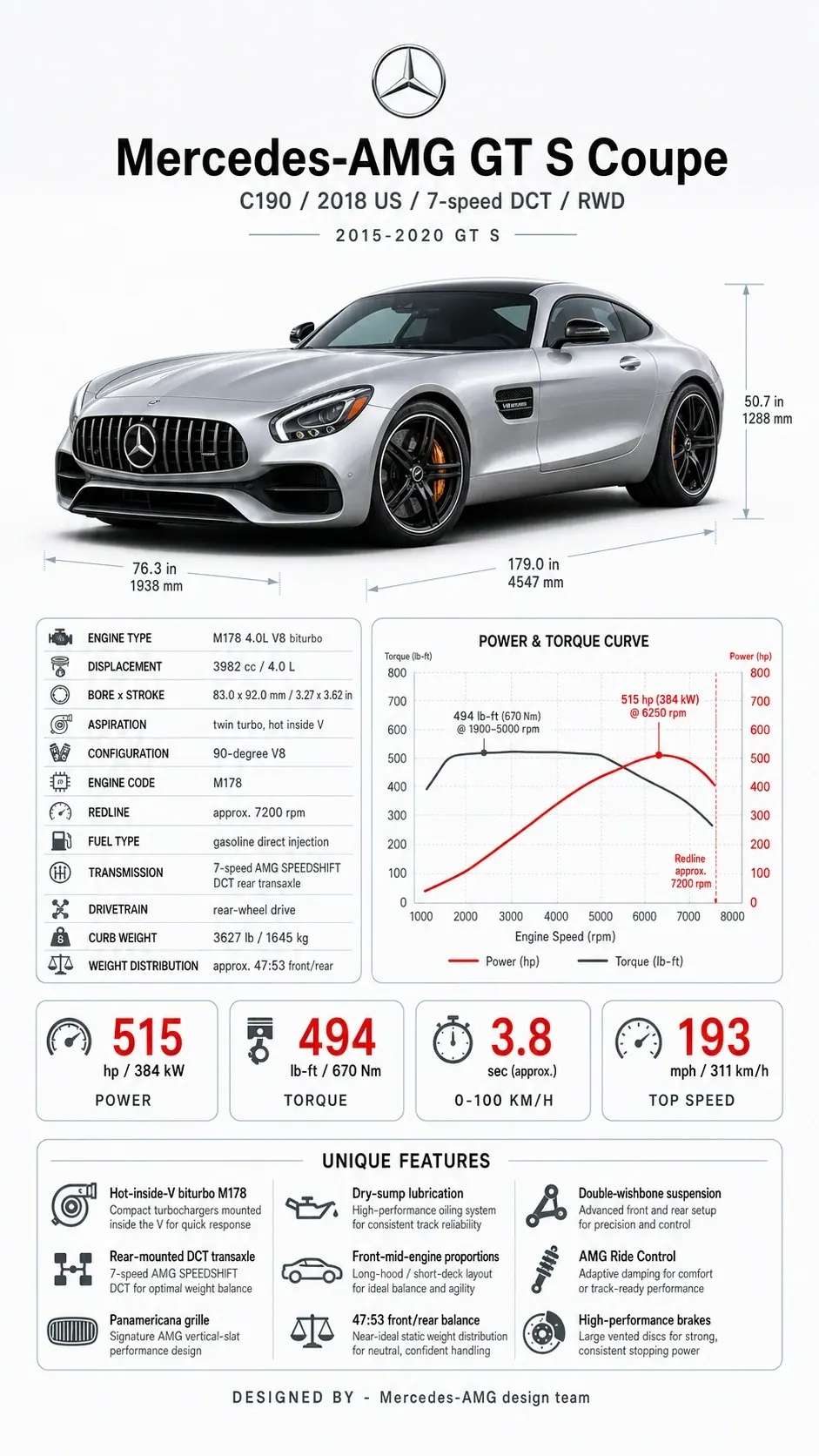
The Mercedes-AMG GT S is worth shortlisting if you want a dedicated AMG sports car with long-hood drama, a handbuilt M178 V8, a rear DCT transaxle, and enough road focus to make more sense than a GT R for many used buyers. It is the wrong shortcut if you want cheap tires, easy visibility, generous cabin storage, or a car that can be bought without an AMG specialist inspection.
This guide locks the baseline to the 2018 US-market Mercedes-AMG GT S Coupe. That matters because “AMG GT” is a messy used-search phrase. It can mean the base GT, GT S, GT C, GT R, Black Series, Roadster, AMG GT 4-Door, or the later 2024+ generation. Those cars do not share one spec sheet.
What Version This Guide Covers
The locked car is the C190 Mercedes-AMG GT S Coupe in 2018 US-market form. The key recipe is the M178 3,982 cc AMG 4.0-liter V8 biturbo, a front-mid-engine layout, rear-wheel drive, and a 7-speed AMG SPEEDSHIFT DCT mounted as a rear transaxle.
For this specific version, the source package uses the 2018 Mercedes-Benz USA AMG GT family brochure as the official spec baseline: 515 hp, 494 lb-ft, 3,627 lb curb weight, 193 mph top speed, and a 3.7-second 0-60 mph claim. Earlier launch coverage can list 503 hp for the GT S, so the model-year lock is not trivia. It keeps the article from mixing different years and trims.
Key Specs
| Item | 2018 Mercedes-AMG GT S Coupe |
|---|---|
| Chassis | C190 first-generation AMG GT |
| Body | Two-door fastback coupe |
| Engine | M178 3,982 cc handcrafted AMG 4.0L V8 biturbo |
| Layout | Front-mid engine, rear-mounted 7-speed DCT transaxle, rear-wheel drive |
| Power | 515 hp / 384 kW at 6,000 rpm |
| Torque | 494 lb-ft / 670 Nm at 1,750-5,000 rpm |
| 0-60 mph | 3.7 sec in 2018 Mercedes-Benz USA brochure data |
| Top speed | 193 mph / 311 km/h |
| Wheelbase | 103.5 in / 2,629 mm |
| Dimensions | 179.0 in L / 76.3 in W without mirrors / 50.7 in H |
| Curb weight | 3,627 lb / 1,645 kg |
| Chassis balance | Approx. 47:53 front/rear |
The numbers matter because the AMG GT S is not just a C63 Coupe with a lower roofline. AMG placed the V8 behind the front axle, put the DCT at the rear, and used the long hood and rear-set cabin to make the car feel like a dedicated sports-car platform.
Why The AMG GT S Still Matters
The first-generation AMG GT is one of the clearest modern Mercedes performance statements: a two-seat sports car developed by AMG around its own proportions. The long hood is theater, but it is also packaging. It creates room for the front-mid-mounted V8 and gives the car its cab-rearward stance.
The M178 V8 is the centerpiece. It uses a hot-inside-V turbo layout, direct injection, dry-sump lubrication context, and AMG’s handbuilt identity. It feels more exotic than a normal luxury-coupe engine, but it also concentrates heat, packaging, fluids, and repair cost into a dense engine bay. That duality defines the car. The GT S feels special because it is serious hardware, and it needs to be bought like serious hardware.
Best For And Wrong For
| Best for | Wrong for |
|---|---|
| Buyers who want a rare, emotional alternative to a Porsche 911 | Buyers who need easy rear visibility and low running costs |
| Drivers who care about V8 character, steering feel, balance, and occasion | Drivers who mostly want comfort, storage, or quiet commuting |
| Owners who will budget for tires, brakes, fluids, battery care, and PPI | Buyers shopping only by monthly payment or color |
| People who want the road-biased AMG GT sweet spot | Buyers who really want a track toy, where GT R logic is clearer |
| AMG enthusiasts who can verify recall and service history | Anyone refusing VIN checks or specialist inspection |
The GT S is the sensible enthusiast target inside an emotional model range. The base GT is still fast but less special. GT C adds wider-body presence, rear steering, and more power. GT R is the track-biased hero. For a used road car, GT S often gives the cleanest mix of performance, value, and usability.
Owner Evidence And Real-World Themes
The source package includes 20 owner/user review records from owner-review pools, market discussions, and AMG GT owner threads. Those records are not a reliability study, but they do reveal the same pattern repeatedly.
Owners love the speed, sound, styling, sense of occasion, and chassis confidence. The warnings are also consistent: comfort is firm, visibility is compromised, storage is limited, battery care matters, tires and brakes are expensive, and AMG-specific repairs can make a cheap-looking car expensive.
That is the useful ownership lens. The AMG GT S is not a fragile car by default, but it is a costly car to inspect lazily.
Rivals And Trim Trade-Offs
Against a Porsche 911 Carrera S or GTS, the AMG GT S is more dramatic and less common. The Porsche is usually the easier all-rounder, with better visibility, more daily practicality, a deeper ownership network, and familiar sports-car ergonomics. Choose the AMG if the V8, long-hood stance, and transaxle layout are the reason you are shopping.
Against an Audi R8 V10, the AMG feels more like a front-engine GT weapon than a mid-engine exotic. The R8 wins on naturally aspirated V10 theater and supercar identity. The AMG wins if you want AMG torque, a lower used entry point, and a more traditional long-hood driving position.
Against a Jaguar F-Type R, the AMG is the sharper, more serious car. The Jaguar may be louder and cheaper at normal speeds, but the Mercedes feels more precise when driven hard.
Against an Aston Martin Vantage, the comparison depends heavily on year, condition, warranty, and service access. The Mercedes has a strong AMG service ecosystem and related engine-family familiarity, while the Aston leans harder into brand romance. Buy the cleaner car with the better paperwork.
What Goes Bad And What To Check
Start with the VIN. The source package flags recall verification for certain 2016-2018 AMG GT vehicles, including carbon-fiber driveshaft bonding and eCall communication-module software context. A seller saying “it should be done” is not proof. Confirm by VIN through the appropriate recall channel.
Then pay for the right inspection. The PPI should check DCT operation, reverse noise, seepage around the transmission and rear main seal area, coolant and oil leaks, brake life, tire date codes, suspension knocks, underbody damage, splitter damage, battery health, and all infotainment, camera, and parking sensor functions.
| Area | What to ask or check | Why it matters |
|---|---|---|
| VIN and recalls | Confirm campaign completion by VIN | Recall status is a specific verification task, not a guess. |
| M178 engine | Oil/coolant leaks, heat traces, service records, fluid history | Hot-V packaging and AMG labor make small issues worth catching early. |
| Rear DCT transaxle | Cold/warm shift quality, reverse behavior, leaks, service history | The transaxle is central to the car’s balance and expensive to diagnose casually. |
| Tires and brakes | Tire brand, age, tread, matching setup, rotor and pad life | Grip is part of the car’s character and a major cost center. |
| Battery and electronics | Battery health, COMAND, camera, parking sensors, warning lights | Poor rear visibility makes driver aids more important, and weak batteries create noise. |
| Body and underside | Splitter, undertray, wheels, carbon trim, paint depth, accident history | The car is low, wide, and expensive to make cosmetically right. |
| Usability | Seat fit, driveway clearance, storage, ride mode comfort | The wrong daily-use fit becomes irritating fast. |
Do not treat cosmetic condition as superficial. On a low, wide AMG sports car, wheel damage, old tires, scraped aero, carbon trim damage, paint mismatch, and underbody marks are evidence about use and care.
Technical Systems And Reliability

The M178 V8 is not a generic turbo V8 dropped into a coupe. It is a compact, AMG-built 4.0-liter biturbo V8 with turbos mounted in the inside V, direct injection, and a dry-sump lubrication context in the AMG GT package. That supports response and packaging, but it also means heat management, fluid service, and specialist familiarity matter.
The rear DCT transaxle is the other reason the GT S feels special. It places mass at the rear and helps give the car its traction and balance. Any transmission complaint should be taken seriously. A short loop around the block is not enough; the car should be driven cold and warm, in normal and manual modes, and through low-speed reversing and parking.
The chassis and brakes are strengths, not footnotes. The GT S uses adaptive AMG Ride Control, serious tire widths, performance brakes, and double-wishbone suspension architecture. Worn tires can make the car feel nervous, and carbon-ceramic brakes, if fitted, require correct inspection rather than casual visual judgment.
Ownership Costs And First Actions
The best first spend is not carbon trim or an exhaust. It is a history check, a VIN recall check, an AMG-capable diagnostic scan, a specialist PPI, fresh fluids where records are thin, good tires, brake measurement, and battery care. A battery maintainer is boring, but boring beats mystery warning lights on a complex AMG.

The cheapest example can become the expensive one. A clean service history, matching quality tires, no unresolved recalls, no warning lights, no accident history, healthy battery behavior, and a credible AMG specialist inspection are worth more than a few thousand dollars off the asking price.
Final Verdict
The Mercedes-AMG GT S is worth buying when you want the M178 V8 and rear-transaxle AMG sports-car recipe for the right reasons: drama, balance, rarity, and a road-biased sweet spot between the base GT and more extreme trims.
The right car is serviced, recall-checked, scanned clean, running proper tires, free of unresolved warning lights, and easy to inspect. The wrong car is the one with vague records, cheap tires, unexplained leaks, warning lights, accident ambiguity, weak battery behavior, or a seller who treats a specialist PPI as an insult.
Shortlist the AMG GT S for the engine and layout. Buy it only for the evidence.
FAQ
Common questions
Is the Mercedes-AMG GT S reliable?
It can be a strong car when maintained correctly, but it is not cheap-risk hardware. Treat transmission behavior, leaks, recall completion, tire and brake life, and battery health as inspection priorities.
Is the GT S better than the GT C or GT R?
For many road buyers, yes. GT C and GT R add hardware and presence, but GT S is the cleaner balance of used value, performance, and road usability.
What engine does the AMG GT S use?
The 2018 US-market AMG GT S Coupe uses the M178 3,982 cc handcrafted AMG 4.0-liter V8 biturbo.
Is the AMG GT S comfortable enough to daily drive?
Some owners daily them, but comfort, visibility, storage, entry and exit, and tire/brake cost are real compromises. Test your real commute before buying.
What is the single biggest buying rule?
Do not buy without a specialist PPI and VIN recall check. The best examples feel special; the wrong one can become expensive quickly.
Sources and references
- Mercedes-Benz USA 2018 AMG GT Family brochureReference for locked 2018 GT S output, torque, dimensions, weight, transaxle, chassis layout, and feature context.
- Mercedes-AMG 4.0L V8 biturbo engine technical release mirrorReference for M178 displacement, hot-inside-V turbo layout, bore/stroke, cylinder layout, and dry-sump context.
- Edmunds 2018 Mercedes-Benz AMG GT reviewReference for GT S recommendation context, driving tradeoffs, and owner-review pool signal.
- Kelley Blue Book 2018 Mercedes-AMG GT consumer reviewsReference for owner sentiment patterns around styling, performance, comfort, reliability concerns, and cost.
- Cars.com 2018 Mercedes-Benz AMG GT recallsReference for carbon-fiber driveshaft bonding recall and eCall recall context.
- NHTSA datasets and APIsReference for VIN-level recall verification method.
- Car and Driver 2018 AMG GT C / GT R reviewReference for GT C and GT R positioning relative to road-biased GT S buyers.
- Road & Track AMG GT C road testReference for GT C street and track positioning.
- What Car used Mercedes-AMG GT reviewReference for used-buyer reliability and ownership-risk framing.
- CARFAX 2018 Mercedes-Benz AMG GT researchReference for market and owner-review aggregate context.
Topic hubs
Tags


