


Quick Answer
Buy a Volvo 850 T-5R or 850R when the car proves exactly what it is, shows clean service history, and prices in the old-turbo-Volvo work that still matters. The best example is not simply the yellow wagon in a dream photo. It is the car with identity paperwork, correct trim evidence, a dry and healthy turbo five-cylinder, cooling and timing records, clean body seams, working electrical systems, and a seller who understands why T-5R and 850R details are not interchangeable.
The T-5R is the sharper collector hook because it is the limited 1995 special-edition story. The 850R is often the more rational fast-brick buy because it carries much of the same culture and usability with less pressure around one-year identity. Both are worth attention because they mix a square family-car shell, turbocharged five-cylinder character, sedan or estate practicality, and a British Touring Car Championship halo that still makes the car feel mischievous. Neither should be bought only because it has a badge, a bumper, or a set of wheels.
If the car is true, documented, structurally clean, and mechanically sorted, it can be a satisfying usable classic. If identity is vague, the PCV system is pressurizing the crankcase, timing-belt history is missing, the turbo is leaking, the automatic shifts badly, warning lights are ignored, or rust is hiding in the usual places, the smart move is to keep searching.
Why This Fast Brick Still Matters
The 850 T-5R and 850R work because the shape is so plain and the attitude is not. A square Volvo sedan or estate should look like transport for people, luggage, dogs, and bad weather. In T-5R and R form, it adds a turbocharged inline-five, lower and sharper visual cues, desirable wheels, sportier cabin trim, and enough touring-car theatre to make the sensible shape feel deliberate rather than accidental. That tension is the whole appeal.
The BTCC connection should be written carefully. The production T-5R is not best treated as a homologation shortcut, but the racing estate made the 850 impossible to ignore. The image of a boxy wagon being driven in anger helped turn the road car into a cult object. That culture still affects prices and buyer desire today, especially for estate/wagon bodies and period-correct colors.
What keeps the car relevant is that the story is useful, not only nostalgic. It is a quick classic you can still imagine using. It has a real trunk or cargo area, normal seating, strong visibility, a durable Volvo platform when serviced, and a powertrain with a sound and delivery newer turbo fours rarely copy. The right article angle is not “old Volvo is secretly fast.” It is “this exact old Volvo is worth buying only when the proof is as strong as the story.”
Identity Proof Comes First
A real T-5R or 850R needs proof before praise. For T-5R cars, color, body style, gearbox, market and production details matter. Cream Yellow is the emotional shorthand, but paint alone is not enough. A regular 850 Turbo with a bumper, badge, wheel set, or repaint can look convincing in photos and still be the wrong car for a collector-price decision. The buyer should check VIN data, build details, trim evidence, market history, service records, import paperwork when relevant, and whether the seller can explain what separates T-5R, 850R, and ordinary T-5/Turbo cars.
For 850R cars, the task is different. The R is the follow-up performance model and may be the better value if you want the driving and ownership experience more than the one-year limited-edition story. It still deserves identity proof, because R badges and R-look parts can move between cars. Wheels, seats, spoilers, and trim are helpful clues, not the final answer.
Manual cars deserve extra attention because they are rarer and often priced with more enthusiasm. That does not make a poor manual car better than a well-documented automatic. It means the paperwork, condition, clutch, gearbox behavior, and market-specific build evidence need to be stronger before the buyer pays the manual premium.
T-5R Versus 850R
The T-5R is the headline car: 1995, limited, strongly associated with the launch story, special colors, Porsche-linked development details, and the version most casual enthusiasts name first. It is the one that tends to pull the collector conversation upward when the example is authentic and clean. If you want the most story-rich version, start there.
The 850R is the practical counterargument. It is still a performance 850, still has the fast-brick stance, and can be easier to justify if the price is below equivalent T-5R money. Depending on market and gearbox, 850R cars can bring desirable power and equipment, and a good one can feel less precious as a usable classic. That can be a strength. A car you are willing to drive, service, and keep dry is often the car that survives.
Do not collapse the two into one spec sheet. Year, market, gearbox, body style, and source all affect the details. The article should compare them as related choices: T-5R for the limited-edition collector hook, 850R for much of the same fast-brick appeal with a better chance of finding the right condition-to-price balance.
Specs That Matter
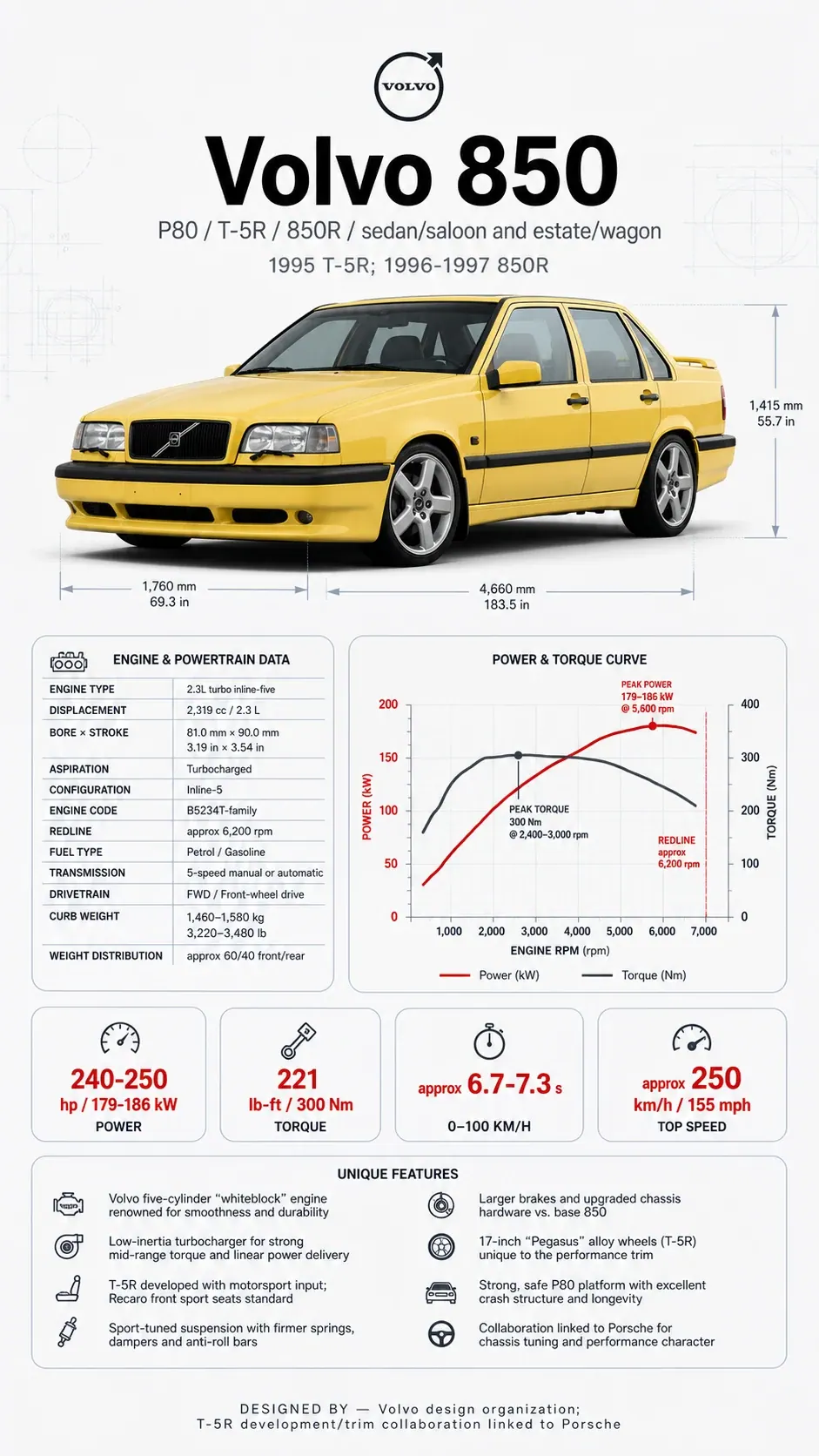
The basic formula is why the car is still interesting: transverse turbocharged Volvo whiteblock inline-five, front-wheel drive, sedan or estate body, and enough output to make a sensible family car feel quick. Public figures vary by source and market, but the buyer-facing story is stable. The T-5R and 850R sit above ordinary 850 models because of turbo five-cylinder power, chassis and appearance changes, sportier trim, and the cultural value attached to the R/T-5R identity.
The useful spec conversation is not just horsepower. The inline-five sound and torque delivery are part of the experience. The front-drive layout is part of the character, too: this is not a rear-drive drift toy or modern AWD launch-control car. It is a square, front-driven turbo brick that makes speed feel a little wrong in the best way. That also means tire condition, suspension health, alignment, brake condition, and torque-steer behavior matter on a test drive.
For the infographic, use source-caveated values: 2.3L turbo inline-five, roughly 240-250 hp depending model/market/overboost context, roughly 300 Nm / 221 lb-ft torque, about 6.7-7.3 seconds to 100 km/h depending body and gearbox, and a top speed around the 250 km/h / 155 mph neighborhood where sources and limiters support it. The public article should not pretend every market car has one universal number.
Current Price Check
The current market is strong enough that you cannot treat a T-5R or 850R like a cheap old Volvo anymore, but it is uneven enough that condition still beats hype. The saved price packet uses price-guide, listing, auction and market-benchmark sources checked for this run. The pattern is simple: driver-quality 850R and T-5R examples can appear from high single digits in GBP/EUR markets, stronger documented cars often sit in the low-to-high teens, and rare body/gearbox/color combinations or unusually clean examples can push higher. US-market auction and benchmark evidence can put strong examples around low-twenties-thousand-dollar money, but one global price number would be misleading.
A fair buy target depends on what the car proves. A documented, dry, clean, stock-looking 850R estate or sedan with fresh timing service, healthy PCV, working electronics, good trim, and no rust story can justify a stronger price than a prettier but unknown T-5R. A real T-5R with production proof, correct body and color evidence, clean underside, documented maintenance, and desirable gearbox/body configuration deserves collector attention. A clone, rough project, or car with warning lights and vague history should be priced as work, not as culture.
The best price advice is not “pay X.” It is “pay for proof.” Spend more for the example that reduces risk and holds the story. Spend less or walk away when the seller asks collector money but cannot support identity, service, body condition, and market-specific claims.
What Goes Bad And What To Check
The PCV system is a central inspection item. A blocked crankcase ventilation system can push leaks into places that make a cheap car expensive. Check for crankcase pressure signs, oil seepage around the rear main area, turbo oil return leaks, and service records showing the system has been dealt with properly. A clean engine bay is nice; a clean history is better.
Timing belt and cooling history are another hard gate. A turbo 850 that has sat, overheated, or run unknown belt intervals is not a carefree classic. Look for timing belt, water pump, tensioner and cooling-system paperwork. Listen for valvetrain noise on cold start, watch temperature behavior, and inspect hoses, radiator condition, oil/coolant signs, and owner habits. These cars can be durable, but age and deferred work erase the Volvo stereotype quickly.
The turbo should build boost smoothly without alarming noises, smoke, or oil mess. The gearbox should shift cleanly. Automatics need smooth engagement and fluid behavior; manuals need synchro, clutch and linkage checks. ABS and electrical warnings deserve attention because age-related modules, solder joints, vacuum lines and sensors are common enough that a warning light should never be waved away. Finally, run the VIN through the relevant recall source before purchase and inspect the body as a thirty-year-old car, not as an indestructible meme.


Interior And Equipment
The interior matters because it tells you how the car lived. A T-5R or 850R cabin should feel like a special 1990s Volvo, not a stripped regular 850 with a badge. Sportier seats, trim condition, steering wheel, gauges, carpets, cargo-area wear, door panels, and small missing pieces all feed the same question: has this car been preserved, used carefully, or assembled into a look?
Worn bolsters are not an automatic deal breaker. Missing rare trim, broken switchgear, dead warning lights, water stains, sagging headliner, hacked stereo wiring, and rough cargo trim are more important because they suggest the ownership budget is still waiting. Estate/wagon buyers should inspect the rear area with extra care. A wagon is the culture hero, but it also may have lived harder as a usable load carrier.
Do not overstate Porsche involvement in the cabin or development story. Use it as part of the period T-5R/R identity where supported, but keep the article focused on what the buyer can inspect. The right cabin is complete, honest, and consistent with the car’s claimed trim. The wrong cabin feels like a parts-bin explanation waiting to happen.

Wagon Or Sedan
The estate/wagon is the image most enthusiasts keep in their heads. It matches the BTCC-era absurdity: a square family hauler with a turbo five-cylinder and R/T-5R attitude. If the car is authentic and clean, the wagon body can make the whole purchase feel more special. It is also genuinely useful, which is why the fast-brick idea works better here than it does on many limited-edition performance cars.
The sedan should not be dismissed. A clean sedan can be stiffer-feeling, less cargo-abused, easier to store, and sometimes better value if wagon hype pushes prices too high. It still carries the same basic performance identity and can be a more satisfying buy when condition is clearly better. Do not buy the worse wagon just because the internet likes the shape.
The smart comparison is condition plus identity plus price. If the wagon proves itself and the price is fair, it is the emotional pick. If the sedan is the honest, documented, dry, mechanically sorted car, it may be the better decision. In both cases, the article should keep saloon/sedan and estate/wagon wording clear because market sources use both.
Ownership Budget
A good 850 T-5R or 850R is not fragile in the way some exotic classics are fragile, but it is old enough that every system has had time to age. The engine can be tough, yet the surrounding service stack matters: PCV, timing, cooling, turbo plumbing, vacuum hoses, ignition pieces, engine mounts, suspension bushings, brakes, tires, and electrical modules. If the purchase price consumes the whole budget, the car is already wrong.
The best ownership budget includes immediate baseline work unless the seller has very recent records. Plan for fluids, filters, timing confirmation, PCV verification, leak fixes, warning-light diagnosis, tire and brake inspection, and a specialist look at anything modified. A modified car can be fine, but the more the car departs from original condition, the more documentation you need. On these cars, originality is not only collector purity; it also reduces the number of unknown interactions.
Parts availability is not the same as modern-car convenience. Some service items are manageable; trim, R-specific pieces, clean interior parts, correct wheels, and market-specific details can take time. That is why a complete car is worth more than a project with a better color.
Best For And Not Best For
This car is best for a buyer who likes the contradiction: practical box, turbo five-cylinder sound, touring-car energy, and a collector story that still lets the car be used. It suits someone who will check records, preserve the special details, and accept that a thirty-year-old performance Volvo needs steady sorting. It is also a good fit for someone who wants a cult wagon or sedan without chasing the same German-market performance icons everyone else is watching.
It is not best for a buyer who wants a cheap no-work daily, a modern-fast car, or a platform for careless power mods. It is also not ideal for someone who buys only the myth. The wrong T-5R/850R purchase starts with a photo, ignores the underside, trusts the badge, skips the PCV and timing conversation, and then discovers that rare trim and old turbo maintenance cost real money.
If your priority is maximum value and easier justification, look hard at 850R examples. If your priority is the limited-edition collector hook, look hard at true T-5R proof. If you cannot verify either, keep the money ready and wait.
Verdict
The Volvo 850 T-5R and 850R are still worth caring about because the package is specific. It is not just a fast sedan or a fast wagon. It is a boxy Volvo with a turbo five-cylinder, a strange racing-culture afterglow, useful body styles, special trim, and enough rarity to make identity proof matter. That mix is why buyers still search for them and why weak cars can still tempt people.
The right answer is proof-first enthusiasm. Buy when the car proves its trim, market, body, gearbox, history and condition. Pay more for originality, body health, complete trim, records, dry mechanicals, and a seller who understands the car. Discount heavily for unclear identity, rough interiors, rust, missing timing records, PCV pressure, turbo oil leaks, transmission issues, warning lights, and modified cars with poor documentation.
The best T-5R or 850R does not need the loudest story. It needs the cleanest evidence. When the evidence is there, the fast brick still makes sense.

FAQ
Is the Volvo 850 T-5R a BTCC homologation car?
Treat BTCC as a culture and attention link, not as a lazy homologation claim. The racing estate made the 850 famous, and the T-5R benefited from that aura, but the buyer guide should avoid overstating the production car’s purpose.
Is the 850R better than the T-5R?
It depends on the job. The T-5R is the collector headline. The 850R can be the better usable-value choice when condition, documentation and price are stronger.
Should I buy a wagon or sedan?
Buy the better proven car. The wagon has the strongest fast-brick image, but a cleaner sedan with better history can be the smarter purchase.
What is the first mechanical check?
Start with identity and records, then PCV condition, timing/cooling history, leaks, turbo behavior, gearbox health, ABS/electrical warnings and rust.
What price is fair?
A fair price is source-backed and condition-backed. Current public sources support broad high-single-digit to low-twenties ranges depending currency, body, gearbox, originality, market and condition. Pay for proof, not for a badge.
FAQ
Common questions
Is the Volvo 850 T-5R a BTCC homologation car?
Treat BTCC as a culture and attention link, not as a lazy homologation claim. The racing estate made the 850 famous, and the T-5R benefited from that aura, but the buyer guide should avoid overstating the production car's purpose.
Is the 850R better than the T-5R?
It depends on the job. The T-5R is the collector headline. The 850R can be the better usable-value choice when condition, documentation and price are stronger.
Should I buy a wagon or sedan?
Buy the better proven car. The wagon has the strongest fast-brick image, but a cleaner sedan with better history can be the smarter purchase.
What is the first mechanical check?
Start with identity and records, then PCV condition, timing/cooling history, leaks, turbo behavior, gearbox health, ABS/electrical warnings and rust.
Sources and references
Topic hubs
Tags

