


Quick Answer
The BMW F10 M5 is worth considering when you want a discreet sedan with modern turbocharged pace, rear-wheel drive, and enough usability to work beyond weekend drives. It is not the easiest used M car to buy. The right example is the one with records, sober modifications, verified gearbox behavior, and a seller who can explain the car beyond horsepower claims.
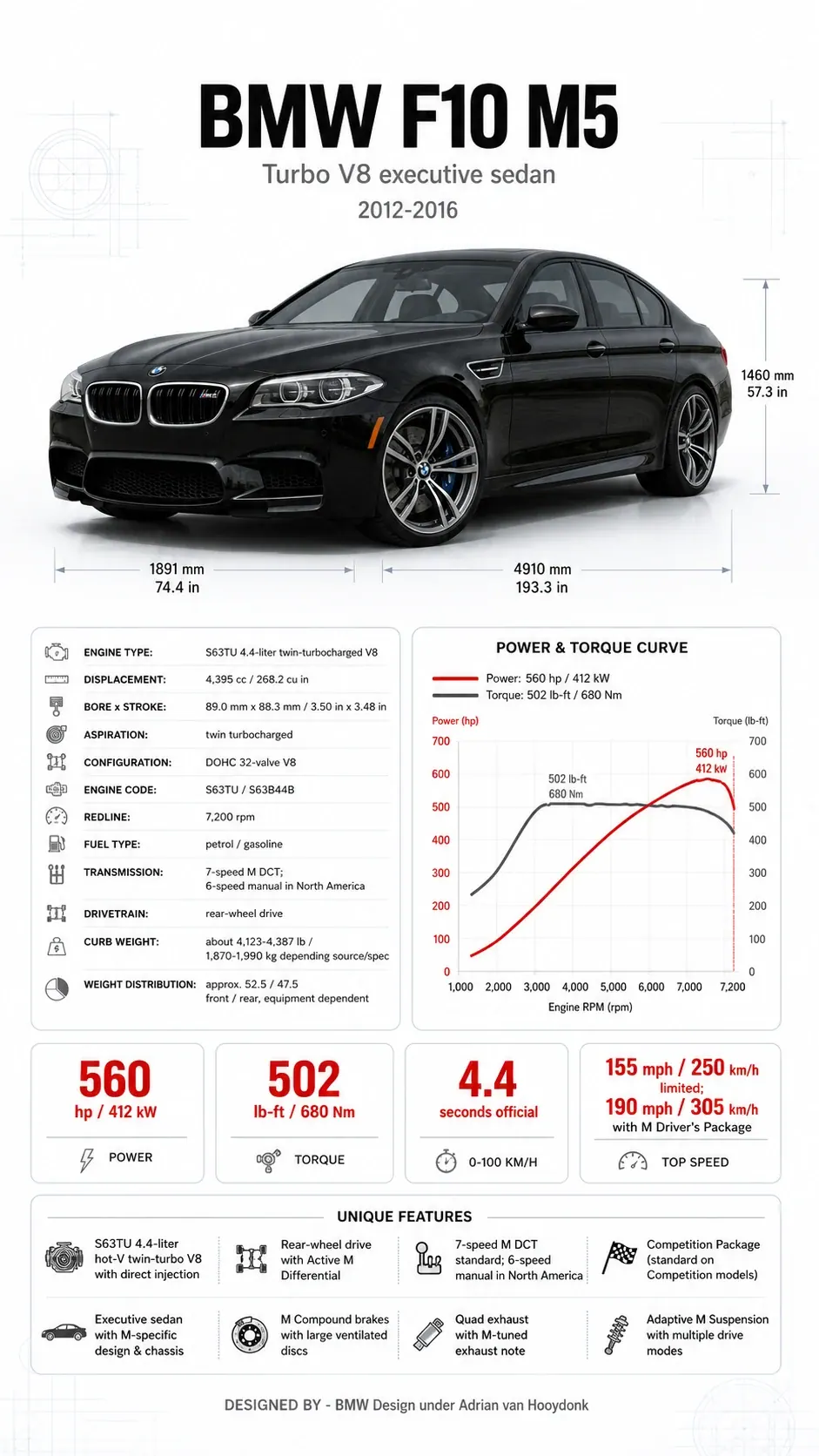
The standard car centers on the S63TU 4.4-liter twin-turbo V8. BMW’s launch material lists 412 kW, or 560 hp, and 680 Nm, or 502 lb-ft, with a 7-speed M DCT. BMW of North America also confirmed a 6-speed manual for the 2013 M5 in that market. That DCT/manual split is one of the biggest buying filters, because most cars are DCT while manual examples attract a different buyer pool.
The safest short list starts with unmodified or well-documented cars, clean cold-start behavior, no unexplained drivetrain clunks, proof of cooling and fluid work, realistic tire and brake spend, and options that match the build record. The riskiest car is a cheap tuned example with vague maintenance, no fault scan, worn consumables, and a seller who treats the S63TU like any ordinary 5 Series engine.
What Counts As An F10 M5
This guide covers the F10-generation BMW M5 sedan, not every fast F10 5 Series. The scope is the S63TU-powered, rear-wheel-drive M5 sold before the all-wheel-drive F90 generation. It does not cover the E60 V10, the newer hybrid G90, non-M F10 models, M Sport appearance packages, M550i variants, or Alpina B5 alternatives.
That boundary matters because listing language can blur the car. An F10 M5 should show M5-specific identity in the VIN/build data, drivetrain, interior, brakes, cooling package, body details, and service file. If a listing leads with badges, “M Sport” phrasing, or a dyno sheet before proving the car is an M5 with matching records, slow down.
Competition Package and limited-edition cars belong inside the F10 M5 family, but they are not the baseline. Treat those as variations that need proof. A standard 560 hp car with excellent history can be a better buy than a higher-output claim with weak paperwork.
Why The S63TU Changed The M5
The F10 M5 matters because it moved the M5 from naturally aspirated drama into turbocharged torque. The previous E60 M5 made its reputation around the S85 V10 and a high-revving character that felt exotic and demanding. The F10 is different. It makes big torque early, covers distance easily, and feels more like a huge executive express than a delicate back-road tool.
That shift is the appeal and the compromise. The S63TU gives the F10 M5 speed that still feels modern, especially in passing situations and highway use. It also adds heat, turbo hardware, cooling sensitivity, and tuning temptation. A good car feels effortless. A neglected one can feel ordinary until the repair estimate arrives.
Use the engine code as more than trivia. It is the core inspection category. Oil leaks, coolant smells, heat-soak behavior, turbo-related work, tune history, and service cadence should all be part of the first conversation.

Specs That Matter
| Detail | Source-backed baseline |
|---|---|
| Generation | F10 BMW M5 sedan |
| Engine | S63TU 4.4-liter twin-turbo V8 |
| Displacement | 4,395 cc |
| Power | 412 kW / 560 hp |
| Torque | 680 Nm / 502 lb-ft |
| Drivetrain | Rear-wheel drive |
| Main gearbox | 7-speed M DCT |
| Manual caveat | 6-speed manual confirmed for North America |
| Official 0-100 km/h | 4.4 seconds |
| Normal limiter | 250 km/h / 155 mph |
| M Driver’s Package limiter | 305 km/h / 190 mph |
The numbers are strong, but the buyer lesson is weight and torque. This is a large sedan with enough power to overwhelm weak tires, tired dampers, old bushings, and poor alignment. A test drive should feel tight, stable, and controlled. If it feels heavy, vague, nervous, or harsh in ways the seller cannot explain, the spec sheet is not a solution.
The official acceleration and top-speed figures also make consumables serious. Tires, brakes, suspension parts, cooling components, and drivetrain mounts are not background details on a car with this much pace.
DCT Versus North American Manual
Most F10 M5s use the 7-speed M DCT, and that is the normal global expectation. A good DCT car is the default daily-performance choice: fast shifts, easy traffic use, and a drivetrain character that matches the torque-heavy engine. Inspect it for clean engagement, consistent behavior when cold and hot, no warnings, no harsh unexplained low-speed behavior, and service records that match the car’s use.
The North American manual is the unusual branch. BMW confirmed the 6-speed manual for the 2013 M5 as a no-cost alternative to the standard DCT in that market. That makes manual cars more collectible to some buyers, but rarity does not excuse a weak example. Check clutch feel, synchro behavior, driveline vibration, service history, and whether the rest of the car deserves a manual premium.
Do not compare every F10 M5 in one pile. Price DCT cars against DCT cars first, then compare manual cars separately. Mileage, color, package, originality, accident history, and maintenance quality can matter as much as the transmission.
Competition Package And Edition Claims
The Competition Package should be treated as a verified option, not a listing adjective. BMW’s U.S. Competition Package material describes the standard M5 as a 560 hp 4.4-liter M TwinPower Turbo V8 car, with power managed through the M DCT or North American manual option. Later Competition and edition references can change output, chassis tuning, wheels, trim, and buyer demand.
That does not mean every car with black wheels or a seller-written “competition” line deserves the premium. Ask for a window sticker, build sheet, VIN option report, dealer record, or other evidence. If the paperwork is missing, price the car as the equipment you can prove, not the equipment the seller wants you to imagine.
The same rule applies to carbon-ceramic brakes, special paint, M Performance parts, and limited-edition claims. Rare parts can be valuable, but they can also be expensive to restore or replace. Proof protects both sides of the deal.
Reliability And Service Risks
The F10 M5 can be a usable performance sedan, but it should not be bought casually. The S63TU’s hot-V turbo layout, heat load, cooling complexity, oil and coolant leak possibilities, and tuning potential all make maintenance records central. A buyer should look for more than a stamped book. Specialist invoices, dated parts lists, fault-scan history, and explanations of recent work are more useful than vague “well maintained” language.
Common inspection themes include coolant smell, oil seepage, turbo-cooling work, charge-air and intake plumbing condition, misfire history, battery and electrical health, DCT behavior, rear differential mount noise, suspension wear, brake spend, and tire quality. Modified cars need an even higher standard. A tune, downpipes, intakes, or repeated launch-control use should come with supporting hardware, conservative calibration, and a shop name you can verify.
Do not turn owner anecdotes into guaranteed failure claims. The practical rule is simpler: if the car has a high-output S63TU, a heavy body, and unclear records, assume deferred work exists until a specialist inspection proves otherwise.
Pre-Purchase Inspection Checklist
| Area | What to verify |
|---|---|
| Identity | VIN/build data, M5 equipment, gearbox, package claims, title history |
| Engine | Cold start, hot restart, leaks, coolant smell, fault codes, oil service cadence |
| Turbo/cooling | Lines, reservoirs, fans, heat symptoms, prior cooling repairs |
| Gearbox | DCT engagement and warnings, or manual clutch/synchro behavior |
| Drivetrain | Differential noise, rear mount condition, vibration, launch-control abuse signs |
| Chassis | Dampers, bushings, alignment, tire wear, brake condition, wheel damage |
| Electronics | iDrive, driver modes, warning lights, sensors, battery condition |
| Modifications | Tune file, hardware list, receipts, shop name, emissions readiness |
Start the inspection cold. Watch the first start, let the car reach temperature, scan it, and drive it in ordinary traffic before asking for full power. A warmed-up clean pull is useful only after the basics make sense. Warning lights, smoke, overheating, hesitation, clunks, harsh shifts, missing receipts, or seller pressure should change the price or end the conversation.

Interior, Brakes, Wheels, And Daily Use
The F10 M5 is still a proper 5 Series sedan. It has usable rear seats, a real trunk, strong long-distance comfort, and a cabin that can feel more expensive than many older M cars. That usability is part of the reason people still shop them. It is also why some examples have lived hard lives as daily drivers, commuters, or tuned highway cars.
Interior condition helps tell that story. Check seat bolsters, switchgear, iDrive behavior, climate functions, warning lights, damp carpets, trim wear, steering-wheel condition, and whether the mileage matches the cabin. A tired cabin is not automatically a deal-breaker, but it should match the price.
Wheels, brakes, and tires deserve the same attention. The F10 M5 is heavy, powerful, and rear-drive. Cheap tires, mismatched rubber, bent wheels, low brake life, or uneven wear can signal budget ownership. If carbon-ceramic brakes or unusual wheel packages are claimed, verify them with build evidence and service records.


Market And Value
F10 M5 pricing is broad because the same model can be a high-mile DCT driver, a clean documented daily, a rare manual, a Competition Package car, a modified power build, or a low-mile collectible. Public auction and market pages show why a single number is not helpful without context. The useful comparison set is narrow: same gearbox, similar mileage, similar option proof, similar modification level, similar history.
The cheapest F10 M5 is rarely the safest one. A lower asking price can disappear quickly into tires, brakes, cooling work, suspension refresh, DCT or clutch issues, and correction of poor modifications. A more expensive car can be the better value when it brings records, stock hardware, clean paintwork, recent consumables, and a specialist inspection that does not uncover surprises.
Use the first-year budget honestly. Include the pre-purchase inspection, fluids, tires, brake work, diagnostic time, and the first deferred-maintenance round before deciding the car is affordable.
Recommendation
Buy the F10 M5 if you want a restrained sedan with serious turbocharged pace and you have the budget to maintain a complicated modern M car. The best examples are stock or carefully modified, fully documented, fault-scanned, and inspected by someone who knows the S63TU platform.
Choose the DCT if you want the normal F10 M5 experience and easier comparison shopping. Chase the manual only if you specifically value the North American 6-speed story and the car itself is strong enough to justify the premium. Treat Competition Package and edition claims as proof-based value items, not automatic buy signals.
Walk away from vague records, unexplained warning lights, cheap tuning, tired consumables, cooling smells, drivetrain noises, and sellers who cannot answer basic questions. The F10 M5 is most rewarding when the evidence is calm. It is most expensive when the price is the only good part of the story.
FAQ
Is the F10 M5 reliable?
It can be usable when maintained carefully, but it is not a low-risk ordinary sedan. Service history, heat management, drivetrain behavior, modification records, and pre-purchase inspection results matter more than mileage alone.
Is the F10 M5 manual worth more than the DCT?
A North American 6-speed manual can carry enthusiast demand because it is rarer than the DCT, but the premium still depends on condition, records, mileage, color, options, and clutch behavior.
Should I buy a modified F10 M5?
Only with detailed build records, conservative tuning, supporting hardware, and a specialist inspection. Extra power is easy to advertise and expensive to verify after damage appears.
What is the safest F10 M5 to buy?
The safest car is usually stock or lightly modified, fully documented, fault-scanned, inspected cold and hot, and priced around its evidence rather than around horsepower claims.


