


Quick Answer
The BMW E28 M5 is still worth attention because it is the original M5 formula: a discreet E28 sedan with BMW Motorsport hardware, a naturally aspirated 3.5-liter inline-six, rear-wheel drive, and a 5-speed manual. The short version is simple: buy one only if the body, identity paperwork, market specification, and service history are stronger than the story around the car. A cheap E28 M5 can become expensive quickly, while a clean, documented driver can still make sense beside modern collector prices.
The article car is the first-generation E28 M5 built from 1985 to 1988. It covers Euro, UK, North American, and South African context with market caveats. It does not treat an M535i, normal 535i, later E34 M5, replica, or modified build as the same thing. That boundary matters because the engine, equipment, value, and buyer risks change when the car is no longer an exact E28 M5.
Treat the E28 M5 as a proof-first purchase, not a mood purchase. The car’s value comes from a specific first-generation M5 identity: the right E28 shell, the right market story, the right M engine family, and enough paperwork to make those claims boring. If those pieces are missing, the badge alone is not enough.
Its appeal is not only that it was first. It created the discreet super-sedan template with real Motorsport hardware under a restrained four-door body. That makes originality, mileage, market specification, and maintenance history part of the buying decision, not small details to sort out after purchase.
Why The E28 M5 Still Matters
The E28 M5 did not become desirable because it looked wild. Its appeal is almost the opposite. It took a clean executive sedan shape and put Motorsport intent underneath it. That subtlety is the point. The car can look almost ordinary until the buyer understands the engine lineage, manual gearbox, hand-built production story, and the scarcity of correct cars.
For a reader shopping today, that history should not become romantic fog. The same details that make the car special are the details that must be verified. A correct engine, correct market specification, original trim, documented maintenance, and clean shell matter more than broad classic-BMW enthusiasm. The E28 M5 is not just a nice E28 with better wheels.
That is why originality matters so much. A normal E28 5 Series can be a lovely classic, but it is not priced or judged like a real M5. The buyer needs to verify that the car is a genuine first-generation Motorsport sedan before giving it first-generation M5 money.
M88/3 Versus S38B35
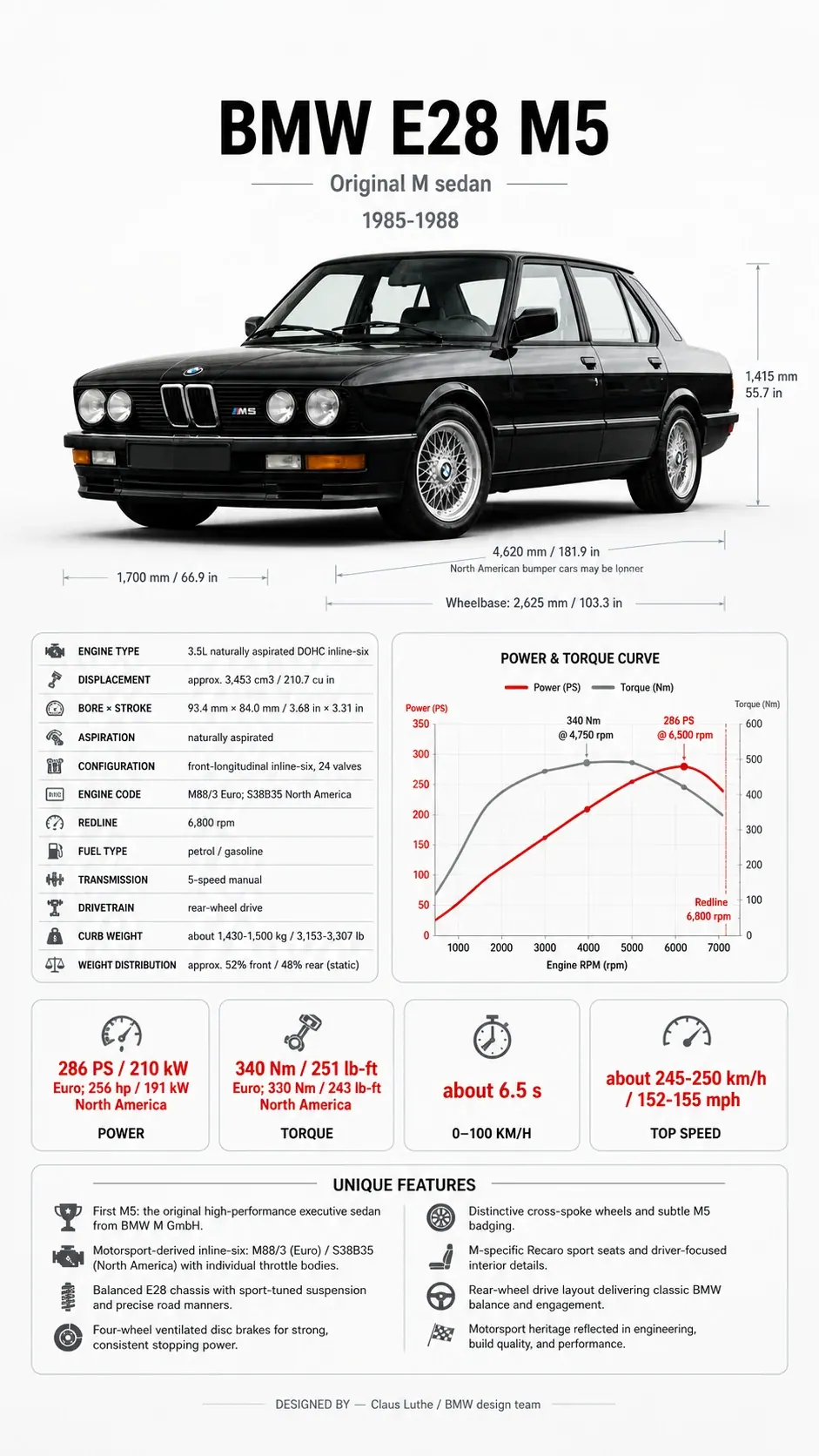
The most important technical caveat is the market engine split. Many European and related-market cars use the M88/3, while North American cars use the catalytic-converter S38B35. Both are naturally aspirated 3.5-liter BMW M inline-sixes, but the buyer should not quote one market’s power figure as if it applies to every car.
That distinction changes article claims, price comparisons, and inspection questions. A North American 1988 M5 may be easier to discuss in a US market guide, while a Euro or UK car may attract a different buyer because of engine specification, steering side, equipment, and import history. The safest public advice is to identify the market first, then compare cars.
Start every inspection by identifying the car’s region and engine. A Euro M88/3 car, a UK right-hand-drive car, a South African-context car, and a North American S38B35 car can all sit under the E28 M5 umbrella, but they should not be described with one lazy spec line. The market split affects power claims, emissions equipment, desirability, and parts conversations.
Equipment deserves the same caution. Reference notes can describe Euro M88/3 cars, North American 1988 S38B35 cars, and UK or right-hand-drive context, but the individual car still needs build-sheet, VIN-tied, or period-document proof. Without that, treat equipment as possible or typical for a market, not confirmed on the car in front of you.
Driving Character
The E28 M5’s appeal is not just acceleration. Modern cars are quicker, quieter, and safer. The E28 M5 is valuable because its powertrain, steering, manual gearbox, and rear-drive balance make the driver part of the process. It is an analog performance sedan, not a digital luxury missile.
That character also means condition is felt immediately. Worn bushings, tired dampers, vague shift feel, old tires, weak cooling, or rough engine behavior can make a special car feel ordinary. A proper pre-purchase inspection should treat the driving feel as evidence, not entertainment after the deal is done.
The manual, rear-drive layout is a major reason the car still feels special. It also exposes neglect quickly. A tired E28 M5 may still look like a collector object, but loose chassis feel, uneven engine response, gearbox noise, or poor cooling behavior will make the car feel like an expensive project instead of a sharp M sedan.

Production And Identity Checks
Scarcity makes identity proof important. The buyer should verify the VIN, market specification, engine, trim, color history, and documentation before using a car’s appearance as proof. The E28 shape is easy to admire and relatively easy to imitate, but a real M5 package is a more specific thing.
The public article should use this as a practical warning. Do not pay M5 money for a story, a badge, or a collection of parts. The best cars have paperwork that makes the identity boring to verify. If the seller cannot explain market specification, engine history, and major service records clearly, the buyer should slow down.
A buyer should be able to trace the car’s identity without relying on seller enthusiasm. The VIN, market specification, engine type, color changes, service books, import history, and old invoices should tell one coherent story. If the story only works when the buyer ignores a gap, that gap belongs in the price.
Low production turns small identity questions into big value questions. A tidy ordinary E28, an M535i, or a later M5 can still be desirable, but none should be used as proof for this car. Cross-check market, mileage, originality, and regional specification before treating any single example as typical.
The same discipline applies to options. Heated seats, leather type, wheels, audio equipment, air conditioning, and market trim can all affect desirability, but the article should not pretend every reference item belongs to every car. Confirmed equipment is valuable because it can be documented; vague equipment claims are just more seller copy.
Current Price Range
June 2026 market evidence shows a wide spread. Valuation guides and sold-price tools put ordinary market context far below the biggest public trophy numbers, while active listings and record sales show how far exceptional cars can run. That does not mean every E28 M5 is a six-figure car. It means originality, mileage, market, records, color, and condition can move the price dramatically.
A practical buyer target is a documented driver-quality car rather than a headline sale. For this pass, a reasonable good-buy discussion sits around USD 55,000 to 80,000 equivalent for a usable, documented car, with major caveats. Rough cars, rusty cars, missing-history cars, and modified cars should be discounted hard. Ultra-low-mile preserved cars can live in another market entirely.
Use price data as a map, not a promise. The useful pattern in 2026 is that average-condition guide values, active listings, and major public sales do not describe the same car. A driver with miles and honest use belongs in a different conversation from a low-mile preserved car with collector-grade documentation.
Sold-price tools give the article a grounded middle, while valuation trend data keeps the guide from treating six-figure cars as normal. They are most useful when paired with the car’s market specification, mileage, originality, rust condition, service records, and repair quality. A price without that context is just a number looking for an argument.
A sensible June 2026 reading puts usable market context around the mid-five-figure zone, with exceptional low-mile or concours cars reaching much higher. For a buyer who wants to drive the car, the more useful target is a documented driver-quality example rather than the cheapest project or the most expensive trophy. Rust repair, originality, records, and market specification should move the recommendation before the asking price does.
Collector Outliers
Recent record and high-asking examples are useful because they show the ceiling, but they are dangerous if used as the baseline. A preserved, low-mile, highly original car can justify collector behavior that a normal driver cannot. A buyer who wants to drive the car should not shop with concours logic unless they can afford the maintenance and opportunity cost.
This is where the article needs plain language. A record sale proves collector demand; it does not prove your local car is worth the same. A high asking price proves a seller’s ambition; it does not prove the market has accepted that number. The better question is whether the specific car’s condition, originality, records, and market specification support the price.
A record sale belongs in the guide because it shows collector appetite for the right E28 M5. It should not become the default price expectation. The cars that earn outlier money usually have unusual mileage, preservation, presentation, originality, or provenance. A normal driver-quality car needs its own evidence.
If a seller points at a trophy sale, ask which parts of that sale apply here. Does this car have comparable mileage, paint, interior, books, engine correctness, market desirability, and inspection confidence? If not, the record is background context, not a valuation shortcut.
Body And Rust Checks
The E28 shell is old enough that body condition can decide the purchase. Rust around arches, jacking points, floors, seams, front structure, rear axle areas, sunroof areas, and hidden repairs should be treated as major buying evidence. Paint shine is not enough. The buyer needs underside inspection, magnet/paint-depth caution, and proof that any repair was done correctly.
This matters even more on an M5 because mechanical restoration is only part of the cost. A special engine in a weak shell is not a good shortcut. The best E28 M5 to buy is often the one with the cleanest structure and most boring documentation, even if it does not have the flashiest listing photos.
The E28 shell should be inspected with the patience usually reserved for the engine. Buyers should look past shine and check jacking points, arches, floors, seams, suspension mounting areas, sunroof drains, previous metal work, and underside protection. A dry, straight shell can be worth more than a glamorous listing with vague repair history.
Rust is the place where a bargain E28 M5 often stops being a bargain. A correct M engine does not rescue a weak shell if the car needs major structural work. Before negotiating around cosmetics or miles, decide whether the body is good enough to deserve the mechanical investment.
Maintenance And Parts Reality
The M88/S38 family deserves specialist respect. A buyer should look for valve-adjustment history, cooling-system health, fuel and ignition condition, oil leaks, timing and chain-related evidence where relevant, clutch and gearbox behavior, and proof that the car has been used and maintained rather than simply stored. Long storage can create its own work list.
The article should not scare readers with vague exotic-car language, but it should be direct. This is a classic BMW M car. Parts, knowledge, and labor are not the same as a normal commuter sedan. The right shop and the right records are part of the value.
Treat engine history as part of the purchase price. The M88/S38 family rewards correct maintenance, but vague promises about recent work are not the same as invoices, specialist notes, parts records, and inspection access. A car with stronger records may be the better buy even if the asking price is higher.
Usability depends on the boring systems too. Cooling, fuel delivery, ignition, clutch hydraulics, suspension rubber, brakes, tires, and stored-car recommissioning can all turn into immediate costs. The best seller will be able to explain what was done, who did it, and what still needs attention.

Interior, Equipment, And Options
Interior condition matters because trim can be harder to solve than a buyer expects. Seat wear, dash cracks, door trim issues, old electronics, air conditioning, switchgear, and market-specific equipment all affect ownership. The E28 cabin is part of the charm, but it is also part of the parts hunt.
Options and equipment must be phrased carefully. Without a build sheet, VIN-tied option proof, factory record, or equivalent documentation, the article should describe possible or reference equipment rather than claim exact installed options on a specific car. That keeps the buyer guide honest.
A correct cabin helps the car feel like the quiet, serious machine it was meant to be. Worn seats, cracked dashboards, tired switches, missing trim, poor aftermarket audio work, and weak air conditioning may not look dramatic in photos, but they can become slow and expensive to correct.
Market equipment should be handled carefully. Euro, UK, North American, and other regional cars can differ, and those differences may be part of the car’s appeal. The buyer guide can discuss those patterns, but the individual example still needs documentation before any option or trim claim becomes part of the car’s value.
Who Should Buy One
The right E28 M5 buyer wants an original M sedan with analog character and is willing to verify the car before falling in love with it. They should be comfortable paying for inspection, specialist maintenance, and condition. They should also understand that market values reward originality and proof, not just the M badge.
The wrong buyer wants a cheap way into M history, plans to ignore rust, or assumes every E28 part is easy and inexpensive. The E28 M5 is rewarding, but it is not a casual old sedan when bought badly.
That buyer profile is narrower than the badge suggests. The best owner is patient, inspection-driven, and comfortable walking away from a car with a better story than structure. The E28 M5 rewards people who want the first M sedan enough to protect its originality, not people who want the cheapest path into an M badge.
Final Verdict
Buy the BMW E28 M5 for the exact thing it is: the first M5, a subtle Motorsport sedan, and one of BMW’s cleanest analog performance ideas. Do not buy it as a generic classic BMW, a badge investment, or a bargain super-sedan. The best car is the one that can prove its identity, market specification, structure, and service history before it asks you to pay collector money.
A good E28 M5 purchase should feel almost uneventful before it feels exciting. The inspection should confirm the identity, the documents should support the seller’s story, the body should not need heroic optimism, and the market specification should be clear. Once those boring pieces line up, the car’s character can become the reason to buy instead of the distraction from hidden risk.
The best closing test is simple: would the car still make sense after a cold inspection, a lift check, a document review, and a market-specific parts conversation? If yes, the E28 M5 can be one of the most rewarding classic BMWs to own. If no, the legend is doing too much of the seller’s work.

FAQ
Common questions
What should I verify first on a BMW E28 M5?
Start with the body, identity paperwork, market specification, M88/3 versus S38B35 engine context, service history, cooling behavior, suspension condition, gearbox feel, rust, and accident evidence.
Is an E28 535i or M535i the same as an E28 M5?
No. The guide treats normal E28s, M535i models, replicas, modified builds, and the later E34 M5 as different cars. Verify genuine first-generation M5 identity before paying M5 money.
Sources and references
- Automotive content provider article packageImported provider package; source facts are recorded in article-workspaces/bmw-e28-m5/source-notes.md.
- Automotive content provider visual handoff packageAccepted provider visuals and usage evidence are recorded in article-workspaces/bmw-e28-m5/article-info.json.
Topic hubs
Tags

