


Quick Answer
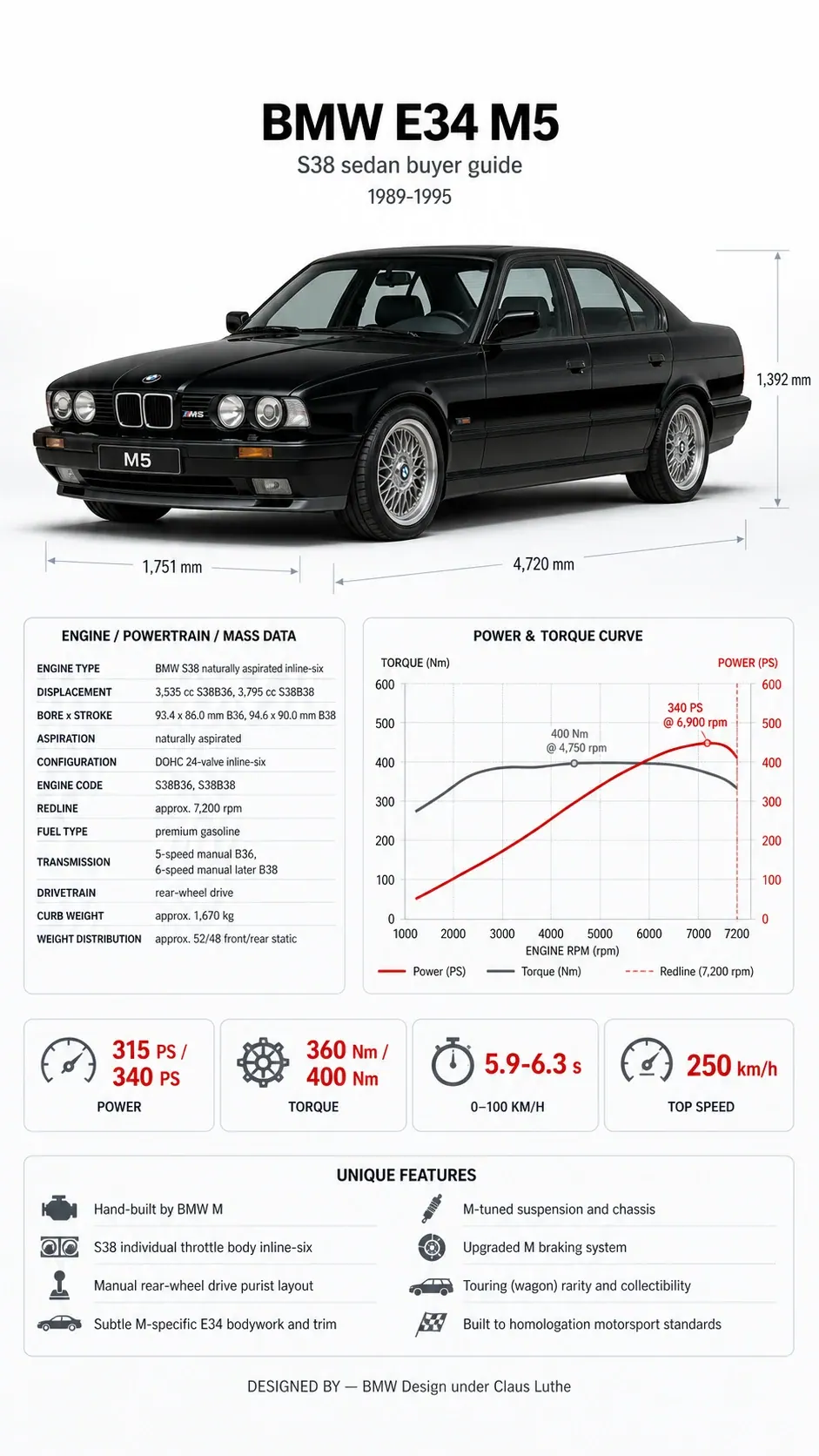
The BMW E34 M5 is worth buying when the car proves three things at the same time: it is truly inside the E34 M5 scope, its S38 service history is strong enough to make ownership realistic, and its body, market, and documentation support the price. It is not just an old fast 5 Series. The article target is the second-generation M5, with the sedan as the default body and Touring, 20 Jahre, Nurburgring-package and late 3.8-liter details treated as variations rather than baseline claims.
The safest buy is a documented, inspected sedan with clear S38 history, clean bodywork, complete M-specific parts, sensible market pricing and no vague claims about exact installed options. The riskiest buy is a cheap car that asks you to ignore smoke, leaks, rust, EDC or self-leveling suspension problems, confused US-versus-Europe specifications, missing valve-clearance records, or seller language that blends a non-M E34, 540i, Alpina or later M5 into the same story.
Recent public market surfaces show a broad spread, from roughly low-$20k or EUR20k results for weaker or higher-mile examples to roughly mid-$50k or GBP47k recent sedan results before Touring and special-edition premiums. That is not a universal valuation. It is a warning that condition, originality, market, body style, mileage and documentation matter more than an average. A sound driver-quality sedan around the low-to-mid $30k to mid-$40k equivalent zone can make sense, but only if the evidence supports it.
For the BMW E34 M5, the useful buyer boundary is E34 M5 second-generation hand-built production scope. Lead with the named E34 M5 anchor and keep any wider BMW context subordinate to that exact vehicle. That keeps the advice tied to this first-generation M car instead of drifting into ordinary E28 5 Series or later M5 guidance.
What Counts As An E34 M5
The E34 M5 covered here is the BMW M car built from the E34 5 Series generation, not a general E34 buying guide. That means the baseline article car is an M5 sedan with S38 inline-six power, rear-wheel drive, manual transmission, M-specific body and interior details, and a market/year context that must be named before making a specification claim. The Touring is important, but it is a variation. The same goes for 20 Jahre and other limited equipment contexts.
This boundary keeps the guide useful. A 540i six-speed can be a compelling E34, and owner communities often mention it as a cheaper way into a quick old BMW sedan, but it does not carry the same S38, M-production, market and parts story. An E28 M5 or E39 M5 belongs in family context, not as a substitute for E34 inspection advice. Alpina B10 variants also deserve separate treatment. They may share the era, shape or enthusiast audience, but they do not make the exact E34 M5 checklist interchangeable.
The public copy should also avoid exact installed-option claims unless a car-specific record proves them. Period brochures, RealOEM-style parts references and model-year descriptions can support possible equipment language, but they do not prove that a specific sale car has a specific option. A buyer should ask for a build sheet, dealer record, option-code evidence or equivalent documentation before paying for exact equipment as value.
For the BMW E34 M5, the useful buyer boundary is E34 chassis M5 sedan/Touring and excluded non-M E34 variants. Lead with the named E34 M5 anchor and keep any wider BMW context subordinate to that exact vehicle. That keeps the advice tied to this first-generation M car instead of drifting into ordinary E28 5 Series or later M5 guidance.

S38 Powertrain And Model-Year Split
The S38 is the E34 M5’s center of gravity as a buyer decision. Early cars use the 3.6-liter S38B36, while later 3.8-liter cars use the S38B38 in markets where that phase applies. That split changes more than a table row. It affects output, gearbox context, rarity, market desirability, maintenance expectations and the way a buyer should read a seller’s claims. A US-market 3.6-liter car and a later European 3.8-liter car should not be described as if they are the same specification with different badges.
The engine is the appeal and the exposure. When healthy, the S38 gives the E34 M5 the old-M character that owner reviews keep returning to: sound, response, high-speed composure and the feeling that the sedan has real motorsport-era hardware under a restrained body. When neglected, it becomes the item that can overwhelm the purchase. Smoke, hot-running behavior, oil leaks, coolant neglect, weak records, valve-clearance uncertainty and rebuild hints should matter more than a shiny engine bay.
The gearbox and drivetrain need the same precision. Early five-speed and later six-speed references must stay tied to the correct phase and market. A tired clutch, vague shift quality, driveline vibration, differential noise or unclear rebuild story can change the car from a strong buy to a project. The best file shows service work, not just parts receipts. It explains what was done, who did it, why it was needed and how the car behaved afterward.
For the BMW E34 M5, the useful buyer boundary is S38B36 and S38B38 E34 M5 engine-phase boundary. Lead with the named E34 M5 anchor and keep any wider BMW context subordinate to that exact vehicle. That keeps the advice tied to this first-generation M car instead of drifting into ordinary E28 5 Series or later M5 guidance.
Why The E34 M5 Still Feels Special
The E34 M5 still works emotionally because it sits in the gap between old-school BMW restraint and full M-car intensity. It looks like a serious sedan before it looks like a spectacle. That matters for readers who want the E34 generation rather than a louder poster car. Period road-test context and owner/user comments both point toward the same appeal: the car feels special because the engine, chassis, manual gearbox and understated body shape make the performance feel earned.
Owner comments also keep the article honest. Some owners praise the sound, torque, high-speed stability, comfort and daily usability. Others point out fuel use, heavy controls, steering feel, parts availability, S38 cost and the risk of treating the car as a casual daily driver. That split is useful. It prevents the guide from turning nostalgia into a verdict. A good E34 M5 can feel smaller, more mechanical and more personal than later fast sedans, but it is still a condition-sensitive specialist car.
The right reader wants that tradeoff. If you only want modern acceleration per dollar, the E34 M5 is not a rational first answer. If you want a hand-built-feeling BMW M sedan with a distinctive engine, period road manners, practical seating and a narrow but committed owner culture, the car makes more sense. The guide should make that fit clear before it talks anyone into a purchase.
For the BMW E34 M5, the useful buyer boundary is 1991 E34 M5 period road-test and BMW M discreet-sedan context. Lead with the named E34 M5 anchor and keep any wider BMW context subordinate to that exact vehicle. That keeps the advice tied to this first-generation M car instead of drifting into ordinary E28 5 Series or later M5 guidance.
Sedan, Touring, And Special Editions
The sedan is the default E34 M5 target because it is the normal public buying path and the cleanest way to compare market results. The Touring is a different conversation. It is rarer, more collectible, more body-style-specific and often much harder to value from sedan results. A Touring may justify a premium, but it also needs its own proof. The buyer should verify that the car is a genuine M5 Touring and that rear-body, interior and suspension details support the claim.
The 3.6-versus-3.8 split also affects the variant story. Later 3.8-liter cars bring their own desirability and complexity, and some markets connect that phase with a six-speed gearbox. Special editions such as 20 Jahre BMW Motorsport and package-specific cars belong in the same carefully separated bucket. They can change collectability, but they should not be used to inflate the value of a normal car that lacks matching proof.
This is also where option language can drift. EDC, self-leveling suspension, wheels, interior trim, Nurburgring-package context and brochure equipment should be described as variant or possible equipment unless the specific car proves it. A seller may be correct that the model could have a feature. That is not the same as proving this chassis has it now, still has it intact, or deserves a premium for it.
For the BMW E34 M5, the useful buyer boundary is E34 M5 Touring and 20 Jahre variation boundary. Lead with the named E34 M5 anchor and keep any wider BMW context subordinate to that exact vehicle. That keeps the advice tied to this first-generation M car instead of drifting into ordinary E28 5 Series or later M5 guidance.
Current Price And Value Caveats
The package price evidence supports a broad, caveated market view rather than a single magic number. Recent public results include a roughly $22,785 modified US sale, a roughly EUR20,250 high-kilometer Belgium result, a roughly $33,000 US sale, a roughly $39,000 US sale, a roughly GBP47,000 UK result and a roughly $56,500 US result. Those observations are useful because they show spread. They are not enough to flatten every E34 M5 into one value.
For a documented driver sedan, a low-to-mid $30k to mid-$40k equivalent target can be a rational starting point if the body, S38 history, mileage, originality and records all support it. Better cars can exceed that. Touring, special editions, low-mileage cars, unusually original examples and market-specific cars need their own appraisal. Cars with rust, smoke, weak history, confusing modifications or missing M-specific parts can be expensive even when the purchase price looks low.
The practical value rule is simple: pay for proof. The strongest car is not always the lowest-mileage car or the cheapest car. It is the one whose price matches its evidence. If the seller claims 3.8-liter rarity, Touring significance, unusual equipment, original paint, expensive recent mechanical work or collector-grade condition, that claim needs supporting documents, photos and inspection results. If the file is thin, the price should move before your standards do.
For the BMW E34 M5, the useful buyer boundary is 2026 E34 M5 public auction and market-result surface. Lead with the named E34 M5 anchor and keep any wider BMW context subordinate to that exact vehicle. That keeps the advice tied to this first-generation M car instead of drifting into ordinary E28 5 Series or later M5 guidance.

Engine Inspection Priorities
Start with the S38 before falling in love with the shape. Check cold start, hot restart, idle quality, smoke, oil leaks, coolant leaks, cooling-system health, fan and radiator condition, service intervals, valve-clearance records, timing-chain context, compression or leakdown evidence where available, and whether the engine has been maintained by someone who understands the S38. A general old-BMW service history is not the same as an M5 service history.
Owner/user evidence points to the same buyer caution from different directions. Some long-term owners report high-mileage usability and normal maintenance. Others warn that S38-family rebuild exposure, valve adjustments, timing-chain-guide concerns and M5-specific parts can become financially serious. Treat those comments as pattern evidence. They do not give a universal failure rate, but they tell you where the inspection should slow down.
The engine bay should make sense as a system. Hoses, wiring, clamps, leaks, intake hardware, heat shielding, exhaust condition and accessory drive details should look like a maintained car, not a recently detailed mystery. A polished bay with missing records is less valuable than a slightly used bay with honest receipts. If the seller cannot explain the engine phase, recent service, leak history and who worked on the car, keep looking.
For the BMW E34 M5, the useful buyer boundary is S38 engine-condition and rebuild-risk checklist. Lead with the named E34 M5 anchor and keep any wider BMW context subordinate to that exact vehicle. That keeps the advice tied to this first-generation M car instead of drifting into ordinary E28 5 Series or later M5 guidance.
The important variation work is to separate confirmed equipment from reference equipment. Relevant variant notes include 3.6-liter sedan; 3.8-liter sedan; M5 Touring. Market and year context includes 1992 3.8-liter technical upgrade for relevant markets; 1994 revision and late visual/technical improvements. Without build-sheet or VIN-tied proof, treat options as possible equipment rather than proof that a specific chassis actually has them.
Suspension, Steering, SLS, And Rust Checks
The E34 M5 buyer checklist should separate suspension and body risk from normal used-car noise. Electronically controlled dampers where equipped, self-leveling suspension, front bushings, rear suspension wear, mounts, steering-box feel, alignment behavior and tire wear can all change the ownership cost. Owner reports repeatedly mention SLS or EDC cost concerns and the need for specialist support. That does not mean every car is broken. It means the car should not be priced as sorted until those systems are inspected.
Rust and repair quality deserve the same attention. Inspect jack points, sills, floors, arches, door bottoms, screen areas, trunk area, suspension pickup points, underbody repairs and evidence of crash damage. The E34 shell can look dignified from ten feet away while still hiding expensive work. Touring bodywork and rear equipment add their own checks. Paint, panel fit and underbody photos should support the seller’s story.
Steering feel can also divide buyers. Some owner/user reports praise composure and cornering; others describe heavier controls or less excitement than expected. That is not a contradiction so much as a reminder to drive the car you are considering. A healthy E34 M5 should feel coherent, stable and mechanical. It does not need to feel like a modern M car, but it should not feel loose, tired or vague in ways the seller cannot diagnose.
Suspension, Steering, SLS, And Rust Checks should stay specific to BMW E34 M5. The saved package boundary identifies the car as generation, , , with and market-specific engine caveats. A useful buyer paragraph should connect that fact to inspection, value, ownership fit or originality instead of repeating a generic classic-sedan summary.

Interior And Electrical Checks
The interior is not just cosmetic. M-specific seats, trim, gauges, switchgear, lights, blower operation, wipers, climate controls, pixels or warning lamps, seat functions and Touring rear equipment where relevant all help tell the car’s story. A worn cabin can be acceptable in a driver, but a mismatched or incomplete cabin should affect the price. Replacement parts may be hard to find or expensive, especially when the missing piece is M-specific.
Electrical behavior also gives clues about storage, moisture, repairs and neglect. Test every switch you can reasonably test. Look for evidence of alarm installs, stereo work, poor wiring repairs, warning-light masking and non-working accessories. A seller who says old BMWs all do that is asking you to accept cost without evidence. Some faults may be minor; the point is to identify them before the car becomes your problem.
Parts-catalog and brochure references are useful at this stage because they support correct component and equipment language. They should not become exact installed-option proof by themselves. If the value depends on a rare package, unusual trim or market-specific configuration, the file should prove it with build data or comparable records.
Can You Daily An E34 M5?
An E34 M5 can be usable in the real world, but it is not a low-effort first car or a cheap commuter. Owner reports include high-mileage use, long trips, comfort and strong satisfaction. They also include fuel use, rare parts, specialist maintenance, old-car snowball risk and advice that a cleaner 540i/6 can make more sense for some buyers. The right answer depends on budget, mechanical tolerance, storage, backup transport and the specific car.
If you want an occasional enthusiast sedan that can do real mileage when sorted, the E34 M5 is plausible. If you need a single daily driver with predictable costs, modern parts availability and no downtime tolerance, the car becomes harder to recommend. Its best role is often a protected driver: used enough to stay healthy, maintained by someone who knows the platform, and not forced into duty when it needs attention.
The daily-use question should also consider market pressure. As values rise, using a rare or highly original example every day may become less appealing. Conversely, a documented driver with honest miles and sorted mechanicals can be more enjoyable than a low-mileage car you are afraid to use. Buy around your actual use case, not around social-media versions of ownership.
Verdict: Who Should Buy One
Buy an E34 M5 if you specifically want the E34 generation, S38 character and restrained M-sedan identity, and if you are prepared to inspect the car like a specialist machine. The best examples make the decision feel calm. They show identity proof, S38 service history, body integrity, clear market context, complete M-specific parts and seller knowledge. You should be able to explain why the price fits the car without relying on the word rare alone.
Walk away from cars that ask you to accept confusion. Wrong-market claims, blended 3.6 and 3.8 specifications, vague engine work, no valve-clearance trail, uninspected SLS or EDC issues, rust denial, missing interior parts, undocumented option claims and thin ownership files are not small details. They are the difference between a special M5 and a project wearing a special badge.
The E34 M5 is still compelling because it rewards the buyer who wants proof, not just nostalgia. It is discreet, mechanical, practical enough to matter and special enough to justify the extra care. That only works when the car in front of you supports the story. If the proof is there, the E34 M5 remains one of BMW M’s most satisfying classic sedans. If the proof is missing, the smart move is to keep your money liquid and keep searching.
FAQ
Is the BMW E34 M5 reliable? It can be durable when maintained correctly, but reliability is condition-sensitive. The S38, cooling system, suspension, SLS/EDC where equipped, body condition and records matter more than mileage alone.
Is the 3.8 better than the 3.6? The later 3.8-liter phase can be more desirable in some markets, but it also changes cost, rarity and specification context. A strong 3.6 with better history can be a better buy than a weak 3.8.
How much should you pay for an E34 M5? Treat roughly $30k-$45k equivalent as a broad driver-sedan starting zone only when the car is documented and sound. Weak cars, modified cars, Touring examples, special editions, low-mileage cars and different markets need separate valuation.
Can you daily an E34 M5? You can, but it is best for an owner with budget, mechanical patience, specialist support and a backup plan. It is not a cheap first car or a low-effort modern commuter.
FAQ
Common questions
Is the BMW E34 M5 reliable?
It can be durable when maintained correctly, but reliability is condition-sensitive. The S38, cooling system, suspension, SLS/EDC where equipped, body condition, and records matter more than mileage alone.
Is the 3.8 better than the 3.6?
The later 3.8-liter phase can be more desirable in some markets, but it also changes cost, rarity, and specification context. A strong 3.6 with better history can be a better buy than a weak 3.8.
How much should you pay for an E34 M5?
Treat roughly $30k-$45k equivalent as a broad driver-sedan starting zone only when the car is documented and sound. Weak cars, modified cars, Touring examples, special editions, low-mileage cars, and different markets need separate valuation.
Can you daily an E34 M5?
You can, but it is best for an owner with budget, mechanical patience, specialist support, and a backup plan. It is not a cheap first car or a low-effort modern commuter.
Sources and references
- E34 M5 - BMW Group Classic
- BMW M5 (E34), 340 hp
- BMW M5 Sedan (E34) - BMW Group Classic
- BMW M5 Touring (E34) - BMW Group Classic
- The 1988 BMW M5 E34
- The BMW M5 generations
- Extremely rare BMW M5 E34 special edition
- The BMW M5 Touring E34
- 5' E34 M5 3.6 Diagram Selection - BMW Parts Catalog
- BMW M5 1992 brochure PDF
- Buyer's guide: BMW M5 (E34)
- BMW M5 (E34): PH Used Buying Guide
Topic hubs
Tags

