


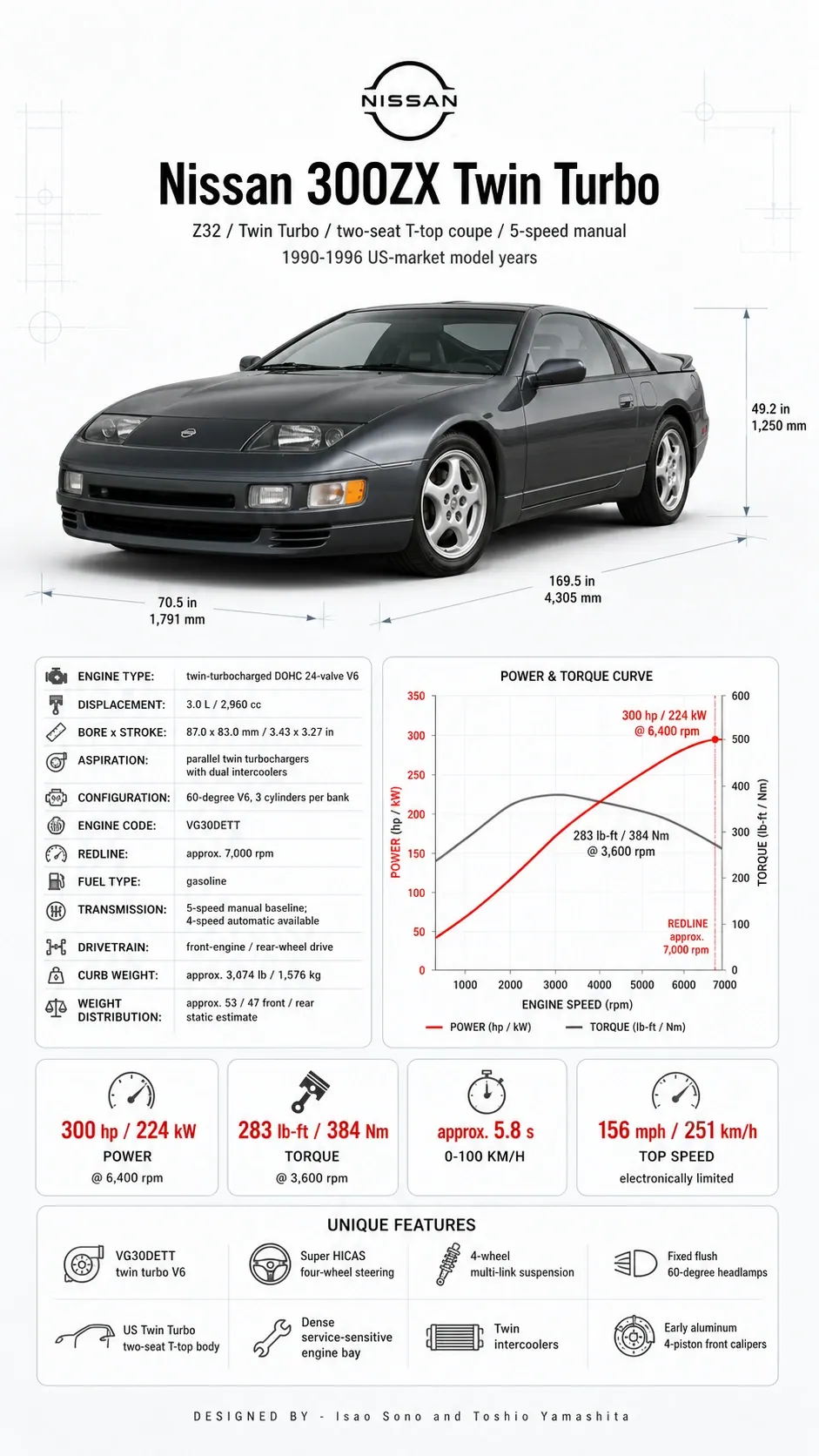
Verdict: buy the Z32 300ZX Twin Turbo for the design, the twin-turbo V6, and the 1990s Nissan flagship feel. Walk away from any car that cannot prove timing service, cooling health, turbo behavior, electrical condition, and clean ownership history.
This guide is for a used-car buyer considering a US-market 1990-1996 Nissan 300ZX Twin Turbo. The baseline is the Z32 Twin Turbo two-seat coupe with the VG30DETT 3.0-liter twin-turbo V6, rear-wheel drive, and a 5-speed manual, with automatic-output and market differences called out where they matter.
Quick Answer
The Z32 Twin Turbo is still worth wanting. It has the low nose, wide stance, T-top-era cockpit, twin-turbo V6 character, and grand-touring polish that made the 300ZX feel expensive when new. Period and buyer-guide sources still frame it as one of the major Japanese performance cars of its generation.
It is also a bad impulse buy. The engine bay is dense, the car is now roughly three decades old, and owner evidence keeps circling the same problems: timing-belt uncertainty, heat-aged wiring, PTU and injector-connector issues, vacuum and boost leaks, cooling-system neglect, turbo labor, and cars modified before they were made healthy.
The best answer is narrow: buy a documented manual Twin Turbo if the inspection supports the price and you still have money left after purchase. Do not buy the cheap non-runner, the smoky turbo car, the seller-story car, or the modified example with no receipts just because the shape looks impossible to resist.
Key Specs
| Item | US-market Z32 Twin Turbo baseline |
|---|---|
| Model years | 1990-1996 US 300ZX Twin Turbo context |
| Engine | VG30DETT 3.0-liter DOHC 24-valve V6 |
| Cylinder count | 6 cylinders, V6 layout |
| Aspiration | Parallel twin turbochargers with intercooling |
| Drivetrain | Front engine, rear-wheel drive |
| Manual output | 300 hp / 224 kW |
| Torque | 283 lb-ft / 384 Nm |
| Transmission | 5-speed manual baseline; 4-speed automatic available |
| Body | 2-door hatchback coupe, commonly T-top in US Twin Turbo context |
| Wheelbase | 96.5 in / 2,451 mm |
Keep the transmission caveat in mind. Some source databases separate manual and automatic Twin Turbo output. This buyer guide uses the manual 300 hp baseline because that is the enthusiast target and the cleanest package lock, but an automatic car should be evaluated on its own year, market, records, and price.
Why The Z32 Twin Turbo Matters
The Z32 matters because Nissan built it like a flagship, not a lightly warmed-over sports coupe. The design is clean, low, and still modern from many angles. Under the skin, the Twin Turbo brought a 3.0-liter DOHC V6, twin turbos, a serious chassis, and a cockpit that made the car feel more like a technical grand tourer than a stripped performance special.
That mix is the hook. A good Z32 Twin Turbo feels more mature than an FD RX-7, less myth-inflated than a Mk4 Supra Turbo, cleaner and more rear-drive focused than a Mitsubishi 3000GT VR-4, and more exotic than many similarly priced American performance cars. The reason to buy one is not that it is the easiest car in the class. It is that you specifically want this shape, this cabin, this twin-turbo Nissan V6, and this era of Japanese GT engineering.
The same engineering is why weak examples hurt. The Z32 hides age poorly when maintenance is skipped. The car can be rewarding and reliable when maintained, but the purchase decision must be built around proof, not vibes.
Best For And Wrong For
| Best for | Wrong for |
|---|---|
| A buyer who wants a special 1990s Japanese twin-turbo GT | A buyer chasing the cheapest Japanese performance badge |
| Someone with specialist inspection access | Someone buying from photos and seller confidence |
| An owner who can budget for timing, cooling, wiring, and turbo-system work | A first-project buyer without tools, space, or cash reserve |
| A shopper who values records over mileage alone | A buyer who thinks a low odometer reading replaces service history |
| A patient enthusiast waiting for the right manual Twin Turbo | Someone trying to rescue a cheap non-runner for daily use |
The Z32 is best treated as a deliberate enthusiast car. If you want a simple daily driver, buy something else. If you want a weekend GT with real character and you are willing to pay for the right inspection, it still has a strong case.
Owner Evidence: What Real Buyers Keep Repeating
The owner/user evidence packet includes 20 accepted records from Edmunds, Cars.com, buyer guides, specialist sources, Z32 owner forums, and Reddit discussions. They are not statistical reliability proof. They are pattern evidence, and the pattern is useful.
The praise is consistent: timeless styling, strong performance, stable handling, comfort, and a sense that a well-kept Z32 still feels special. Owners who love these cars usually talk about the way the car looks and the way it feels once it is sorted.
The warnings are also consistent. Buyers and owners repeatedly mention hard service access, timing-belt records, cooling and boost leaks, brittle connectors, PTU and injector diagnosis, vacuum lines, expensive turbo labor, and the danger of neglected or badly modified cars.
That is the buyer lesson: do not ask whether “a 300ZX is reliable” in the abstract. Ask whether this specific car has evidence that the known hard work has already been handled by someone competent.
Common Failures And Pre-Purchase Checks

Start with the timing service. If the seller cannot prove timing belt, water pump, tensioner, idlers, coolant service, and related age-sensitive work, price the car as if the job is due immediately. The VG30DETT is not a casual interference-engine gamble.
Then check the systems that owner evidence keeps repeating:
| Area | What to verify | Why it matters |
|---|---|---|
| Timing service | Receipts, dates, mileage, parts, and shop | A missing record can turn a dream car into immediate major service. |
| Cooling system | Pressure test, hose condition, radiator, thermostat behavior, coolant history | Heat and age punish the packed engine bay. |
| Boost and vacuum | Intercooler piping, vacuum lines, boost behavior, smoke, oil leaks | Leaks and turbo problems can hide behind normal seller language. |
| Electrical connectors | PTU, injector connectors, fusible links, harness brittleness, hot-start behavior | Owner discussions repeatedly start no-start and misfire diagnosis here. |
| Turbo health | Smoke, shaft noise, oil consumption, uneven boost, service records | Turbo access is poor, so cheap symptoms can become big labor. |
| Body and roof | T-top seals, hatch area, spare tire well, jack points, rockers, crash repair | A pretty upper body does not prove the shell is clean. |
| Modifications | Boost controller, ECU/tune, wiring, injectors, intercoolers, exhaust, receipts | Good upgrades are documented; mystery upgrades lower confidence. |

Do not let a smooth five-minute drive replace a Z32-aware inspection. The better order is records first, VIN/title check, cold start, diagnostic scan, leak/boost/cooling checks, compression or leakdown when justified, paint/body inspection, then price.
Technical Systems And Reliability
The VG30DETT is the reason to want the car, but it is also the first place to be disciplined. It is a 3.0-liter twin-turbo V6 with six cylinders, dual overhead cams, and a tight engine bay. That packaging means labor access is part of the ownership story, not a side note.
Reliability depends on maintenance quality more than reputation. A sorted Z32 can be a strong, satisfying grand tourer. A deferred one can make every system feel suspect: timing components, cooling, intake leaks, turbo oil seals, brittle connectors, old hoses, and previous-owner wiring all overlap.
The best reliability strategy is conservative. Keep the timing service current. Keep the cooling system healthy. Fix leaks before turning up boost. Diagnose electrical faults properly. Avoid buying a high-power build whose base maintenance is unclear. A stock or lightly upgraded car with records is usually more valuable than a louder car with guesswork under the hood.
Interior, Body, And Use Case

Interior condition matters because it tells you how the car lived. Check pod switches, climate control, seat wear, T-top trim, water leaks, hatch plastics, warning lights, and whether the cabin still feels like a cared-for flagship rather than a stripped project. The Z32 cockpit is part of the appeal, so a trashed cabin should change the way you read the whole car.
The body needs the same suspicion. Look for crash repair, mismatched paint, tired T-top seals, hatch leaks, rust-prone lower areas, damaged jack points, and signs that the car has been sitting. A clean exterior photo set is not enough. Old performance cars often look best from ten feet away.
As a use case, the Z32 Twin Turbo is strongest as a weekend GT, careful collector-driver, or long-term enthusiast car. It is weakest as a rushed first car, cheap track base, or only transportation when your budget depends on nothing going wrong.
Competitors And Generation Trade-Offs
Against the Mk4 Supra Turbo, the Z32 usually has less cultural heat and less market frenzy, but it also has less universal parts and tuning mythology around it. Against the FD RX-7, the Nissan feels more like a GT and less like a featherweight sports car, but it trades rotary anxiety for cramped twin-turbo V6 access. Against the Mitsubishi 3000GT VR-4, the Z32 is less all-wheel-drive theater and more rear-drive sports GT. Against a C4 Corvette, the Nissan is more exotic in feel but often more complicated for an ordinary US shop.
That comparison is why the Z32 is not the rational answer for everyone. It is the emotional answer for a buyer who still wants a 300ZX Twin Turbo after learning what it takes to buy one well.
Final Verdict
The Nissan 300ZX Twin Turbo Z32 is worth buying when you want the car badly enough to buy it correctly. It is beautiful, fast enough to matter, technically interesting, and still deeply tied to the golden-era Japanese performance-car story.
It is not forgiving. The wrong car will punish optimism through timing-service debt, cooling problems, brittle wiring, turbo access, undocumented modifications, and seller vagueness. The right car has records, inspection access, healthy systems, and a price that leaves room for age-related sorting.
Shortlist it for the design and the VG30DETT. Buy it only for the evidence.
FAQ
Common questions
Is the Z32 Nissan 300ZX Twin Turbo reliable?
It can be reliable when maintained correctly, but age and packaging make proof more important than promises. Timing service, cooling, wiring, vacuum lines, turbo health, and specialist inspection matter before purchase.
Is the manual Z32 Twin Turbo the one to buy?
The manual is the baseline used here and is usually the enthusiast target. Condition, documentation, and inspection quality still matter more than gearbox preference alone.
What is the biggest red flag on a 300ZX Twin Turbo?
No timing-service record is the simple red flag. Smoke, overheating, brittle wiring, rough running, undocumented boost changes, poor modifications, and seller vagueness should also slow or stop the purchase.
Should I buy a modified Z32 Twin Turbo?
Only with documentation. Well-planned upgrades can be fine, but mystery wiring, unverified tunes, old boost changes, cheap parts, and no maintenance baseline increase risk.
Sources and references
- Nissan Heritage Collection Fairlady Z 2by2 300ZX Twin-TurboReference for vehicle identity, Z32/Fairlady Z context, VG30DETT identity, displacement, and feature cross-checks.
- Nissan 1990 300ZX brochure PDFReference for period specifications, equipment context, visual identity, and launch positioning.
- Nissan 1993 cars and trucks lineup brochureReference for model-line context and 300 hp output cross-check.
- NICOclub 1996 Nissan 300ZX factory service manualReference for service-system context and maintenance-sensitive inspection caveats.
- NHTSA recalls lookupReference for VIN-level recall verification workflow only.
- Edmunds 1995 Nissan 300ZX review and owner reviewsReference for owner praise, owner complaints, market context, and maintenance themes.
- Cars.com 1995 Nissan 300ZX consumer reviewsReference for owner review evidence around performance, reliability, value, and complexity.
- Hagerty 1990-1996 Nissan 300ZX buyers guideReference for collector context, trim desirability, and buyer framing.
- Grassroots Motorsports Z32 Nissan 300ZX buyers guideReference for buyer risks, chassis context, and ownership decision framing.
Topic hubs
Tags

