


Verdict: the fifth-generation Prelude Type SH is worth chasing when you specifically want Honda’s high-rpm H22 character and ATTS handling story. It is not the smart buy when the trim identity, ATTS health, timing records, gearbox condition, rust condition, and ownership history are vague.
Quick Answer
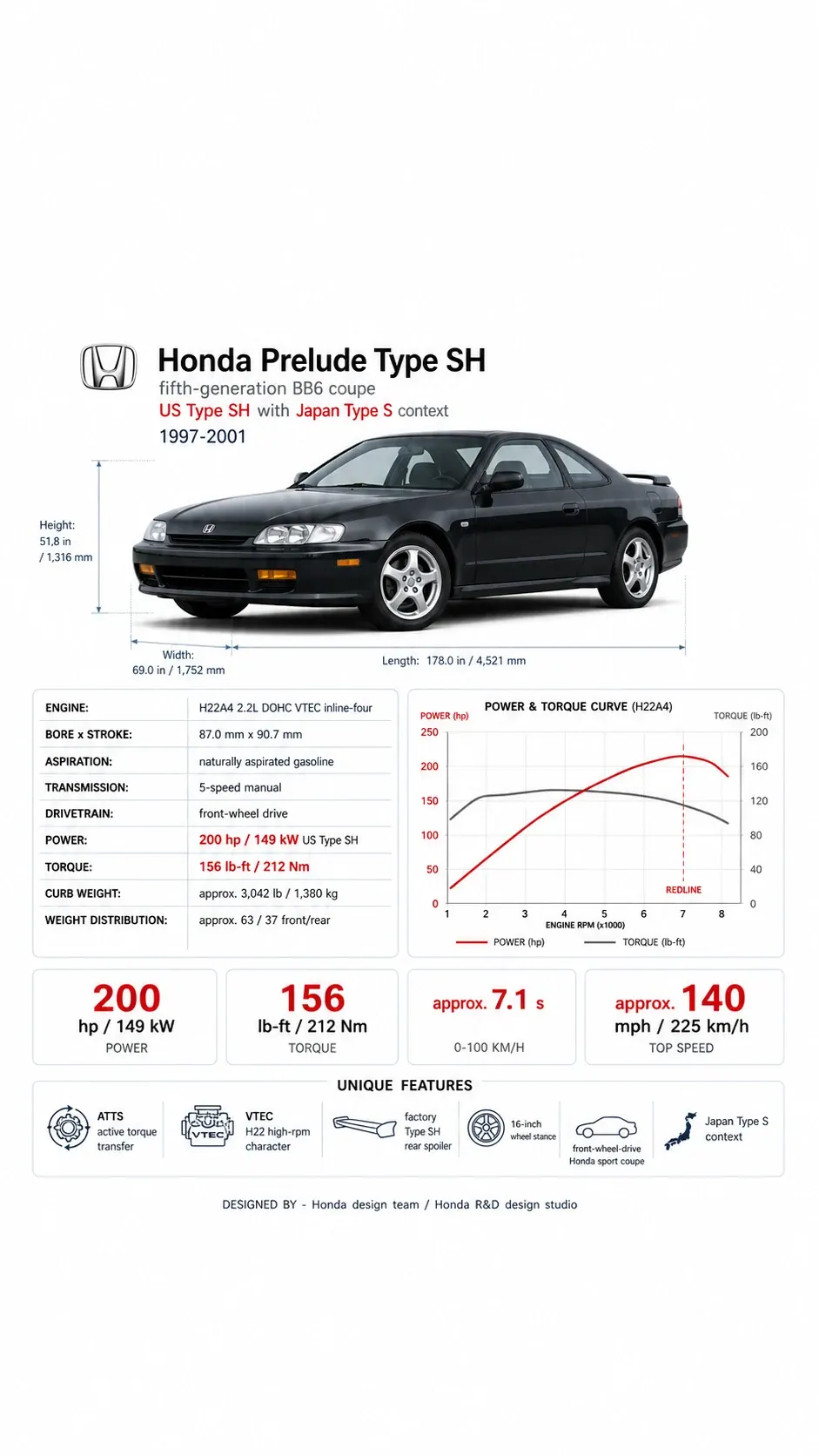
The Honda Prelude Type SH is one of the more interesting late-1990s Honda coupes because it is not just a normal Prelude with a spoiler. Its signature feature is Active Torque Transfer System, Honda’s front-drive torque-transfer hardware that was meant to make the car rotate more eagerly under load. Combined with the H22A4 DOHC VTEC inline-four and a five-speed manual, the SH gives buyers a more technical and more specific reason to care than the usual “old Honda coupe” pitch.
The right car is a documented, stock or lightly improved Type SH with working ATTS, clear timing-belt and water-pump history, manageable oil consumption, a clean manual gearbox, healthy cooling behavior, intact warning lights, and no mystery wiring. The wrong car is a badge story with deleted ATTS, heavy tuning, vague service history, rust, trunk leaks, oil smoke, bad synchros, or a seller who cannot explain what makes the SH different.
Use the Japan-market Type S as context, not as a substitute fact sheet. A Type S can be more powerful and rarer, but it requires import documentation, engine-code proof, market-specific parts awareness, and careful separation from US-market Type SH specifications. The smart answer is simple: buy the exact car in front of you only after proof, not because the badge sounds special.
Why It Matters
The Prelude was Honda’s technology coupe, and by the fifth generation it had matured into something different from a light Civic-style tuner shell. The fifth-generation car is more of a refined, long-door sport coupe with a high-revving engine, clean proportions, and an engineering story that still feels unusual today. That story is strongest in the Type SH because ATTS gives the car a factory handling hook that most front-drive coupes of the era did not have.
That matters for buying because the Type SH’s strength and risk are the same thing. A working ATTS car feels more special than the horsepower figure suggests. A broken, deleted, or misunderstood ATTS car can become a harder-to-source version of a normal Prelude. If you only want the H22 engine for a swap or big power, the SH may not be the path of least resistance. If you want Honda’s factory experiment in making a front-drive coupe feel more deliberate at corner exit, the SH is the one to inspect.
The market also rewards originality differently than it rewards modification. Clean, lower-mileage, record-backed cars are not priced like tired high-mileage cars. At the same time, a high asking price does not erase title issues, insurance history, poor paintwork, missing records, or system faults. This is why the article treats ATTS proof, trim proof, H22 condition, and current price together instead of as separate topics.
Buyer Fit
The best Prelude Type SH buyer wants an analog Honda coupe and has enough patience to preserve it. They care about a car that feels tight, stock-correct, and mechanically honest. They understand that the H22 likes maintenance, that old Honda seals and rubber age, and that a rare trim can make sourcing parts slower. This buyer is willing to spend money on timing service, tires, brakes, suspension refresh, inspection, and documentation before chasing horsepower.
The Type SH is not ideal for someone who wants the cheapest daily driver, a first project where every repair must be common and easy, or a big-power build that ignores factory systems. A base Prelude, RSX Type-S, Integra, or newer Civic/Accord path can make more sense for heavy modification or daily parts availability. The SH earns its place when the buyer values its factory personality enough to protect the hardware that creates it.
If you are shopping emotionally, slow down at the first call with the seller. Ask whether the car is a real Type SH, whether ATTS works, whether there are warning lights, when the timing belt was done, whether it uses oil, whether the manual transmission grinds, whether the body has rust or leaks, and what has been modified. A seller who can answer cleanly is worth your time. A seller who only repeats “rare Honda” is not.
Variants, Options, And Trim Proof
The main boundary is US Type SH versus related Japan-market Type S context. For a US-market Type SH, the baseline is the fifth-generation Prelude coupe with H22A4 power, front-wheel drive, a five-speed manual, and ATTS as the defining trim hardware. For Japan-market Type S context, the H22A and higher-output specification belong in the article only when they are labeled as Japan-market context. Mixing the two turns a useful buyer guide into bad data.
Do not assume exact installed equipment from a badge. A seller photo, VIN history, window sticker, build-sheet equivalent, import paperwork, factory brochure match, or detailed records should prove the claim. Sunroof, spoiler, wheels, interior equipment, audio, warning-light behavior, and chassis/trim identifiers all help, but none should replace documentation. Imported Type S cars need extra care because market paperwork, emissions legality, parts support, and prior repair history may be less familiar to a local inspector.
There are also year and source caveats around output. US Type SH references can appear as early 195 hp context and later 200 hp context, while Japan Type S material can point to 220 PS. Those numbers should not be collapsed into one universal Prelude claim. For a specific car, verify model year, market, engine code, and trim before using a number to judge price.
Specs That Matter
| Item | Buyer baseline |
|---|---|
| Core model | Fifth-generation Honda Prelude coupe |
| US focus | Type SH, H22A4, five-speed manual, ATTS |
| Japan context | Type S / related high-output H22A context |
| Engine layout | Transverse naturally aspirated 2.2L DOHC VTEC inline-four |
| Drivetrain | Front-wheel drive |
| US output context | 195-200 hp depending on year/source context |
| Japan Type S context | 220 PS context, not a US SH claim |
| Key hardware | Active Torque Transfer System |
| Body style | Two-door sport coupe |
The practical spec is not just horsepower. The car is valuable because it combines a high-rpm VTEC engine, a manual gearbox, a rigid-feeling Honda chassis, and ATTS. A buyer should care more about whether those pieces still exist and work together than whether an ad repeats the highest number from a different market.
The H22A4 is an interference-era maintenance conversation, not a disposable accessory. Timing belt, water pump, balance-shaft belt, seals, cooling condition, oil level discipline, and any signs of smoke or overheating matter. A clean valve cover does not prove engine health. A stack of records, compression/leakdown confidence, stable temperature behavior, and a clean cold start carry more weight.
Current Price Check
Current price evidence checked on May 17, 2026 shows a wide market. The package price packet includes a Hagerty guide result, two Edmunds live listing observations, a Cars.com listing observation, and recent Bring a Trailer auction results. The useful observed spread is roughly $7,500 to $29,999, but that range is too wide to use without context. It includes high-mileage budget examples, mid-teen auction results for clean documented cars, and optimistic dealer asking prices.
The practical good-buy target is more useful than the raw spread. A clean, stock or lightly improved manual Type SH with working ATTS, records, good paint/body condition, clean title, no major rust, and convincing H22 maintenance is most defensible around the low-to-mid teens, roughly $12,000-$17,000 in the current evidence set. A high-mileage car with needs can be a $7,000-$10,000 conversation only if the expensive risks are already priced in. A car above $20,000 needs exceptional mileage, originality, documentation, clean history, and minimal unresolved work.
Do not confuse asking price with sale price. A $29,999 dealer listing may describe a rare low-mileage car, but an insurance-loss note, title history, or unanswered maintenance question changes the value. Likewise, a cheap 196,000-mile listing is not automatically a bargain if it needs timing service, gearbox work, rust repair, ATTS diagnosis, or engine work. The number is only smart after the inspection proves which bucket the car belongs in.
Inspection First
Start with identity. Confirm whether the car is a real Type SH, a base Prelude with added badges, or an imported/Japan-market Type S. Check VIN and title history, seller paperwork, trim identifiers, ATTS equipment, and market-specific documents before emotional test-drive impressions take over. If the seller claims Type S, ask for import documents, engine-code proof, and clear market history.
Next, check ATTS behavior. At key-on, warning lights should behave normally. On a scan, fault codes should be understood, not dismissed. Look for signs the system was deleted, bypassed, or made irrelevant by a swap or tuning path. The SH’s identity depends on this hardware; treating it as optional is how buyers overpay for the wrong car.
Then inspect the H22 and drivetrain. Ask for timing-belt, water-pump, balance-shaft belt, valve-cover, cam-plug, coolant, and oil records. Watch for smoke, poor idle, overheating, oil leaks, coolant neglect, and improvised wiring. During the test drive, pay attention to clutch engagement, gear selection, fifth/reverse complaints, grind, pop-out, and drivetrain noises. A Honda manual can be excellent, but age and abuse still matter.
Finally, inspect the body slowly. Rear quarters, rocker areas, jack points, trunk floor, sunroof drains, seals, water entry, mismatched paint, VIN tags, and crash repairs can turn a fun coupe into a restoration problem. A clean-looking car in photos can still hide water or rust. Bring a flashlight, check under trim where reasonable, and do not let rare-trim excitement shorten the inspection.

Technical Reliability
The H22 is the reason the Prelude feels alive. It likes revs, has real character, and gives the car a different flavor than a lower-output commuter Honda. The cost side is that the engine deserves specific maintenance. Timing service should be current and documented. Oil consumption should be discussed honestly. Cooling-system behavior should be stable. Any smoke, misfire, overheating, or vague rebuild history should be priced as real risk.

The FRM cylinder-wall discussion is another reason to avoid casual assumptions. The article should not turn that into panic, but it should make buyers careful about oil use, compression, and rebuild path. A neglected engine can be more complicated than the phrase “old Honda four-cylinder” suggests. For a good car, that simply means records and inspection. For a bad one, it means walking away before the badge gets expensive.
ATTS is the second reliability gate. When it works, it is the SH’s personality. When it does not, parts knowledge and diagnostic familiarity matter. The system can also complicate modification choices, which is why big-power plans and mystery ECU/wiring changes deserve skepticism. A stock or mildly refreshed SH is easier to defend than a half-finished build where nobody can explain what happened to the factory systems.
Interior, Electronics, And ATTS Signals
The cabin is not only a comfort check. It is evidence. A clean, original interior with intact warning lights, normal switch behavior, factory-style wiring, and a complete gauge cluster supports the story that the car was cared for. A missing bulb, hacked steering wheel wiring, loose aftermarket alarm, cut audio harness, unexplained ECU changes, or dead warning lights should slow the purchase down.
The Prelude’s interior also reveals how the car was used. Worn bolsters, broken trim, water smell, damp trunk carpet, sunroof issues, and nonfunctional electronics are not unusual old-car checks, but they matter more when parts are not as easy as common Civic pieces. Inspect the seating, shifter, pedals, steering wheel, HVAC, sunroof, windows, locks, and all warning lights before you negotiate.

Use the interior check as a story check, not just a comfort check. A believable Type SH should have a cabin that matches the seller’s claims: manual-shifter focus, intact warning lights, normal electrical behavior, and wear that fits the mileage and maintenance story.
Ownership Budget
The best ownership plan is maintenance-first. Tires, brakes, suspension refresh, fluid service, timing work, engine diagnostics, and clean electrical repairs come before performance parts. A tight, stock-feeling SH is the good version of this car. A cheap one with deferred maintenance can consume the money that made it look like a deal.
Parts availability deserves realistic expectations. The Prelude has Honda durability appeal, but that does not mean every SH-specific piece is as easy as a common Civic or Accord component. ATTS-related parts, trim pieces, interior parts, certain drivetrain details, and clean body panels can take time. That does not make the car a bad buy; it means you budget like you are buying a specific old coupe, not generic transportation.
This article may eventually include paid or affiliate links. Any recommendations should stay tied to the exact car and exact fitment: vehicle-history checks, inspection support, maintenance parts after VIN/trim confirmation, and conservative baseline refresh items. Universal power parts, vague upgrade lists, and unverified fitment should not be presented as buyer guidance.
How It Compares
An Integra Type R is sharper and far more collectible, but it usually lives in a different price, theft-risk, and preservation category. An RSX Type-S is newer, K-series powered, and often easier to support, but it does not have the same late-1990s Prelude identity. A Toyota Celica GT-S gives high-rpm four-cylinder energy with less ATTS complexity. A Nissan 240SX is rear-drive and modification-friendly, but clean stock examples bring their own demand and drift-market baggage.
The Prelude’s lane is narrower. It is for someone who wants Honda’s technology-coupe feel, the H22’s rev-happy character, and ATTS as a factory curiosity worth preserving. If you want the fastest car for the money, it is not the obvious answer. If you want the most distinctive front-drive Honda coupe of its era, it has a stronger case.
This package does not publish competitor price targets because the current MxInfo3 price packet was scoped to the article car. If a future revision adds a price table against Integra Type R, RSX Type-S, Celica GT-S, or 240SX, each competitor needs its own current six-source price check before public copy uses numbers.
Modification Boundary
Modified cars are not automatically bad. A well-documented car with quality suspension refresh, good tires, careful maintenance, and reversible period-correct upgrades can be excellent. The issue is undocumented systems work. Engine swaps, ECU changes, wiring changes, missing ATTS, transmission swaps, turbo or supercharger installs, emissions changes, and half-finished suspension work all need receipts and a coherent explanation.
For the Type SH, modification has a sharper boundary because ATTS is central to the trim. If the car has been changed in a way that removes or confuses that system, value should change. If the goal is a big-power project, a different Prelude or Honda platform may be smarter. If the goal is a special factory Honda coupe, keep the car close to what made it special.
When negotiating, ask for the modification list before you drive. Compare the list to the physical car. Look for missing heat shields, odd vacuum routing, spliced wires, aftermarket alarm residue, questionable engine mounts, mismatched suspension, leaking dampers, non-OEM sensors, and unsupported claims. A seller who understands the work can usually explain it clearly.
Next Action
Before visiting the car, ask for the VIN, title status, trim proof, ATTS status, timing-service records, oil-consumption notes, gearbox history, cold-start video, modification list, underbody photos, trunk photos, and interior warning-light video. If the seller avoids those basics, do not reward the listing with a long trip.
At the car, scan it, check every warning light, test every switch, inspect the body and trunk for water, drive it long enough to feel the gearbox warm and cold, watch temperature behavior, and listen for suspension or drivetrain noise. The right Prelude Type SH should make you feel like the records, body, engine, and systems all tell the same story.
If it passes, negotiate from evidence. If it fails, leave cleanly. There will always be another rare-sounding listing. The smart Type SH buy is the car where the badge, hardware, service records, and price agree.
FAQ
Is the Type SH better than the base Prelude?
It is better if you specifically want ATTS and the factory SH handling story. It is not automatically better for swaps, big power, easiest ownership, or cheapest repairs.
Is the Japan-market Type S the same as the Type SH?
No. Treat the Type S as related context, not the same car. Verify import paperwork, engine code, trim equipment, and market-specific parts separately.
What is the biggest red flag?
Missing timing-belt history is the easy one. After that, watch for deleted or faulty ATTS, oil smoke, bad synchros, rust, trunk leaks, water smell, hacked wiring, and title-history problems.
What should a clean one cost?
The current evidence supports a broad spread. A good documented manual Type SH is most defensible in the low-to-mid teens, while high-mileage cars with needs should be much cheaper and exceptional low-mileage cars need exceptional proof to justify prices above $20,000.
Should I buy a modified one?
Only with documentation. Mild maintenance-focused upgrades can be fine. Undocumented engine, ECU, ATTS, transmission, wiring, or forced-induction changes should be priced as risk until proven otherwise.
FAQ
Common questions
Is the Type SH better than the base Prelude?
It is better if you specifically want ATTS and the factory SH handling story. It is not automatically better for swaps, big power, easiest ownership, or cheapest repairs.
Is the Japan-market Type S the same as the Type SH?
No. Treat the Type S as related context, not the same car. Verify import paperwork, engine code, trim equipment, and market-specific parts separately.
What is the biggest red flag?
Missing timing-belt history is the easy one. After that, watch for deleted or faulty ATTS, oil smoke, bad synchros, rust, trunk leaks, water smell, hacked wiring, and title-history problems.
What should a clean one cost?
The current evidence supports a broad spread. A good documented manual Type SH is most defensible in the low-to-mid teens, while high-mileage cars with needs should be much cheaper and exceptional low-mileage cars need exceptional proof to justify prices above $20,000.
Sources and references
- Honda Global Active Torque Transfer System technology history
- Honda Global 1998 Prelude SiR S Spec release
- Honda US 2001 Prelude brochure PDF
- Honda 2000 Prelude online owner's manual
- NHTSA recalls lookup
- Edmunds 2001 Honda Prelude review
- Edmunds 2001 Honda Prelude Type SH consumer reviews
- Cars.com 2001 Honda Prelude review and consumer ratings
- Kelley Blue Book 2001 Honda Prelude consumer reviews
- Hagerty 2001 Honda Prelude valuation configuration page
- Car and Driver 1997 Honda Prelude SH archive test
- Car and Driver 1997 Honda Prelude SH long-term test wrap-up
Topic hubs
Tags

