


The Honda Accord Type R is easy to misunderstand. It looks like a sensible four-door Accord, and that makes some buyers expect a cheap old sedan with a loud engine. The better way to read it is as a focused, manual, front-drive performance car that happens to have rear doors and real daily usefulness. The European CH1 Accord Type R and the Japanese CL1 Accord Euro R are close enough to compare in one buyer guide, but they are not the same car and should not be priced, imported, or inspected as if the badges are interchangeable.
This guide treats the CH1 as the main public article car and uses CL1 evidence where it helps explain import alternatives, output differences, and current market context. The safest buying advice is simple: buy the cleanest shell with the best history, not the cheapest VTEC badge. Rust, gearbox feel, missing Type R equipment, questionable modifications, and poor paperwork can turn a tempting Accord into a long restoration project.
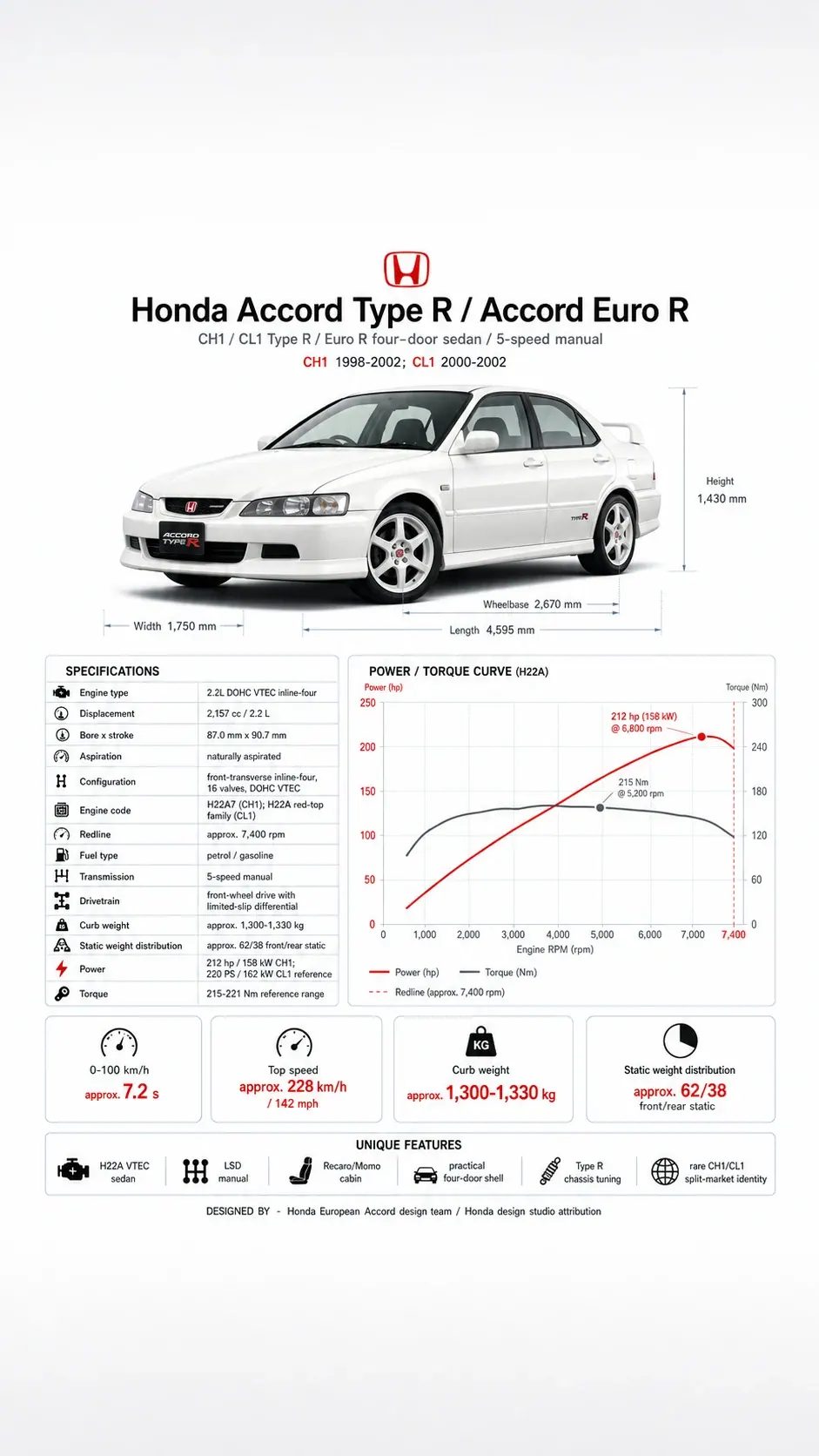
Quick Verdict
Buy an Accord Type R if you want a practical, naturally aspirated, high-revving performance sedan and you are willing to inspect it like an aging enthusiast car, not like a normal used Accord. A strong one gives you the best part of the old Honda Type R formula: an eager 2.2-liter VTEC engine, manual gearbox, limited-slip front-drive traction, Recaro-style cabin focus, and a body that still works as a useful sedan.
Do not buy one just because it looks cheap beside newer performance cars. The value is in a straight, documented, original or intelligently maintained shell. A rusty example with tired suspension, vague shifts, cheap modifications, and incomplete paperwork can eat the price gap quickly. The right buyer is patient and condition-led. The wrong buyer shops only by horsepower, badge, or a low asking price.
Spec Boundary: CH1 Type R Versus CL1 Euro R
The European Accord Type R is usually discussed as the CH1. The Japanese Accord Euro R is usually discussed as the CL1. They share the same general idea: sixth-generation Accord sedan, high-revving H-series VTEC power, manual gearbox, front-wheel drive, and a more serious chassis than a normal family Accord. The differences matter because public copy, parts advice, price advice, and import decisions change when the car is a Japan-market CL1 instead of a UK or European CH1.
For this article, treat CH1 figures such as the H22A7, roughly 212 hp / 158 kW, and European-market equipment as CH1-specific. Treat CL1 figures such as commonly listed 220 PS / 162 kW red-top H22A context as CL1-specific. If a seller advertises one car with facts from the other, slow down and verify. A good listing should make the chassis, market, paperwork, engine identity, and equipment clear.
What Makes It Special
The Accord Type R is special because it does not behave like a generic warmed-over sedan. Honda took a practical body and gave it a focused engine, manual gearbox, sharper chassis tuning, more serious cabin hardware, and enough restraint to keep it usable. That mix is why the car has a strange appeal today: it is not as obvious as an Integra Type R, not as common in conversation as a Civic Type R, and not as luxury-focused as a German sport sedan.
The appeal is also fragile. A tired Accord Type R can feel like a noisy old Accord with parts bills. A good one feels lighter on its feet than the shape suggests. It wants revs, responds to commitment, and rewards a driver who likes front-drive balance instead of brute torque. That means condition and originality are not cosmetic extras. They are central to whether the car still delivers the reason it exists.
Engine And Gearbox
The engine is the core event. In CH1 form, the H22A7 is a 2.2-liter naturally aspirated DOHC VTEC inline-four. In CL1 context, buyers will often see red-top H22A references and slightly different output claims. Either way, the point is the same: this car is about revs, response, and mechanical character, not turbocharged shove. It should pull cleanly, sound eager, and feel like it wants to work in the top half of the tachometer.
The gearbox is just as important. A five-speed manual and factory limited-slip differential are part of the reason the car works as a serious front-drive sedan. On inspection, do not let a seller rush the test drive. Check cold and warm shift quality, second and third gear engagement, clutch take-up, drivetrain vibration, and whether the limited-slip behavior feels natural rather than abused. A strong engine in a car with a tired gearbox is not a bargain. It is a negotiation point or a walk-away signal.
How It Drives
A good Accord Type R should feel more precise than its ordinary body shape suggests. The steering, LSD, gearing, and engine character work together to make it a car you drive with rhythm. It is not a modern grip monster, and it should not be sold to the reader as one. Its best quality is the way it turns a useful four-door sedan into something that encourages clean inputs, high revs, and confident corner exits.
The age of the car changes the test. If the suspension is tired, bushes are old, brakes are cheap, or tires are mismatched, the car will not show its character properly. That can make a bad example feel underwhelming even if the engine is healthy. Budget for refresh work unless there is evidence it has already been done. The right car should feel composed, direct, and mechanically honest. The wrong one will feel loose, noisy, and expensive before the VTEC novelty wears off.
Interior And Daily Use

The cabin helps separate the Type R from a normal Accord. Recaro-style seats, Momo steering wheel references, Type R trim cues, and the manual driving position give the car its enthusiast identity. The useful part is that it remains a sedan. You can carry people, use the trunk, and live with the car in a way that smaller Type R models or more compromised imports may not allow.
That practicality is a real buying advantage, but it also means many cars were used hard in ordinary life. Check seat bolsters, steering wheel wear, carpets, boot floor, water leaks, switchgear, heater and air-conditioning operation, and signs that interior parts have been swapped. Missing or damaged Type R-specific cabin pieces are not always cheap or easy to replace. A tidy cabin supports the story that the car was valued. A rough cabin does not prove abuse by itself, but it should lower your confidence until the mechanical and body checks support the asking price.
Reliability And Inspection

Rust is the first inspection gate. Look at rear arches, sills, jacking areas, floor edges, inner seams, boot floor, spare-wheel well, suspension mounting areas, and any area hidden by trim. Do not rely on fresh underseal or a shiny exterior. A clean-looking Accord can still hide expensive metal work. If you cannot inspect underneath, treat the car as unproven.
Mechanical checks should be just as structured. Ask for timing belt and water-pump history, fluid records, clutch history, suspension refresh evidence, brake condition, tire quality, and proof that the car was maintained as a performance model. Listen for knocks, smoke, overheating, idle problems, and driveline noise. None of these checks are exotic, but they matter because the car is old enough that neglect can outrun the purchase price. The best examples are not merely fast. They are documented, dry, straight, and consistent.
Price And Value
Current market evidence is scattered, so use price ranges carefully. Recent and current listing references show everything from lower auction or classified numbers around the mid-thousands to clean or imported CL1 references that can push toward five figures in dollars or pounds after condition and market context are considered. A rough buyer frame is GBP 7,000-9,000 for a genuinely clean UK CH1, with cheaper cars needing hard body checks, and roughly USD 10,000-12,000 for a solid imported CL1 before local fees, taxes, and registration details.
Do not turn that into a rigid valuation table. Condition, originality, paperwork, rust repair quality, import status, market region, mileage, and modifications can all move the number. A cheaper rusty car can be worse value than an expensive documented one. A modified CL1 can be tempting, but only if the paperwork, parts quality, and inspection story are strong. The best advice is to price the body first, then the drivetrain, then the rare equipment.
CH1 Versus CL1 Buying Advice
A CH1 makes the most sense if you want the European Accord Type R story and want simpler local-market context in the UK or Europe. A CL1 Euro R makes sense if you specifically want the Japanese-market version and accept the import work that comes with it. Neither is automatically better for every buyer. The better car is the one with the cleaner shell, clearer history, correct equipment, and fewer unresolved questions.
For CL1 imports, verify paperwork, chassis identity, auction or export records when available, mileage documentation, corrosion state, parts support, insurance, and registration status. For CH1 cars, verify body condition and whether the car still has the equipment and feel that justify the Type R badge. If a seller mixes CH1 and CL1 claims, ask for proof rather than arguing from memory. The badge is desirable, but the proof is what protects the buyer.
Ownership Costs
The Accord Type R can be a sensible enthusiast car only if you budget like it is a specialist old Honda. It is not expensive because every part is exotic. It becomes expensive when the buyer assumes old Accord equals cheap Accord. Suspension work, brakes, tires, clutch work, rust repair, interior trim, import-specific parts, and Type R-specific details can all matter at the same time.
A smart buyer sets aside money after purchase instead of spending every dollar on the asking price. Start with fluids, belts if history is unclear, alignment, tire quality, brake condition, and a suspension inspection. Keep the car close to its factory identity unless modifications are documented and reversible. The strongest long-term examples will be the ones that still feel like Accord Type Rs, not cars that were stripped of their identity chasing short-term speed.
Who Should Buy One
The Accord Type R suits a buyer who likes naturally aspirated Honda engines, wants a manual front-drive car, and values the contradiction of a serious driver car in a practical sedan body. It is also for someone who enjoys a car with a story that is not obvious to everyone at a stoplight. If you want daily usefulness with old Honda feel, the car makes sense.
It is not ideal if you want easy parts availability everywhere, effortless modern torque, a soft ride, or an inspection-light purchase. It also may not suit buyers who want the cheapest possible Type R badge. You need to care about provenance, condition, and whether the car still has its factory character. The reward is a sedan that feels more special than its shape implies. The risk is paying enthusiast money for a tired car that no longer drives like the evidence says it should.
Sources And Methodology
This guide uses source research, specialist buyer-guide sources, model-specific Honda Type R references, owner/user evidence, and accepted provider visuals. CH1 and CL1 facts are kept separate where market, engine, output, paperwork, or import context can change the buying advice. Owner evidence is treated as qualitative signal, not as a statistical reliability study.
Current prices, import fees, registration requirements, insurance acceptance, and individual vehicle condition are live checks. Verify the exact chassis, paperwork, rust condition, gearbox behavior, service history, and Type R equipment before treating any asking price as fair.
Final Recommendation
Buy the Honda Accord Type R or Accord Euro R only when the car passes the body, gearbox, equipment, history, and price logic together. A clean, original, documented example is one of the more interesting ways to own the old Type R idea without giving up sedan practicality. It is quick enough to matter, useful enough to live with, and specific enough to feel special.
Walk away from rust, vague shifts, missing proof, careless modifications, and sellers who cannot explain whether they are selling a CH1 Type R or CL1 Euro R. This is not a car to buy blind from excitement. It is a car to buy after the evidence lines up. When it does, the Accord Type R is more than a forgotten Honda. It is the practical VTEC sedan that rewards patience.
Buyer Notes To Keep The Search Honest
The most useful way to shop this car is to separate emotion from verification. The engine note, Type R badge, and four-door usefulness can make a weak car feel tempting in the first ten minutes. The purchase should not be decided in those first ten minutes. Photograph the lower body, ask for lift access when possible, check whether the seller can explain the chassis and market version, and compare the price with the work still required. A car with lower mileage but hidden corrosion can be worse than a higher-mileage car with honest history and a dry underside.
For a CL1, add import questions before enthusiasm. Ask how the car entered the country, whether registration and compliance are settled, whether the mileage story is supported, and whether any modifications affect insurance, emissions, or parts supply. For a CH1, focus on whether it still feels like a Type R rather than a normal Accord wearing a badge. The best purchase is the car whose condition, paperwork, equipment, and price all tell the same story.
The final check is whether the car still has a coherent identity. A clean CH1 should not need borrowed CL1 claims to justify its value, and a CL1 should not be sold as a casual local-market substitute without import proof. Treat repaint quality, wheel choice, ride height, interior completeness, service invoices, and seller knowledge as part of the evidence package. When those details agree, the car can be a rare practical performance sedan with real character. When they conflict, keep looking.
FAQ
Common questions
What is the difference between the CH1 Accord Type R and the CL1 Accord Euro R?
The CH1 is the European Accord Type R baseline, while the CL1 is the Japan-market Accord Euro R context. Treat chassis, market, engine output, paperwork, parts, and pricing as version-specific instead of mixing claims from both cars.
Is the Honda Accord Type R a good daily driver?
It can be, because it keeps a usable four-door sedan body, but it should be bought as an aging specialist Honda. Rust, suspension condition, gearbox feel, interior parts, and service history matter more than the badge alone.
What should I inspect first on an Accord Type R?
Start with rust around rear arches, sills, jacking points, floor edges, seams, and the boot floor. Then verify timing-belt history, clutch and gearbox behavior, Type R equipment, modifications, and import or registration paperwork.
Should I buy a cheaper rusty Accord Type R?
Usually no. The source package treats body condition as the first value gate because metal work, missing Type R pieces, and vague paperwork can outrun the savings from a cheaper asking price.
Topic hubs
Tags

