


Quick Answer
The Ford Escort RS Cosworth is worth caring about because it is not just a quick Escort with a famous spoiler. It is a factory homologation road car built around Cosworth turbo power, four-wheel drive and a body that made the rally connection visible from half a street away. The large rear wing is the hook, but the car’s value comes from proof: correct identity, shell condition, original hardware where it matters, credible service history and a clear answer on whether the car is an early big-turbo example or a later small-turbo road car.
For a buyer, the best answer is rarely the cheapest car or the highest-boost car. A usable, documented Escort RS Cosworth with a clean shell and sensible maintenance history is usually the better buy than a cheaper car carrying mystery repairs, vague import history, patchy corrosion work or years of undocumented tuning. The market now prices these cars like collector machinery, so the inspection needs to treat the car as a special Ford first and a nostalgia object second.
The short version is simple: buy the story only when the car proves the story. The wing, arches and Cosworth badge create desire, but the value lives in the matching evidence. A car with calm boost behavior, clean underside photos, believable mileage trail, known turbo-era identity and sensible invoices can be a deeply satisfying collector driver. A car that asks the buyer to trust a few dramatic photos and a vague RS description should be left alone until the proof catches up.
What Makes The Escort RS Cosworth Different
The RS Cosworth feels different from ordinary Escort performance models because the road-car story sits closer to Sierra Cosworth and Group A logic than to a normal hot hatch. The proportions look Escort at a glance, but the wide arches, deeper bumpers, vented bonnet and wing make it obvious that the shape had a homologation job to do. That visual aggression is not a styling kit that can be copied onto a normal shell and treated as equal; the factory car’s identity is tied to the drivetrain, structure, trim, documentation and period Ford RS engineering.
That distinction matters in the article because many readers meet the car through images and auction headlines. A normal Escort with a body kit can imitate the silhouette. It cannot become a factory RS Cosworth with the same market meaning. The strongest cars are the ones where the paperwork, chassis identity, mechanical specification and physical details all tell the same story. When any of those disagree, the price should stop looking like a discount and start looking like risk.
Exact Spec Boundary
This guide is about factory Ford Escort RS Cosworth road cars from the 1992 to 1996 production window. It includes the important split between early big-turbo cars and later small-turbo T25 cars, but it does not treat competition Escort Cosworth rally cars, ordinary Escort hatchbacks, Sierra RS Cosworth models, RS2000s, replicas or body-kit conversions as the same thing. That boundary is important because the Escort RS Cosworth name gets used loosely in listings, forum shorthand and social posts.
The exact car being inspected should prove itself before the article’s normal advice becomes useful. Check the identity documents, VIN consistency, RS-specific details, engine and drivetrain evidence, history file, old MOT or inspection notes where available, and whether the body has been repaired after corrosion or accident damage. Factory paint, trim and equipment can vary, and many cars have been modified, but the seller should be able to explain what changed, when it changed and whether original parts remain with the car.

Big Turbo Versus Small Turbo
The big-turbo versus small-turbo split is one of the most important Escort RS Cosworth details because it changes both character and value conversation. Early big-turbo cars carry more of the raw homologation drama. They are the versions many collectors picture first, with more lag, stronger event value and a closer mental link to the rally-car image. Later small-turbo T25 cars are often described as easier road cars because the power delivery is more accessible, even if they do not have the same early-car mythology.
Neither version is automatically the right answer. A tired big-turbo car with missing history can be a worse buy than a sharp, documented later car. A clean early car with original details and a credible maintenance path can deserve a premium. The article should not flatten the two into one claim. It should help the reader identify which turbo era is in front of them, then price and inspect the car through that exact context.
Performance And Drivetrain
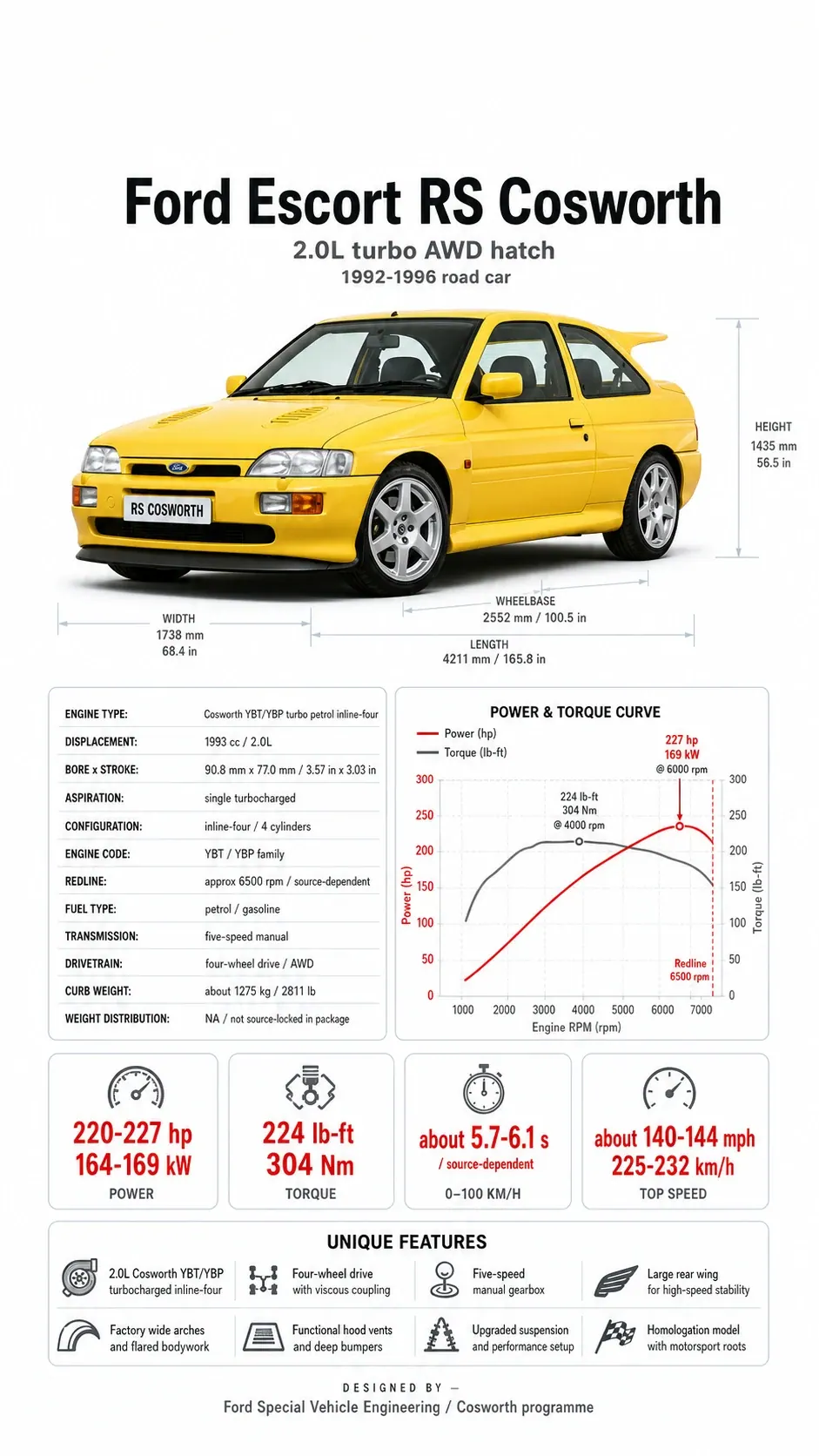
The Escort RS Cosworth’s numbers still explain the appeal. A turbocharged 2.0-liter Cosworth inline-four, five-speed manual gearbox and four-wheel-drive layout give the car a serious mechanical core for its era. Depending on source and variant, output is usually quoted around the low-220-hp range, with torque strong enough to make the car feel much more muscular than a normal compact hatchback. Weight sits around the high-1200-kg range, so the car has enough mass to feel substantial without losing the compact-road-car character.
The driving promise is traction, boost and old-school feedback rather than modern effortless speed. That is also where inspection becomes important. Turbo health, boost control, cooling, driveline noise, clutch behavior, differentials, transfer hardware, fuel system and old wiring can all change the buying equation. A car that feels exciting on boost but vague in its history should not get a pass just because it performs in a short test drive.
Healthy cars should feel cohesive, not merely loud or boosted. The engine should build pressure cleanly, idle and restart without drama, hold temperature, pull without detonation or hesitation and leave no mystery smoke trail. The gearbox should not feel like it is masking abuse, and the four-wheel-drive hardware should not add clunks, binding or vibration that the seller waves away as character. A careful road test is less about chasing maximum acceleration and more about confirming that the expensive systems still work together.
The Wing And Rally Bodywork
The wing is the reason casual observers remember the Escort RS Cosworth, but the better way to view it is as part of a full homologation visual package. The huge rear spoiler, flared arches, deep bumpers and bonnet vents create a shape that makes the car unmistakable. It is not subtle, and it should not be photographed or described as if subtlety is the point. This car’s design identity is its promise that the road version is close enough to rally logic to feel special.
For buyers, the bodywork also creates inspection work. Wide arches and special panels can hide poor repairs or replacement parts. Panel fit, paint match, corrosion at seams and mounting points, bumper condition, underbody repairs and evidence of previous accident damage deserve attention. A car that looks dramatic in photos still has to prove that its shell is straight, dry and correctly repaired.
Reliability And Common Faults
The Escort RS Cosworth is not a normal low-stress commuter car, but it is also too simple to call it fragile without context. Reliability depends heavily on maintenance quality, modification history and how honestly the car has been used. The Cosworth turbo engine needs proper servicing, clean cooling, correct fueling and sensible boost control. Old hoses, tired sensors, poor mapping and neglected ignition or fuel components can make a good car feel troublesome.
The drivetrain deserves the same respect. Four-wheel-drive hardware, clutch condition, gearbox feel, differential noise and vibration under load tell you more than a polished engine bay. Many cars have been modified because the platform responds well to power upgrades. That is part of the culture, but it also means the buyer must separate careful, documented work from old boost chasing. A standard-looking car is not automatically better, and a modified car is not automatically wrong, but the paperwork needs to match the claim.
Rust And Inspection Checklist
Rust and repair quality can decide the car before the engine does. Inspect the underside, sills, arches, floors, suspension mounting areas, rear structure, front chassis legs, boot floor, door bottoms, screen surrounds and any previous welding. A lift inspection by someone who knows old Ford shells is not optional at this price level. Photographs taken from flattering angles cannot show enough of the truth.
The strongest inspection file includes underside photos, invoices, old MOT records, paint and repair explanations, compression or leakdown evidence when available, tuning documentation, dyno or mapping notes if modified, and proof that the car’s identity matches the listing. If the seller cannot explain the shell, the service history and the turbo-era details clearly, the car should be treated as unfinished research rather than a buy.

Interior And Equipment
The cabin is part of the ownership story because it shows how the car has lived. Correct seats, steering wheel, instruments, trim condition, switchgear, carpets, boot trim and age-sensitive plastics can all reveal whether the car has been cared for, stored, stripped, damp, crashed or rebuilt. A perfect cabin is not required for a usable driver, but a confused cabin should push the buyer back toward the paperwork.
Interior claims also need caution. Market cars differ by year, region and specification, and many Escort RS Cosworths have been altered over three decades. Treat equipment as reference information until exact-car proof exists. A seller should be able to say what is original, what was replaced, what is missing and whether removed original parts remain available. For a collector, those details can move value.
Prices And Market Position
The current market treats the Escort RS Cosworth as a collector car, not a cheap 1990s performance Ford. Price guides, auction archives and active listings show a broad spread because mileage, originality, shell condition, turbo era, country, history and modification quality change the value sharply. A rough usable-car range around the middle of the market can make sense for documented drivers, while exceptional low-mile or unusually original examples can push far past normal buyer budgets.
The useful buy target is not the headline record price. It is the number at which the car’s body, identity, history and mechanical state all make sense. A documented, usable road car in the GBP 55,000 to 75,000 zone can be more rational than a cheaper car that needs hidden shell work or an expensive recommissioning. Very special examples deserve their own appraisal, but record-style auction results should be treated as outlier context rather than a normal shopping target.
Because the spread is so wide, the buyer should price the car by evidence buckets rather than by one universal guide number. A stock-looking car with patchy history is not automatically premium. A mildly modified car with original parts, excellent records and careful mapping can be more honest than a claimed untouched car with obvious repaint questions. Currency, import costs and local availability also matter. The public article range should therefore stay broad, but the recommendation should stay narrow: pay for proof, not for the loudest claim in the listing title.
Rivals And What To Buy Instead
The obvious alternatives are not all the same kind of purchase. A Sierra RS Cosworth or Sapphire Cosworth gives a more direct family connection to the drivetrain story. A Lancia Delta Integrale brings a different rally-homologation legend with its own rust, parts and market concerns. Subaru Impreza STI and Mitsubishi Evo models can deliver more modern pace and stronger parts ecosystems, but they do not carry the same Ford RS and big-wing collector identity.
That means the Escort RS Cosworth is best for someone who specifically wants the Ford RS story, the visual drama and the collector-market meaning. If the buyer mainly wants speed per dollar, there are cleaner routes. If the buyer wants the most usable all-weather performance classic, a later Japanese rally sedan may be easier. If the buyer wants the car that looks like a road-legal rally poster and still has serious Ford history behind it, the Escort remains difficult to replace.
The rival comparison also protects the reader from buying the wrong dream. The Sierra may satisfy the Cosworth powertrain itch with a different silhouette. The Integrale may satisfy the European rally-homologation itch with more Italian charisma and its own ownership challenges. The Subaru or Mitsubishi may satisfy the boost-and-traction itch with more modern usability. The Escort RS Cosworth should win only when the buyer wants the exact mix of Ford RS, compact hatch body, collector wing and documented 1990s homologation theatre.
Ownership Verdict
Buy the Escort RS Cosworth when the car proves itself as a real, documented, structurally sound road car. The best examples make the drama feel earned: correct identity, honest bodywork, clear maintenance, sensible modifications or valuable originality, and a seller who can explain the exact turbo-era and service story. Walk away from vague cars, badly repaired shells, confused paperwork, unexplained tuning and listings that lean only on the wing.
The car deserves its reputation because it combines visual theater with genuine hardware and rally-era purpose. That same reputation makes careless buying expensive. Treat the wing as the invitation, not the proof. The proof is underneath, in the history file, in the mechanical behavior and in the way every detail supports the same factory Escort RS Cosworth story.
A good purchase should leave the buyer with fewer questions after inspection than before it. The seller should welcome detailed checks, not rush past them. The files should explain the car’s life, the body should support the files, and the road test should support both. When those three layers line up, the Escort RS Cosworth still feels like one of the most charismatic fast Fords ever sold. When they do not, the safest move is to keep shopping, even if the car photographs beautifully.
FAQ
Is the big-turbo Escort RS Cosworth always better? Not always. Big-turbo cars usually carry more collector romance and early-car drama, but a clean later small-turbo car can be a better road buy if it has stronger condition and proof.
What is the biggest buying risk? Shell condition and poor repairs are the biggest first-pass risks, followed closely by undocumented tuning, weak service history and drivetrain issues hidden by a short test drive.
Should I buy a modified Escort RS Cosworth? Only if the work is documented, reversible where originality matters and supported by credible mapping, hardware and service records. A modified car without proof should be priced as risk, not as extra value.
FAQ
Common questions
What is the key Ford Escort RS Cosworth identity check?
Confirm factory RS Cosworth identity, VIN and documentation, RS-specific hardware, shell condition, turbo era, service history, and whether any modifications are documented.
Should I prefer a big-turbo or small-turbo Escort RS Cosworth?
Neither version is automatically the right buy. Early big-turbo cars carry more homologation drama, while later small-turbo cars can be easier road cars; condition and history decide value.
Sources and references
- Provider article package
- Visual handoff package
Topic hubs
Tags

