


Quick Answer
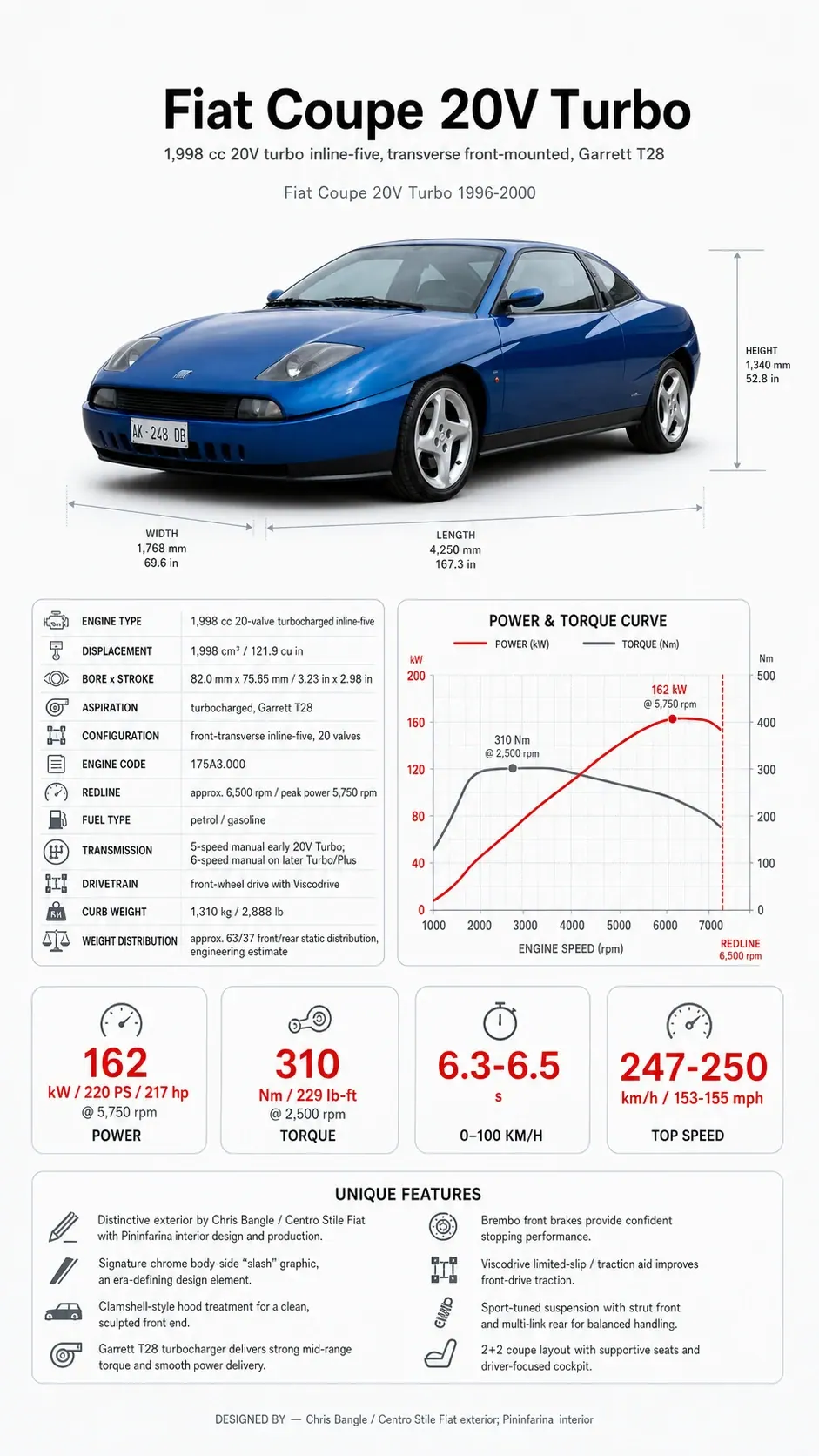
The Fiat Coupe 20V Turbo is the Fiat Coupe to take seriously if the question is more than styling. The Type 175 body gives you the strange Chris Bangle exterior, the Pininfarina cabin gives it the Italian showpiece feel, and the 2.0-liter 20-valve turbo inline-five gives it the reason enthusiasts still chase it. It is not just a quirky coupe with slash marks on the side. In 20V Turbo form it is a fast, noisy, front-drive oddball that can still feel special when the car is sorted.
The best example is not automatically the cheapest car, the highest-power modified car, or the one wearing the rarest trim label. The best example is the car with a solid shell, clear service history, proof of belt work, healthy turbo behavior, correct 20V Turbo identity, good brakes, and an interior that has not been ruined. LE and Plus cars can deserve more money when their equipment and history are documented, but those labels do not replace condition.
For most buyers, the smart range is a documented, usable car in the middle of the current European market. A low auction result can be real, but it usually needs an explanation. A high asking price can also be real, but it needs proof: body condition, records, originality, mileage, color, variant and recent work. Buy it because you want the weird design and the five-cylinder turbo character together, not because it is the cheapest route into 1990s performance.
Why The Shape Still Looks Strange
The Fiat Coupe still works because it does not look like a normal Fiat. The exterior came from Fiat’s own design team under Chris Bangle, while Pininfarina handled the interior and production context. That split matters. It explains why the car can wear Pininfarina badges while the outside looks far more aggressive and angular than many people expect from the name.
The body-side slash, the wide-looking fenders, the clamshell-style hood treatment, the busy front lighting and the short tail are not styling accidents. They are the car’s identity. A clean 20V Turbo should preserve those shapes instead of hiding them under generic tuner parts. The shape is also why color and body condition matter so much. Rust, poor paint, mismatched panels or awkward body kits damage more than resale value; they erase the reason the car is memorable.
Inside, the Pininfarina work makes the car feel more special than its Fiat badge might suggest. The body-color strip across the dash, rounded forms and driver-focused layout give the cabin a stronger identity than many contemporary coupes. That does not make it a luxury car, and it does not excuse sticky plastics or tired seats. It does mean the cabin should be treated as part of the car’s originality story, not just an old interior to tolerate.

The 20V Turbo Powertrain
The 20V Turbo is the variant that turns the Fiat Coupe from design object into serious performance car. The key facts are specific: 1,998 cc, five cylinders, 20 valves, turbocharging, about 162 kW or 220 PS, and 310 Nm. Those numbers belong to the later five-cylinder Turbo, not to every Fiat Coupe. The naturally aspirated 20V and earlier 16V Turbo deserve separate treatment because they do not create the same engine character or market pull.
The five-cylinder engine is the unusual part. Fiat did not simply build another four-cylinder hot coupe. The 20V Turbo has the sound, torque delivery and mechanical novelty that make people remember it after a test drive. A healthy car should pull hard from the midrange and feel eager without smoking, overheating, hunting, hesitating or masking problems with an aggressive tune.
That powertrain also raises the ownership bar. Belt work, fluids, cooling, turbo health, boost control and specialist knowledge matter. A seller who can explain the service history clearly is worth taking more seriously than one who only quotes the power figure. The engine is robust when cared for, but it is not a car to buy blind because the maintenance is old, specialist and packed tightly into the nose.
Performance And Front-Drive Traction
On paper, the 20V Turbo is still quick enough to feel credible. Period and specialist sources put it around the low-six-second range to 100 km/h and near 250 km/h at the top end. The more important point is how it delivers that performance. This is a front-drive turbo coupe with substantial torque, not an all-wheel-drive rally car or a balanced rear-drive sports car. The front tires, suspension condition and traction-aid hardware shape the experience.
A good 20V Turbo should feel urgent, alive and a little unruly without feeling broken. There can be torque steer and front-end effort, but it should not wander, clonk, pull randomly, or feel vague because wishbones, tires, alignment or steering parts are tired. If the car feels dramatic only because it is fighting itself, the buyer should slow down and inspect harder.
Brakes matter as much as boost. Turbo Coupes can be driven hard, and old brake fluid, tired discs, weak calipers or mismatched tires will make a fast car feel cheap. Treat a test drive as a systems check: cold start, warm idle, boost build, coolant temperature, braking, steering, clutch, gearshift and hot restart. The performance is the reward only after those basics behave.
20V Turbo, Limited Edition, And Plus
The Fiat Coupe market is full of trim shorthand. Standard 20V Turbo, Limited Edition and Plus all matter, but they should not be mashed together. LE and Plus cars can bring desirable cosmetic and equipment differences, and buyers often pay more for them. That does not mean every LE or Plus is automatically the best car, and it does not mean a standard 20V Turbo with excellent history should be ignored.
The right way to use variant information is to ask what is proven. Is the car a real 20V Turbo? Is the claimed LE or Plus equipment documented by the car, paperwork and physical details? Are seats, wheels, badges, colors, interior trim and options consistent with the variant and market? If the answer is vague, value should be cautious.
Also keep the 16V Turbo and naturally aspirated 20V out of the main decision. They are useful comparisons, but this article is about the 20V Turbo. A cheaper non-turbo 20V may be a charming car, but it does not have the same five-cylinder turbo performance story. An earlier 16V Turbo has its own appeal, but it is not the exact variant covered here.
Current Price Range
Current visible European listings show why one fixed Fiat Coupe 20V Turbo value is not honest. You can see usable-looking 20V Turbo cars advertised around the mid-teens in euros, higher-mile or rougher examples lower, and special or very strong examples pushing well above EUR20,000. LE and Plus cars can sit higher when sellers believe the trim, color, mileage and condition support it.
Auction history adds another warning. Lower UK results show that a 20V Turbo can sell cheaply when the buyer pool is small or the car has questions. Better restored or rebuilt examples can bring stronger money, but even then the number must be compared with the work already done. A car with a rebuilt engine, respray, detailed history and club-known maintenance is not the same thing as a tired car wearing the same badge.
A practical good-buy range is around EUR15,000 to EUR22,000 for a documented, usable 20V Turbo before rare-trim or exceptional-condition premiums. Below that, ask what you are inheriting. Above that, ask what the seller can prove. Rust-free body condition, recent belt work, turbo health, good brakes, clean interior, originality and credible ownership history should carry more weight than listing adjectives.

Inspection And Reliability
Start with the body. Rust is the enemy that can turn a tempting Fiat Coupe into a false economy. Check the structural front areas, under-bonnet sections, sills, arches, floor, jacking points and repairs. Paint and panels should make sense. A respray is not automatically bad, but it needs paperwork and quality. Poor paint on a design-led car hurts both ownership and value.
Then move to the engine service record. The 20V/20VT belt work is a serious item, not an optional nice-to-have. Ask when the belt, tensioners, water pump and related work were last done, who did it, and what receipts exist. Cooling behavior, oil condition, boost behavior, turbo smoke, idle quality and hot restart should all be checked. A car that has been sitting can still need expensive sorting even if the mileage looks attractive.
Gearbox and clutch checks are basic but important. The shift should feel clean, the clutch should bite predictably, and there should be no worrying whine or crunch. Steering and suspension should feel precise, not loose or noisy. Rear brakes, headlights, electrical equipment and interior functions can all reveal neglect. None of these points makes the car bad; they simply decide whether the asking price belongs to a ready-to-enjoy car or a project.

Interior And Usability
The Fiat Coupe is a two-door coupe with a usable but not magical cabin. The seating position, dash design and body-color cabin strip make it feel more special than an ordinary Fiat of the period. The rear seats can help in the way old coupes often help: short trips, smaller passengers, luggage overflow and occasional practicality. Do not buy it because it is practical. Buy it because it is more usable than a pure two-seat toy.
Interior condition is a value signal. Sticky plastic, worn bolsters, broken trim, damaged switches and tired carpets may not stop the car from driving, but they tell you how it has lived. Correct trim is also part of the variant story. If a seller claims LE or Plus desirability, the cabin should support that claim rather than contradict it.
For long-term ownership, completeness matters. Some trim pieces and detail parts are not as easy to replace as generic service items. A complete, honest interior can be worth paying for because the car’s charm depends on the whole design, not only the engine. A mechanically strong car with a ruined cabin may still be fun, but it should be priced like a car that needs real parts hunting.
What It Competes With
The Fiat Coupe 20V Turbo gets compared with the Alfa Romeo GTV, Audi TT, Toyota Celica GT-Four, Nissan 200SX and other 1990s performance coupes, but those comparisons can mislead. The Fiat’s appeal is not pure handling balance, not premium German polish, and not rear-drive tuning culture. Its appeal is the strange combination of Fiat badge, Bangle body, Pininfarina cabin, five-cylinder turbo and front-drive performance.
Against the Alfa GTV, the Fiat feels more outrageous in design and engine character. Against the Audi TT, it feels older, rawer and less polished, but also more surprising. Against Japanese turbo coupes, it lacks the same modification ecosystem and may need more specialist parts patience, yet it offers a very different design and sound.
That means the best buyer is not simply shopping by horsepower. The best buyer wants the Fiat because it is odd and specific. If you only want easy parts, huge tuning support or the cleanest dynamic layout, another car may make more sense. If you want something that still makes people ask what it is, the Coupe 20V Turbo has a stronger case.
Originality And Modified Cars
Modified Fiat Coupes are common enough that originality needs careful wording. A tasteful exhaust, sympathetic suspension refresh or documented brake work can make sense. Poor body kits, fake badges, unknown tunes, boost shortcuts and interior hacks can hurt the car. The question is not whether a car is perfectly factory. The question is whether changes are documented, reversible, honest and helpful.
The engine is capable enough that tuning temptation is obvious. That does not mean a tuned car is the right first recommendation. More power can expose cooling, clutch, gearbox, turbo, traction and brake weaknesses. If the seller cannot explain the tune and supporting work clearly, the buyer should value it as risk rather than as an upgrade.
Original design details deserve respect. The Coupe is visually loud from the factory, so it does not need much help. Correct paint, panel fit, lights, wheels, badges, cabin trim and factory-style stance make the car look more valuable than generic modifications. A sorted standard or lightly improved 20V Turbo is often the most convincing version.
Recommendation
Buy the Fiat Coupe 20V Turbo if you want a car that still feels like a brave product decision: a sharp-looking Fiat coupe with a Pininfarina cabin and a five-cylinder turbo engine that sounds far more exotic than the badge suggests. It is not the sensible coupe in a spreadsheet. It is the one you buy because the design and engine make you care.
The purchase rule is simple. Pay for proof, not mythology. A good car should have a strong body, recent belt evidence, sensible turbo and cooling behavior, clean braking, honest steering, credible variant proof and a cabin that supports the story. The 20V Turbo is special enough to justify paying more for the right one, but not special enough to ignore expensive problems.
Walk away from cars that depend on vague claims, hidden corrosion, unexplained modifications, weak service records or an asking price borrowed from better examples. The right Fiat Coupe 20V Turbo is a brilliant strange classic. The wrong one is a long list of overdue work with a dramatic body over it.
FAQ
Is the Fiat Coupe 20V Turbo the best Fiat Coupe?
It is the most desirable performance version for many buyers because it combines the five-cylinder turbo engine with the wild Type 175 body. A naturally aspirated car can be cheaper and simpler, but it does not deliver the same character.
Is the Fiat Coupe 20V Turbo reliable?
It can be reliable when maintained by someone who understands the car. The risk is neglected age: rust, overdue belts, turbo issues, weak brakes, tired suspension, electrical faults and missing specialist history.
Should I pay more for a Limited Edition or Plus?
Yes, but only when the car proves the variant and condition. LE or Plus equipment can raise desirability, but a rough special-trim car is not automatically better than a clean standard 20V Turbo.
What should I check first?
Start with body condition, belt history, turbo/cooling behavior, brakes, steering and suspension, gearbox feel, electrical functions, interior completeness and whether the claimed variant matches the physical car and paperwork.
FAQ
Common questions
Is the Fiat Coupe 20V Turbo the best Fiat Coupe?
It is the most desirable performance version for many buyers because it combines the five-cylinder turbo engine with the wild Type 175 body. A naturally aspirated car can be cheaper and simpler, but it does not deliver the same character.
Is the Fiat Coupe 20V Turbo reliable?
It can be reliable when maintained by someone who understands the car. The risk is neglected age: rust, overdue belts, turbo issues, weak brakes, tired suspension, electrical faults and missing specialist history.
Should I pay more for a Limited Edition or Plus?
Yes, but only when the car proves the variant and condition. LE or Plus equipment can raise desirability, but a rough special-trim car is not automatically better than a clean standard 20V Turbo.
What should I check first?
Start with body condition, belt history, turbo/cooling behavior, brakes, steering and suspension, gearbox feel, electrical functions, interior completeness and whether the claimed variant matches the physical car and paperwork.
Sources and references
- Provider article package
- Visual handoff package
Topic hubs
Tags

