


Quick Answer
The Eunos Cosmo 20B is not just another obscure Japan-market coupe. It is Mazda’s luxury rotary statement: a smooth grand tourer built around the 20B-REW three-rotor sequential twin-turbo engine, wrapped in a cabin that tried to make early-1990s technology feel effortless. The short answer for most buyers is simple: want it for the history, the cabin, the sound and the rarity, but buy one only after a deep rotary inspection and a realistic parts plan.
If you want a sharp, simple, manual sports car, the Cosmo is probably the wrong target. An FD RX-7, a Nissan 300ZX Twin Turbo, or a lighter JDM coupe will make more sense for that job. If you want one of the strangest luxury performance cars Mazda ever put into production, the Cosmo 20B finally starts to make sense. It is not rational in the normal used-performance-car way. It is appealing because it combines a quiet grand-touring body, Japan-market luxury equipment, and a production three-rotor engine that no direct rival can copy.
The buying rule is strict: do not let rarity replace evidence. A strong 20B Cosmo needs compression proof, cooling-system evidence, electronics that actually work, complete trim, clean import paperwork, and a service plan with someone who understands rotary cars. Without those pieces, a cheap Cosmo can become a very expensive way to own an engine story.
Why This Car Matters
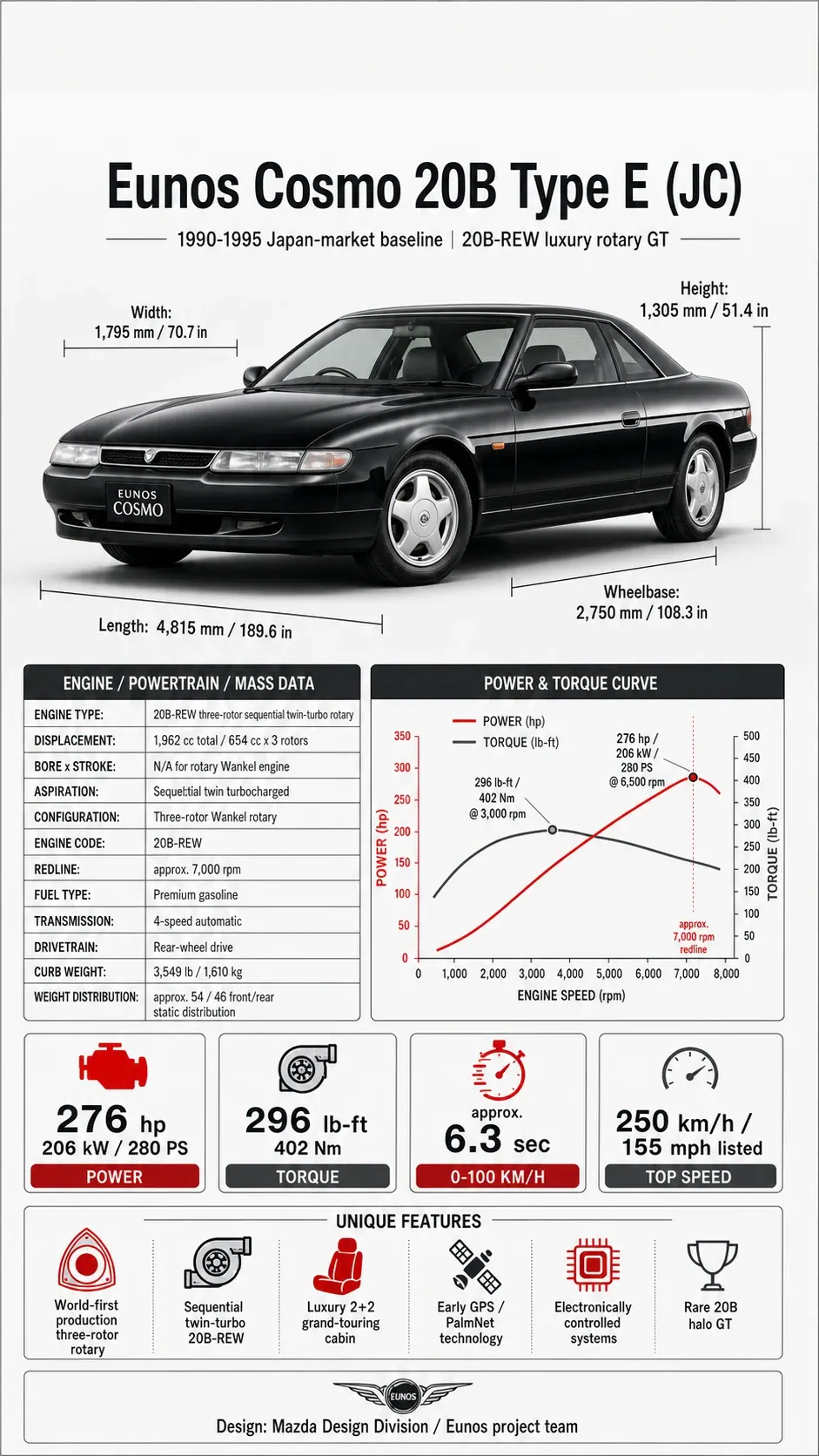
Mazda’s own history makes the Cosmo’s importance unusually clear. The Eunos Cosmo was introduced in 1990, and Mazda describes it as the world’s first mass-production vehicle with a three-rotor rotary engine and sequential twin turbocharger. Mazda also records the 20B-REW at 280 PS and 41.0 kg-m, which made it Japan’s most powerful domestic engine at the time.
That matters because the Cosmo was not trying to be a stripped-out road racer. It was a luxury coupe with a calm shape, automatic transmission, serious torque for a rotary, and a cabin built around early connected-car ideas. The car’s weirdness is the point: it is a technology flagship hiding inside a quiet grand tourer.
The 20B engine is the headline, but the Cosmo is more interesting when you treat the whole car as Mazda’s top-shelf experiment. It came from an era when Japanese manufacturers were willing to build complex halo products that did not fit simple categories. The Cosmo was not a homologation special. It was not a volume sports coupe. It was not a mainstream luxury car. It was a rotary-powered personal GT for buyers who wanted something more technical and more exclusive than the usual badge hierarchy.

That odd position is why the car still feels like a secret. Enthusiasts know the 20B, but many people know it as a swap engine before they know the car it came in. A proper Cosmo reverses that view. It asks the buyer to value the complete car, not just the powertrain.
Best For And Not Best For
The 20B Cosmo is best for a buyer who already accepts rotary maintenance as part of the ownership experience. Compression readings, cooling health, oiling habits, turbo behavior and warm-start manners matter more than paint shine. The buyer also needs patience for Japan-market trim, electronics and interior parts.
It is also best for someone who likes grand touring more than track chasing. The Cosmo is long, smooth and relatively heavy by sports-car standards. Its normal factory context is a 4-speed automatic driving the rear wheels, and that changes the whole personality. The car is more about effortless shove, rarity and cabin drama than rowing gears down a back road.
It is not best for someone who wants a cheap first rotary, a daily driver with easy parts support, or a manual canyon car. Most 20B Cosmos were automatic luxury coupes, and that personality is central to the car. Trying to judge it as a heavier RX-7 misses what Mazda built.
The right buyer should enjoy research as much as acceleration. You need to be comfortable calling specialists, checking chassis and import history, waiting for parts, and walking away from cars that look good but have weak proof. The wrong buyer will see the 20B badge, assume the hard part is finding one, and then discover that buying the car was only the first challenge.
Specs That Matter
The source-locked baseline is the Japan-market JC Eunos Cosmo with the 20B-REW three-rotor sequential twin-turbo rotary. The engine displaces 654 cc x 3, or 1,962 cc total. Locked output is 280 PS / 206 kW at 6,500 rpm, with 41.0 kg-m, about 402 Nm or 296 lb-ft, at 3,000 rpm. The normal transmission context is a 4-speed automatic driving the rear wheels.
The size is closer to a luxury GT than a compact sports car: about 4,815 mm long, 1,795 mm wide, 1,305 mm tall, on an approximately 2,750 mm wheelbase. Curb weight depends on trim, but the useful buyer range is about 1,590 to 1,640 kg. A Type E baseline around 1,610 kg is a useful mental anchor.
Those numbers explain why the Cosmo feels special in a different way from an RX-7. It is smooth, torque-rich and rare, not light and simple. The engine gives it a collector hook, but the dimensions and automatic transmission define how you should think about the car. This is not a compact lightweight coupe with an exotic engine dropped into it. It is a luxury GT built around an exotic engine.
The specification boundary matters when reading listings. Sellers can blur trim names, production-year boundaries and equipment descriptions, especially because many cars are imported and translated from Japan-market documentation. Treat the public specs as the baseline, then verify the exact car in front of you with records, photos, chassis details and inspection evidence.
Powertrain Character
The 20B-REW is the reason most people start looking at the Cosmo. A three-rotor sequential twin-turbo rotary is inherently unusual, and in the Cosmo it is paired with a calm luxury-coupe mission rather than a stripped sports-car mission. The result is the car’s core contradiction: a rare, technical engine in a body that does not shout about it.

Do not reduce that engine to a trivia line. In buyer terms, the 20B changes the risk profile, the inspection process and the ownership plan. It also changes why the car is desirable. A normal six-cylinder or V8 grand tourer can be judged mostly on condition, parts availability and driving preference. A Cosmo 20B adds engine-health proof as a central value question. The car’s best feature is also the feature that can punish lazy buying.
The sequential turbo system and rotary layout mean the test drive should be more disciplined than emotional. Watch for warm-start behavior, smoke, cooling stability, boost behavior, idle quality, oil leaks and evidence of previous troubleshooting. A car that feels quick for five minutes but has no compression report, no cooling history and no specialist support is not a strong example.
This is also why modifications need caution. Some owners and sellers value the 20B as an engine platform, but the article car is most compelling as a complete Cosmo. A modified car can be interesting, but every change should come with receipts and a clear explanation. Otherwise the buyer is inheriting someone else’s experiment.
Interior And Electronics Are Part Of The Story
The Cosmo’s cabin is not just background scenery. The early-1990s Eunos luxury context, right-hand-drive layout, CCS/PalmNet screen context, audio, climate control, cluster and switchgear are part of what separates the Cosmo from a simple engine-donor narrative. A good car should still feel like a period luxury coupe, not a gutted shell waiting for its 20B to be removed.
That makes the interior a serious inspection item. Check the display functions, climate controls, audio behavior, cluster illumination, speedometer, tachometer, switches, seat motors where fitted, trim panels, door seals and fragile plastic pieces. Owner and community evidence repeatedly points toward electronics and parts sourcing as real ownership filters. A car can look clean in exterior photos and still be frustrating if its cabin systems are dead or half-bypassed.
The interior also affects value because Cosmo-specific parts are not as easy as general Mazda performance parts. Missing trim, broken displays, hacked wiring and incomplete luxury equipment are not cosmetic footnotes. They can change the ownership experience and the restoration cost. If the seller says a feature is “probably just a fuse,” treat that as unverified until proven.
For a buyer, the best cabin is not necessarily the most perfect one. It is the one with honest condition, working major functions, clear photos and no mystery modifications. A complete, functional interior supports the idea that the car was preserved as a Cosmo, not simply kept around as a rare engine wrapper.
Variations, Options And Trim Boundaries
The public article should stay careful around Cosmo trim claims because source boundaries can vary. The saved package facts frame the car around the JC Eunos Cosmo with 20B Type E / Type SX / ECCS context, Japan-market baseline, and production years spanning 1990 through 1995 or January 1996 depending on source and trim boundary. That is enough to guide the buyer, but not enough to claim exact installed equipment on a specific listing without proof.
This matters because sellers may use broad names loosely. A listing can mention 20B, Type E, Type SX, ECCS, leather, navigation, audio, or rare equipment, but the buyer should separate possible Cosmo equipment from confirmed equipment on that car. Exact installed options need evidence: auction sheet, Japanese paperwork, build details, chassis-specific records, clear photos, or equivalent proof.
The engine choice is the largest variation point for this article because the 20B is what makes this package special. A non-20B Cosmo can still be interesting, but it is a different buyer decision. This guide is about the triple-rotor 20B car, so the inspection and value logic should not be copied blindly onto every Cosmo.
Market context matters too. Many cars seen by English-language buyers are imports, and their condition can depend heavily on storage, auction grade, shipping, title process, and the care taken after arrival. A clean imported car with complete documentation is easier to understand than a vague car with a big story and little paper.
What Goes Bad And What To Check
Start with a hot rotary compression test. Without it, the rest of the inspection is theater. The 20B is the reason the car is valuable, and it is also the reason a weak example can become financially ugly. Look for smoke, coolant pressure issues, oil leaks, turbo-control problems, rough warm starts and signs that the cooling system has been neglected.
Then move to the things that make a Cosmo a Cosmo. Check the CCS/PalmNet screen, climate control, cluster, speedometer, tachometer, audio, switches and cabin electronics. Owner and forum evidence repeatedly points toward electronics and parts sourcing as part of the real ownership risk. Missing trim, dead displays and hacked wiring can matter as much as mechanical wear.
Finally, inspect it like any rare imported GT: rust, accident repair, paint quality, glass, seals, suspension arms, brake condition, tire age and documentation. A clean-looking Cosmo with no records is still a gamble.
The inspection should be sequenced, not casual. First decide whether the engine is healthy enough to keep discussing. Then decide whether the electronics and trim are complete enough to preserve the car’s identity. Then decide whether the chassis, suspension and paperwork support the asking price. If any of those stages fails, do not let rarity talk you into lowering the standard.
Ownership And Buying Notes
The right 20B Cosmo should feel like a preserved luxury object, not a half-finished swap donor. Originality matters because many surviving cars are valued for the engine itself. The more a car has been stripped, modified or neglected, the more the buyer is paying for risk instead of rarity.
Parts sourcing is the quiet ownership test. Engine specialists can support rotaries, but Cosmo-specific electronics, interior pieces and trim are not as easy as RX-7 parts. Before buying, identify who will service the car, where you will source wear items, and what you will do if the display or automatic transmission needs attention.
Budget for patience as well as money. A rare Japan-market grand tourer does not always break on a convenient schedule, and not every repair will have a simple catalog answer. The car rewards owners who can plan ahead: spare wear items, specialist relationships, careful documentation and a willingness to wait for the correct part instead of improvising.
The automatic transmission deserves its own respect. It is easy for enthusiasts to dismiss it because the 20B sounds like it belongs in a manual sports car, but the automatic is part of the Cosmo’s factory luxury identity. Inspect shift quality, fluid condition, kickdown behavior and any slipping or harsh engagement. A manual swap might make a different kind of fun car, but it also moves the example away from the preserved-GT argument.
Price And Market Reality
Current prices should be rechecked before publication or purchase because import listings, auction results and dealer inventory move quickly. The safer article stance is not to publish a fixed price from stale data. Instead, use the market logic: strong 20B cars should cost more because they combine rarity, engine desirability, complete luxury equipment and import appeal; weak cars can still be expensive because the engine itself has value.
That creates a trap. A cheap-looking Cosmo may not be cheap after compression testing, electronics repair, trim sourcing, shipping history, registration, tires, fluids and specialist sorting. A more expensive car with proof can be the better buy if it removes uncertainty. The purchase decision should compare total risk, not just asking price.
When comparing listings, sort them by proof. The best listing has clear exterior, interior, engine-bay and underside photos; a compression report; cold and warm running evidence; operating electronics; import documents; service records; and honest notes about flaws. The weakest listing leans on rarity, uses vague “runs and drives” language, has limited cabin photos and cannot answer basic rotary-health questions.
If you are shopping across borders, add regional friction to the equation. Shipping, compliance, title timing, parts support and specialist access can change the real cost. A Cosmo that looks like a deal in one marketplace can become expensive once the buyer does the work needed to own it properly.
Compared With Rivals
Against an FD RX-7, the Cosmo is rarer, smoother and more luxurious, but heavier and less focused. The RX-7 is the sharper sports car and the more obvious enthusiast driver’s choice. The Cosmo is the stranger collector GT with a triple-rotor identity and a more unusual cabin story.
Against a Toyota Soarer or Lexus SC, the Cosmo is more exotic and historically important, but less straightforward to maintain. The Soarer and SC appeal through durability, refinement and stronger parts familiarity. The Cosmo asks the buyer to accept extra complexity in exchange for a powertrain and story those rivals do not have.
Against a Nissan 300ZX Twin Turbo, the Cosmo is stranger and more discreet, with a stronger collector hook around the 20B engine. The 300ZX is easier to explain as a 1990s Japanese performance flagship. The Cosmo is harder to explain, which is exactly why some buyers find it more compelling.
That comparison is the whole appeal. The Cosmo is not the rational middle choice. It is the car for someone who wants a luxury coupe with a powertrain story no rival can copy, and who understands that the story comes with a higher standard for evidence.
Verdict
Buy the Eunos Cosmo 20B for the right reason: because you want Mazda’s triple-rotor luxury experiment, not because you think it will be an easy way into rotary ownership. A strong car with proof, compression, functioning electronics and complete trim is special. A cheap one without evidence is not a bargain; it is a warning.
The best version of this car is not the loudest or the most modified. It is the example that still makes sense as a Cosmo: complete, documented, right-hand-drive luxury cabin intact, 20B healthy, electronics functioning, and enough originality to justify preserving it. If the car passes that test, it offers something rare even among 1990s Japanese icons.
If it does not pass that test, walk away cleanly. There will always be another tempting rare import, but there are not many ways to make an unsupported 20B luxury coupe cheap after purchase. The Cosmo rewards disciplined buyers and punishes romantic ones.
FAQ
Is the Eunos Cosmo 20B manual?
The normal factory context is a 4-speed automatic. Manual-swapped cars exist, but they should be treated as modified examples and inspected on their own merits. A swap can make the car more exciting for some drivers, but it also changes the preservation argument and can introduce wiring, driveline and documentation questions.
Is the 20B-REW really a three-rotor engine?
Yes. The 20B-REW uses three 654 cc rotors for 1,962 cc total displacement, with sequential twin turbocharging. Mazda’s own history identifies the Cosmo as a mass-production three-rotor sequential-twin-turbo milestone.
Is it better than an FD RX-7?
It is different. The RX-7 is the sharper sports car. The Cosmo is the rarer luxury GT with the more unusual engine story. Choose the RX-7 if you want a focused driver; choose the Cosmo if you want a rare technology flagship and accept the extra ownership complexity.
What is the biggest buying risk?
The biggest risk is a car with weak engine health, poor cooling-system history, failing electronics and no parts plan. Verify those before falling for the rarity. Compression proof, warm-start behavior, cooling stability, working cabin systems and documentation should all influence the decision.
Should I buy a cheap Eunos Cosmo 20B project?
Only if you are intentionally buying a project and have specialist support already lined up. A cheap Cosmo can become expensive quickly because the car combines rotary engine risk, rare Japan-market trim, complex electronics and import-specific parts issues. For most buyers, a documented car that costs more up front is the safer route.
What makes the 20B Cosmo collectible?
The collectible hook is the complete package: Mazda’s production three-rotor sequential-twin-turbo engine, Japan-market Eunos luxury identity, early connected-car cabin technology, rarity, and the fact that it does not overlap neatly with more familiar 1990s Japanese performance cars. It is collectible because it is specific, not because it is simply old or fast.
FAQ
Common questions
Is the Eunos Cosmo 20B manual?
The normal factory context is a 4-speed automatic. Manual-swapped cars exist, but they should be treated as modified examples and inspected on their own merits. A swap can make the car more exciting for some drivers, but it also changes the preservation argument and can introduce wiring, driveline and documentation questions.
Is the 20B-REW really a three-rotor engine?
Yes. The 20B-REW uses three 654 cc rotors for 1,962 cc total displacement, with sequential twin turbocharging. Mazda's own history identifies the Cosmo as a mass-production three-rotor sequential-twin-turbo milestone.
Is it better than an FD RX-7?
It is different. The RX-7 is the sharper sports car. The Cosmo is the rarer luxury GT with the more unusual engine story. Choose the RX-7 if you want a focused driver; choose the Cosmo if you want a rare technology flagship and accept the extra ownership complexity.
What is the biggest buying risk?
The biggest risk is a car with weak engine health, poor cooling-system history, failing electronics and no parts plan. Verify those before falling for the rarity. Compression proof, warm-start behavior, cooling stability, working cabin systems and documentation should all influence the decision.
Sources and references
- Mazda History of Mazda: Cosmo
- Mazda 100th Anniversary Legendary Mazdas: Eunos Cosmo
- Mazda Newsroom rotary engine vehicle total production volume surpasses two million
- Mazda Newsroom technology: Rotary Engine
- Mazda rotary engine technical history PDF
- Craig's Rotary Page: Mazda's Rotary Muscle Car - JC Cosmo
- Automobile Catalog 1990 Eunos Cosmo 20B Type E
- Automobile Catalog 1990 Eunos Cosmo Coupe JC full range
- Auto-Data Mazda Eunos Cosmo 20B Type E
- Onteco Eunos Cosmo 20B Type-SX specifications
- JapaneseCarTrade Eunos Cosmo 20B Type E CCS
- Drifted Ultimate Mazda 20B Engine Guide
Topic hubs
Tags

