


Verdict: the E36 M3 is worth chasing if you buy condition and documentation before badge nostalgia, especially because market, engine, and maintenance history change the car dramatically.
Quick Answer
The E36 M3 is the M car for someone who wants a usable 1990s driver’s car, not a fragile poster car. It moved the M3 from the E30’s homologation attitude into a smoother, more daily-friendly shape with inline-six power, rear-wheel drive, and enough practicality to make regular driving realistic.
The catch is that “E36 M3” is not one exact spec. European 3.0 cars, European 3.2 cars, North American cars, sedans, convertibles, manuals, and SMG examples all need different expectations. For this guide’s spec lock, the reference car is the European-market 3.2 coupe with the S50B32 inline-six and six-speed manual.
Best for: a driver who wants compact size, mechanical steering feel, naturally aspirated response, and a car that rewards maintenance records.
Not best for: someone shopping only by lowest asking price, highest horsepower, or clean paint in photos. Rust, deferred cooling-system work, tired suspension, VANOS issues, gearbox wear, and poor modifications can turn a dream listing into a very expensive lesson.
This article includes paid / affiliate links. If you click through and buy or sign up, we may earn a commission at no extra cost to you. Recommendations stay tied to the article’s evidence and use case.
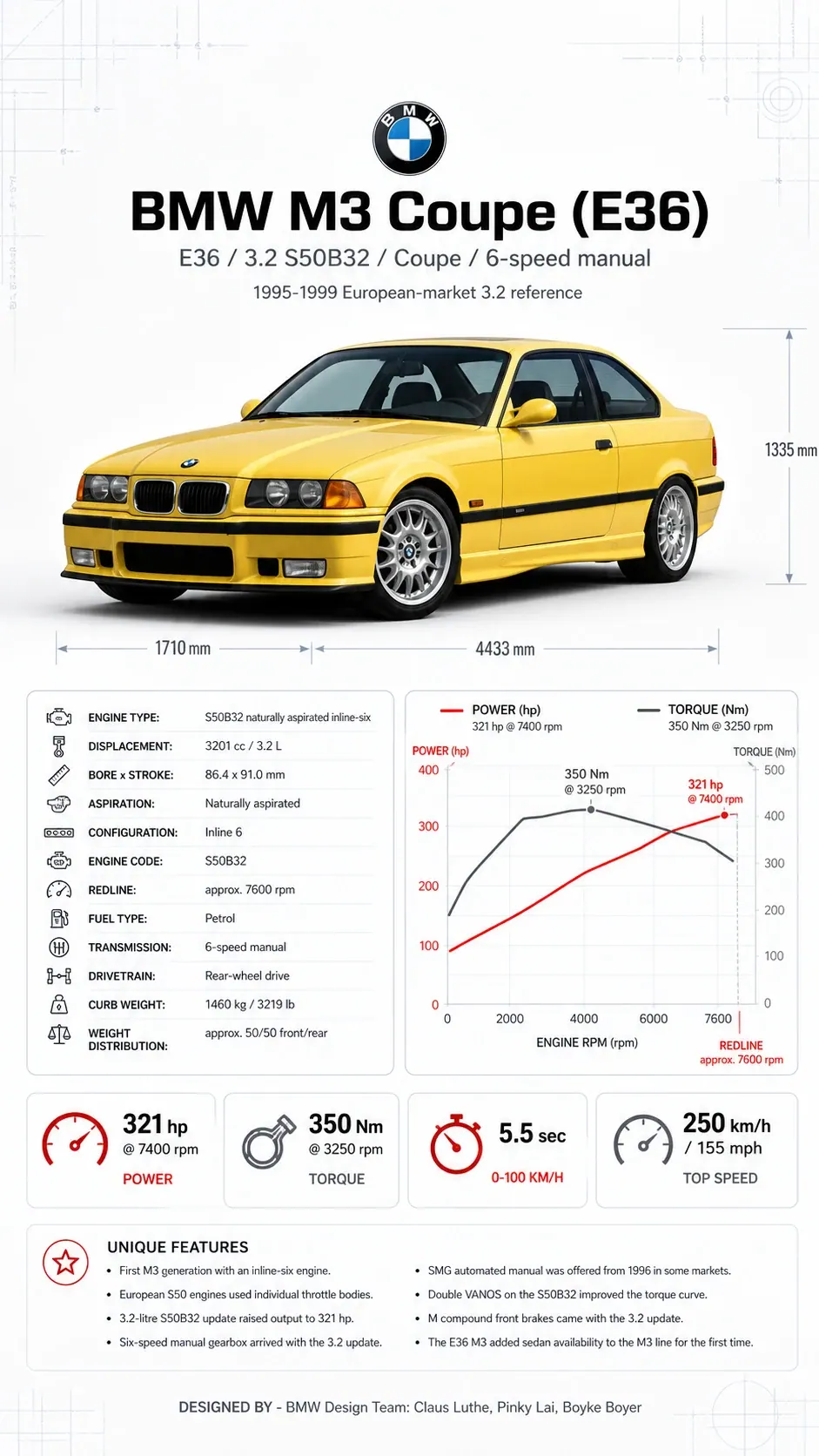
E36 M3 Specs At A Glance
These figures are locked to the European-market 3.2 coupe reference, not every E36 M3 sold globally.
| Item | Locked reference value |
|---|---|
| Model | BMW M3 Coupe (E36) 3.2 |
| Engine | S50B32 naturally aspirated inline-six |
| Displacement | 3201 cc / 3.2 L |
| Power | 321 hp at 7400 rpm |
| Torque | 350 Nm at 3250 rpm |
| Transmission | 6-speed manual |
| Drivetrain | Rear-wheel drive |
| 0-100 km/h | 5.5 sec |
| Top speed | 250 km/h / 155 mph, electronically limited |
| Curb weight | 1460 kg / 3219 lb |
| Dimensions | 4433 mm L / 1710 mm W / 1335 mm H |
| Wheelbase | 2700 mm |
The most important buying note is the market split. BMW M’s own overview separates the European M3 story from the North American S50B30US and S52B32US branch. That does not make the U.S. car useless. It means you should not compare a U.S. listing against a European S50B32 reference spec and assume the same engine, throttle hardware, gearbox, or parts path.
Why This Car Matters
The E36 M3 matters because it made the M3 broader without making it dull. The E30 M3 was motorsport-shaped; the E36 was more mature, more discreet, and much easier to live with. BMW M moved to a high-revving inline-six, kept rear-wheel drive, and gave the car enough refinement that it could be a real road car instead of a weekend-only machine.
That is also why clean examples are appealing now. The E36 shape is simple, narrow by modern standards, and not trying too hard. It is quick without being absurd, analog without being primitive, and practical enough that a well-sorted coupe or sedan can still feel useful.

The 3.2 update is the headline version for many enthusiasts. The S50B32 brought 3201 cc displacement, 321 hp, 350 Nm, double VANOS, a six-speed gearbox, and M compound braking. It is the spec most people picture when they talk about the full European E36 M3.
Which E36 M3 Are You Looking At?
Start by identifying the car before judging the price.
European 3.0 cars use the S50B30 and are the early, 286 hp branch. They are still proper M cars, with individual throttle bodies and the sharper European engine character, but they do not have the later 3.2’s six-speed update package.
European 3.2 cars use the S50B32 and are the reference for the locked specs. These are the cars most associated with the 321 hp figure, double VANOS, six-speed manual, optional SMG, and stronger late-model performance story.
North American cars are their own branch. They typically trade the exotic European engine hardware for simpler S50B30US or S52B32US powerplants and about 240 hp. The upside is a simpler ownership path and strong street torque. The downside is that they do not deliver the same engine character as the European S50B32.
Sedans and convertibles matter too. The sedan makes the E36 M3 more useful and historically interesting because this was the first M3 generation offered as a four-door. Convertibles add weight and complexity. They can be great cruisers, but they should not be priced like the sharpest coupe unless condition and documentation justify it.
Inspection Priorities
Do not inspect an E36 M3 like a normal clean used coupe. Inspect it like a performance classic that has had three decades of owners, shops, shortcuts, and weather.
Start with rust. Check rear arches, jacking points, boot or trunk edges, bonnet or hood seams, underside fuel and brake lines, and any repaired panels. Rust is not just cosmetic on a car that buyers increasingly treat as collectible.

Then check the engine and cooling history. VANOS noise, leaks, poor idle, old hoses, tired cooling parts, and missing service records should change your offer. A healthy S50 or S52 can be strong, but deferred maintenance quickly erases the savings from a cheap listing.
Suspension deserves a careful look. Rear trailing arm bushings, rear shock mounts, front control arms, dampers, alignment, uneven tire wear, and cheap coilover installs tell you how the car has lived. The E36 chassis is good enough that a tired one feels obviously worse than a sorted one.
Transmission history matters. On manual cars, feel for second-gear synchro wear and clutch issues. On SMG cars, check hydraulic operation, warning lights, pump behavior, and whether a manual conversion was done cleanly.
Finally, judge modifications honestly. Good suspension, braking, and maintenance upgrades can help. Cheap engine dress-up, mystery tunes, poorly fitted wheels, hacked wiring, and missing original parts should make you slow down.
Best For / Not Best For
| Best for | Not best for |
|---|---|
| Enthusiasts who want compact, naturally aspirated rear-drive feel | Buyers who only want the cheapest M badge |
| Drivers who value balance more than huge power | Anyone expecting modern M-car straight-line speed |
| Owners willing to maintain a 1990s performance car properly | Buyers who cannot budget for age-related repairs |
| Collectors who understand market and engine-code differences | Shoppers who treat U.S. and European specs as interchangeable |
| People who enjoy subtle design and mechanical feedback | People who want a warranty-like ownership experience |
Next Action
Before you chase a listing, build a short inspection sheet around five checks: identity, rust, engine and cooling, suspension, and records. The best E36 M3 is not automatically the most powerful one. It is the car whose condition, version, paperwork, and parts path still make sense after the first wave of nostalgia wears off.
FAQ
Is the E36 M3 reliable?
It can be, but age matters more than reputation. A well-maintained car with cooling, VANOS, suspension, rust, and gearbox history handled is a very different prospect from a cheap modified car with missing records.
Which E36 M3 engine is best?
For the full European performance story, the S50B32 3.2 is the headline engine. For simpler North American ownership, the S52 branch can be easier to live with and source parts for. The better buy is usually the best-documented car, not automatically the highest-output one.
Why is the U.S. E36 M3 less powerful?
North American cars used different S50B30US and S52B32US engines rather than the European S50B30 and S50B32 specification. They are commonly discussed as about 240 hp cars, while the European 3.2 is the 321 hp reference.
Is the E36 M3 a good first classic performance car?
Yes, if you can budget for maintenance and avoid poor examples. It is usable, compact, and rewarding, but it is still a 1990s performance car with age-related weak points.
What should I inspect first?
Confirm the exact variant, then inspect rust, service records, VANOS and cooling health, suspension bushings, rear shock mounts, gearbox behavior, and brake or fuel line condition.
FAQ
Common questions
Is the E36 M3 reliable?
It can be, but age matters more than reputation. A well-maintained car with cooling, VANOS, suspension, rust, and gearbox history handled is a very different prospect from a cheap modified car with missing records.
Which E36 M3 engine is best?
For the full European performance story, the S50B32 3.2 is the headline engine. For simpler North American ownership, the S52 branch can be easier to live with and source parts for. The better buy is usually the best-documented car, not automatically the highest-output one.
Why is the U.S. E36 M3 less powerful?
North American cars used different S50B30US and S52B32US engines rather than the European S50B30 and S50B32 specification. They are commonly discussed as about 240 hp cars, while the European 3.2 is the 321 hp reference.
Is the E36 M3 a good first classic performance car?
Yes, if you can budget for maintenance and avoid poor examples. It is usable, compact, and rewarding, but it is still a 1990s performance car with age-related weak points.
Sources and references
- Automotive content provider article packageImported provider package; source facts are recorded in article-workspaces/bmw-e36-m3/source-notes.md.
- Automotive content provider visual handoff packageAccepted provider visuals and usage evidence are recorded in article-workspaces/bmw-e36-m3/article-info.json.
Topic hubs
Tags

