


Verdict: the E30 M3 is worth the legend when it is original, documented, rust-free, and mechanically healthy; it is not a cheap shortcut into M ownership.
Quick Answer
The BMW E30 M3 is the first M3 and one of the clearest examples of a road car shaped by touring-car rules. If you want the most honest version of the story, start with the standard 2.3-litre coupe rather than the special editions. It gives you the S14 engine, the wide-track bodywork, the dogleg European gearbox, the aero changes, and the sharp handling balance without mixing in Sport Evolution values.
Best for: buyers who want a landmark homologation BMW and will pay for originality, inspection, documentation, and specialist maintenance.
Not best for: someone expecting modern turbo torque, cheap parts, relaxed commuting, or a casual project. A tired E30 M3 can look like a dream in photos and still be a very expensive shell, engine, gearbox, or rust problem.
This article includes paid / affiliate link slots. If you click through and buy or sign up, we may earn a commission at no extra cost to you. Recommendations stay tied to the article’s evidence and use case.
Best next action: inspect body condition and provenance before you fall in love with mileage, paint, wheels, or a short test drive.
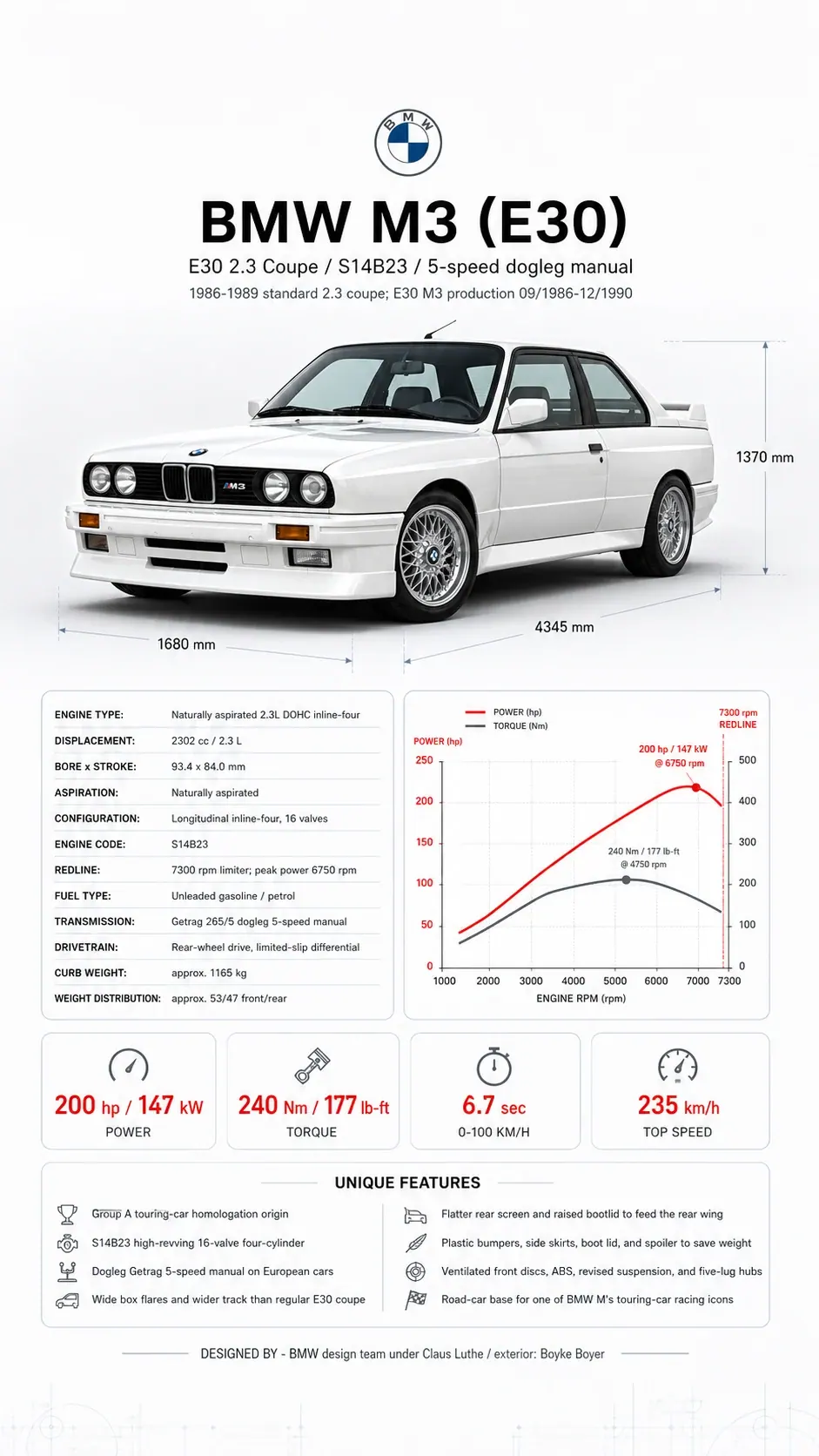
Key Specs
This article locks the standard European 2.3 coupe reference specification. It does not use Evo II, Cecotto/Ravaglia, US catalyst, convertible, or Sport Evolution data for the main infographic.
| Item | Locked value | Note |
|---|---|---|
| Model | BMW M3 (E30) | Standard 2.3 coupe reference |
| Production | 09/1986-12/1990 overall | Standard 2.3 coupe values vary by market/year |
| Engine | S14B23 2.3L inline-four | DOHC, 16 valves, naturally aspirated |
| Bore x stroke | 93.4 x 84.0 mm | Specialist technical data cross-check |
| Power | 200 hp / 147 kW at 6750 rpm | Non-catalyst European reference value |
| Torque | 240 Nm / 177 lb-ft at 4750 rpm | Peak torque arrives high enough to matter in real driving |
| Transmission | Getrag 265/5 dogleg 5-speed manual | European-spec reference |
| Drivetrain | Rear-wheel drive | Limited-slip differential context |
| 0-100 km/h | 6.7 sec | Period benchmark, not modern super-hatch shock value |
| Top speed | 235 km/h / 146 mph | Source conflict noted below |
| Curb weight | approx. 1165 kg | Market/equipment values vary; around 1200 kg is also common |
| Dimensions | 4345 x 1680 x 1370 mm | Length x width x height |
| Weight distribution | approx. 53/47 front/rear | Static distribution, not drivetrain torque split |
Why This Car Matters
The E30 M3 is not just a badge upgrade over a normal E30 coupe. BMW Motorsport created it for Group A racing homologation, and the road car carries the evidence in its body. The blistered arches, wider track, revised rear screen angle, raised bootlid, rear wing, unique bumpers, and lighter plastic exterior pieces were there to make the racing car work.
The S14 engine is equally central to the story. It is a high-revving four-cylinder rather than the smoother six-cylinder layout many people associate with BMW. That choice helped weight and response, and it gives the car much of its character. You do not buy an E30 M3 for lazy low-rpm torque. You buy it because the engine, gearbox, steering, brakes, and chassis ask you to drive with precision.
That is also why condition matters so much. The car’s reputation can make people excuse problems they would never accept on a less famous classic. Rust, track history, poor repairs, tired suspension, a notchy gearbox, differential noise, weak records, or a rough S14 should change the price and sometimes end the conversation.
Best For / Not For
| Best for | Not for |
|---|---|
| Collectors who value documented homologation cars | Buyers looking for a cheap classic BMW entry point |
| Drivers who enjoy momentum, revs, and chassis precision | Drivers who want modern turbo torque and comfort |
| Originality-focused restorers | Heavy modification plans that erase M3-specific value |
| People with access to BMW classic specialists | Owners who want low-effort maintenance |
| Enthusiasts who understand market/spec differences | Anyone mixing Sport Evolution specs into a standard car listing |

Buying Notes
Start with the body. Hagerty and PistonHeads both put rust and hidden repairs high on the inspection list. Check floors, boot area, window surrounds, sunroof areas if fitted, inner arches, doors, chassis legs, suspension turrets, and the underside. Fresh paint is not automatically bad, but it needs proof rather than optimism.
Then check identity and originality. A real E30 M3 has body and suspension changes that ordinary E30 coupes do not. Verify the VIN, paperwork, engine identity, trim, wheels, panels, and history. Because values are high, incorrect parts and replica details can become expensive mistakes.
For the S14, listen for rough running, check for leaks, verify warm-up discipline, and ask for valve-clearance, chain, cooling, and oil-service records. The engine is durable when maintained, but it is not cheap to put right. The gearbox and differential deserve the same suspicion: notchy shifting, noise, leaks, and poor records all matter.
Affiliate slots should stay useful here, not random. The best commerce fit is a vehicle-history check, pre-purchase inspection checklist, paint-depth gauge, battery maintainer, service manual, and specialist inspection booking. Live links still need verification before publishing.
Next Action
Before you compare listings, build a three-part filter: proof of identity, proof of body condition, and proof of S14/gearbox maintenance. If one of those is weak, the car is not automatically disqualified, but the price and inspection depth need to change.

FAQ
Is the E30 M3 fast today?
It is quick enough to feel special, but modern performance cars are much faster in a straight line. The E30 M3’s appeal is response, balance, revs, steering, and racing lineage more than headline acceleration.
Which E30 M3 spec is this infographic based on?
The standard European 2.3 coupe with the non-catalyst 200 hp S14B23 reference specification. The package keeps catalyst, later 215 hp, Evo II, and Sport Evolution values separate.
What should buyers inspect first?
Body structure, rust, accident history, identity, paperwork, engine health, gearbox/differential condition, and originality. Cosmetics come after those.
Was the E30 M3 sold in right-hand drive?
The factory E30 M3 was left-hand drive. Some period right-hand-drive conversions exist, but they need careful documentation and value context.
Source Links
- BMW Group Classic: https://www.bmwgroup-classic.com/en/models/bmw-classics/product-description-page.ad-239-1.bmw-m3-e30.html
- BMW M: https://www.bmw-m.com/en/topics/magazine-article-pool/bmw-m3-e30-portraet.html
- E30Mpower technical specs: https://e30mpower.com/M3-techspec.html
- Auto-Data dimensions/spec range: https://www.auto-data.net/en/bmw-m3-coupe-e30-generation-2015
- BMW E30 specifications PDF: https://www.myclassicparts.com/wp-content/uploads/2021/10/103_BMW-E30-3-Series-Specifications.pdf
- BMW E30 design story: https://www.bmwblog.com/2025/01/26/bmw-e30-3-series-design-history/
- Hagerty UK buying guide: https://www.hagerty.co.uk/articles/buying-guides/buying-guide-bmw-m3-e30-1986-1992/
- PistonHeads pocket buying guide: https://www.pistonheads.com/features/ph-buying-guides/bmw-m3-e30-1986-1992—ph-pocket-buying-guide/34261
FAQ
Common questions
Is the E30 M3 fast today?
It is quick enough to feel special, but modern performance cars are much faster in a straight line. The E30 M3's appeal is response, balance, revs, steering, and racing lineage more than headline acceleration.
Which E30 M3 spec is this infographic based on?
The standard European 2.3 coupe with the non-catalyst 200 hp S14B23 reference specification. The package keeps catalyst, later 215 hp, Evo II, and Sport Evolution values separate.
What should buyers inspect first?
Body structure, rust, accident history, identity, paperwork, engine health, gearbox/differential condition, and originality. Cosmetics come after those.
Was the E30 M3 sold in right-hand drive?
The factory E30 M3 was left-hand drive. Some period right-hand-drive conversions exist, but they need careful documentation and value context.
Sources and references
- bmwgroup-classic.comImported from the automotive content provider package; verify exact claim mapping before final publish.
- bmw-m.comImported from the automotive content provider package; verify exact claim mapping before final publish.
- e30mpower.comImported from the automotive content provider package; verify exact claim mapping before final publish.
- auto-data.netImported from the automotive content provider package; verify exact claim mapping before final publish.
- myclassicparts.comImported from the automotive content provider package; verify exact claim mapping before final publish.
- bmwblog.comImported from the automotive content provider package; verify exact claim mapping before final publish.
- hagerty.co.ukImported from the automotive content provider package; verify exact claim mapping before final publish.
- pistonheads.comImported from the automotive content provider package; verify exact claim mapping before final publish.
Topic hubs
Tags

