


Quick Answer
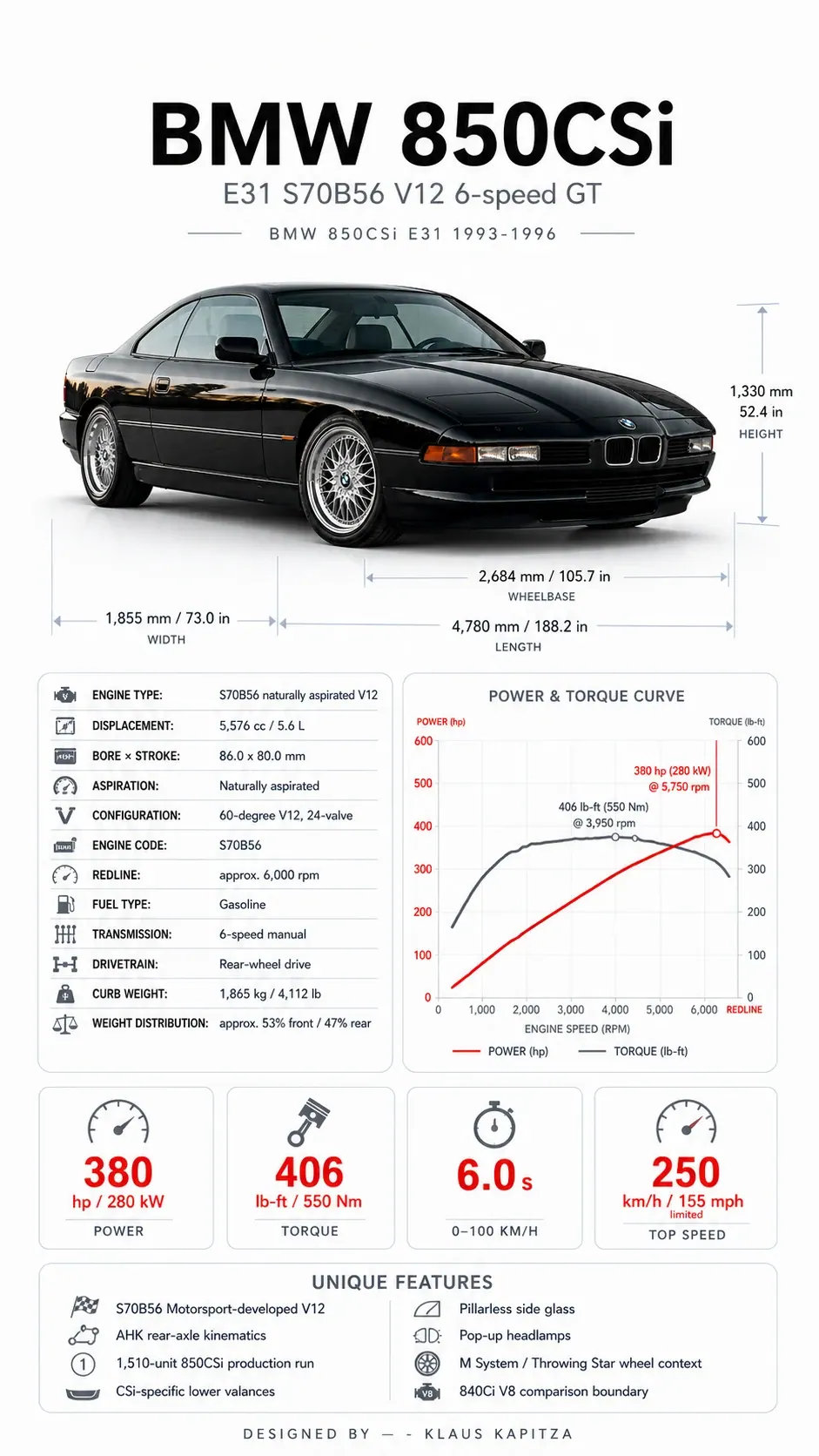
The BMW 850CSi is the E31 to buy when the goal is the most special factory version of the original 8 Series. It has the S70B56 V12, a six-speed manual, BMW M development fingerprints, AHK rear steering, CSi-specific body and chassis details, and a production count low enough to make every clean example matter. That does not make it the easiest E31 to own. It makes it the one where proof matters most.
The BMW 840Ci is the E31 to buy when the goal is the shape, the long hood, the pillarless glass, the low seating position, and the 1990s flagship feel without paying the full CSi collector premium. It is not a fake CSi or a consolation prize. It is a different ownership answer: V8, automatic in most real-world shopping, simpler value math, and usually less pressure to preserve every rare part as if the car were a museum piece.
The collector-risk story is simple. A documented, correct 850CSi can justify serious money because the model is scarce, technically unusual, and market-proven. An undocumented one can turn into an expensive lesson because CSi-specific parts, V12 maintenance, electrical issues, and originality questions all stack on top of normal E31 age. A 840Ci can be a smarter driver if you want the E31 experience more than the top-model badge. The best choice depends on whether you are buying a collectible machine, a usable grand tourer, or a restoration project wearing an attractive wedge body.
Why This E31 Matters
The E31 8 Series was not a small sports coupe. It was BMW’s flagship grand tourer for an era when technology, refinement, and visual restraint mattered as much as lap-time theater. The 850CSi sits at the top of that platform because BMW M reworked the V12 into the S70B56, paired it with a manual gearbox, and gave the car systems and details that separate it from ordinary 850i and 850Ci examples.
That distinction matters because the public story around the car often drifts into shortcut language. Calling the 850CSi an unofficial M car is useful only after the article explains what the production car actually received. The S70, AHK rear steering, CSi-specific hardware, lower stance, body details, and limited production do the real work. The mythology is the garnish. The hardware is why the car deserves attention.
The 840Ci matters for the opposite reason. It lets the E31 shape and cabin exist as a usable grand tourer without turning every purchase decision into a six-figure collector argument. The V8 car carries less of the M-adjacent glamour, but it can be the better answer for a buyer who wants to drive, maintain, and enjoy the car instead of protecting a rare CSi from miles and imperfect weather.
850CSi vs 840Ci
The 850CSi and 840Ci are close enough visually that casual observers may place them in the same mental bucket. A buyer should not. The CSi is the S70 V12, six-speed manual, low-production, M-touched version. The 840Ci is the V8 alternative, using the M60 4.0-liter engine in early cars and the M62 4.4-liter engine in later cars depending on market and model year. That distinction changes value, maintenance planning, and the inspection checklist.
The CSi is the emotional and financial peak. It is the one to chase if you want the model that collectors recognize first. It is also the one where originality, factory-correct details, records, and correct parts matter most. A buyer should verify the VIN, the CSi-specific equipment, service history, paint history, wheels, interior, and any claimed rare color or market story before trusting the asking price.
The 840Ci should be judged by a different standard. It is not valuable because it pretends to be a CSi. It is valuable because it gives the E31’s design and flagship cabin in a package that can be less intimidating to buy. A clean V8 car with records can be a better driver than a tired V12 car with a more glamorous badge. The article recommendation should keep those two ideas separate.
Price Risk
The 850CSi market is wide because condition and story carry heavy weight. Recent public data includes six-figure results for strong cars and lower bids or asks for cars with higher mileage, condition questions, or less perfect presentation. The correct reader takeaway is not that every CSi is worth the highest number. The takeaway is that every CSi needs proof before it deserves the number.
For a documented, usable 850CSi, a cautious good-buy band starts around the high-five-figure to low-six-figure zone, with exceptional mileage, rare colors, or unusually complete history pushing above that. A rough or incomplete car should not be treated as cheap just because the entry price is lower. The money saved can disappear into deferred maintenance, paint correction, missing CSi parts, electrical diagnosis, and parts hunting.
The 840Ci changes the math. It gives up the CSi’s S70/manual collector peak, but it also avoids the expectation that every choice must preserve a rare top-model asset. A good 840Ci can make sense for someone who wants the E31 silhouette and a real driving car. The risk is buying a neglected 840Ci because it appears affordable. The same E31 body, interior, electronics, suspension, and aging trim still need inspection.
Inspection And Records
The first option to verify on any E31 is not a wheel, trim package, or paint code. It is the service record file. These cars are old flagship BMWs with complex systems, expensive trim, and many age-related failure points. A beautiful exterior does not prove the cooling system is current, the suspension is tight, the batteries and charging system are healthy, the climate control works correctly, or the electronics behave after a cold start.
On an 850CSi, the inspection should slow down around the V12, the manual gearbox, the rear steering system where fitted, CSi-specific body parts, and any evidence that scarce parts have been substituted. On a 840Ci, the inspection should still treat the car as a complex E31, not a simple V8 coupe. Engine variant, transmission behavior, cooling health, oil leaks, suspension bushings, tires, brakes, and interior electronics all shape the real purchase price.
The best pre-purchase inspection is one that can say no. A car with shiny paint, weak records, and obvious deferred maintenance is not automatically a project worth rescuing. It is a negotiation with missing information. The article should encourage readers to pay for condition, documentation, and honest disclosure instead of chasing the cheapest listing.
Build the inspection around two starts and one long look underneath. A cold start can reveal weak batteries, lazy throttle response, old ignition parts, uneven idle quality, warning-light behavior, and seller excuses. A warm restart can expose heat-soak issues, tired sensors, cooling-system anxiety, or transmission behavior that was hidden during a short photo-session drive. Under the car, the buyer should look for fluid leaks, crushed jacking points, exhaust condition, suspension age, brake-line condition, tire date codes, and evidence that the car has been stored more than maintained. None of those checks are glamorous, but they decide whether the wedge GT is a collector asset or a postponed invoice.
For the CSi, the inspection should also preserve the model’s identity. The buyer should confirm that the engine bay, interior, bodywork, wheels, mirrors, bumpers, and paperwork support the CSi story before paying CSi money. For the 840Ci, the inspection can be more driver-focused, but it should still reject a car that needs every expensive E31 system revived at once. A strong 840Ci is not cheap because it skips maintenance. It is smart because its purchase price leaves room for honest sorting.
Recall And VIN Checks
Recall and safety information should be handled by VIN, not by broad memory. The E31 spans years, markets, engines, and equipment, so public recall summaries are a starting point rather than final proof. A buyer should run the exact VIN through the relevant market’s recall or safety database and compare that result with service records.
This matters because the reader is likely shopping across private sellers, auction listings, imported cars, and cars that have moved across states or countries. A claim that a campaign was completed should be backed by paperwork. A claim that no campaign applies should be checked against the VIN. The article should frame this as ordinary due diligence, not as a reason to fear the car.
The same thinking applies to title, mileage, accident history, and import paperwork. A clean listing summary is useful, but it is not the whole evidence file. The E31 is valuable enough now that a careful buyer should expect documentation to support the story.
Originality, Colors, And Parts
Originality matters differently on a 850CSi than it does on a 840Ci driver. A CSi with the correct bodywork, interior, wheels, trim, records, and paint story can justify a premium because those details are part of why the car is collectible. Rare colors and unusual interiors can help, but they are not magic by themselves. They matter when they are documented and attached to a healthy car.
CSi-specific parts are not just cosmetic trivia. They can affect value, replacement cost, and buyer confidence. The same applies to evidence of repainting, removed spoilers, aftermarket wheels, modified lighting, stereo changes, suspension parts, and missing original pieces. Some changes are acceptable on a driver. On a collector-grade CSi, each change needs to be understood.
For a 840Ci, originality is still useful, but the decision can be more flexible. A tastefully maintained V8 E31 with good records may be more satisfying than a highly original car that needs everything. The public copy should help the reader decide what they are buying: a collector CSi, a preserved grand tourer, or a driver-quality 840Ci.
The M8 Myth
The M8 story is part of the E31’s gravity, but it can distort the buying conversation. The production 850CSi should not be sold as the prototype that never reached showrooms. It should be explained as the production car that received a serious BMW M engineering treatment and stands closest to that legend in the public market.
This is important because myth can make buyers careless. A seller can lean on M8 language, a buyer can get excited, and the inspection can become too soft. The real questions are simpler: Is this a genuine CSi? Are the CSi-specific parts present? Is the S70 healthy? Is the manual gearbox right? Is the AHK system understood? Are records strong enough for the price?
Used carefully, the M8 shadow makes the article more interesting. Used lazily, it turns into hype. The recommendation should keep the prototype story in the background and make the production car’s hardware the center.
Driving Feel
The E31 is wide, low, and deliberate. It does not feel like a small M3, and that is not a flaw. The 850CSi is compelling because it layers V12 torque, a manual gearbox, long-distance composure, and special chassis systems onto a big GT platform. The car’s appeal is not only speed. It is the way the body shape, cabin, drivetrain, and rarity make the drive feel like an event.
The 840Ci feels different. It is still a flagship coupe, but the V8 route can be easier to rationalize as a usable car. It can be the E31 that gets driven more often because the owner is not constantly thinking about CSi values, scarce model-specific parts, or low-mile collector status. That can be a real advantage.
The article should not pretend the E31 is light or simple. It should tell the reader to expect a grand tourer with presence, technology, and age. The best examples feel expensive because BMW built them that way. The worst examples feel expensive because the previous owner stopped maintaining them that way.
The 840Ci Alternative
The 840Ci deserves a fair paragraph because it is the practical counterweight to the 850CSi. A V8 E31 can be the right buy when the reader wants the design and usable grand-touring character more than the top-model story. It is especially attractive when the CSi market has moved beyond the budget of someone who actually wants to use the car.
That does not mean every 840Ci is a bargain. A cheap E31 can still need expensive E31 work. The buyer should ask why the car is priced where it is, whether the records support the mileage, whether the engine and transmission match the year, whether the suspension and electronics have been addressed, and whether the car presents honestly in person.
The clearest recommendation is this: buy the best documented E31 you can justify. If that is a 850CSi, pay for the proof. If that is a 840Ci, do not apologize for choosing the version you will enjoy driving.
Recommendation
Buy the 850CSi if you want the most collectible factory E31 and are prepared to pay for documentation, originality, and specialist inspection. The CSi is the article’s hero because its hardware and production story earn that position. It is not the right car to buy casually, and it is not the right place to save money by ignoring issues.
Buy the 840Ci if the E31 shape, cabin, and grand-touring feel matter more than owning the top-model story. The V8 car can make more sense for a reader who wants to drive the car, accept normal age-related work, and avoid the stress of preserving a rare CSi. It is still a complex flagship BMW, so the inspection standard should remain high.
Walk away from either version when the records are thin, the seller cannot explain recent maintenance, the VIN story is weak, or the car shows signs of expensive neglect. The E31 is a beautiful car, but beauty is not proof. In this market, proof is the product.


FAQ
Is the 850CSi a real M car?
It is not badged as an M car in the modern sense, but BMW M developed key parts of the 850CSi and the S70-powered CSi sits at the top of the E31 range. The safest wording is to call it an M-developed E31 top model rather than pretending it is the production M8.
Is the 840Ci a smarter buy?
It can be. A well-documented 840Ci may be a better driver than a neglected V12 car. The 850CSi is the collector target; the 840Ci is the lower-exposure way into the E31 shape.
What should I inspect first?
Start with records, VIN checks, cold-start behavior, electrical health, cooling history, suspension condition, tires, brakes, interior functions, and evidence that model-specific parts are present. Do not let rare badges distract from basic condition.
What is the safest buying rule?
Pay for the car with the best proof, not the car with the best story. A documented E31 is expensive for a reason. An undocumented one can become expensive for a different reason.
FAQ
Common questions
Is the 850CSi a real M car?
It is not badged as an M car in the modern sense, but BMW M developed key parts of the 850CSi and the S70-powered CSi sits at the top of the E31 range. The safest wording is to call it an M-developed E31 top model rather than pretending it is the production M8.
Is the 840Ci a smarter buy?
It can be. A well-documented 840Ci may be a better driver than a neglected V12 car. The 850CSi is the collector target; the 840Ci is the lower-exposure way into the E31 shape.
What should I inspect first?
Start with records, VIN checks, cold-start behavior, electrical health, cooling history, suspension condition, tires, brakes, interior functions, and evidence that model-specific parts are present. Do not let rare badges distract from basic condition.
What is the safest buying rule?
Pay for the car with the best proof, not the car with the best story. A documented E31 is expensive for a reason. An undocumented one can become expensive for a different reason.
Sources and references
- Automotive content provider article packageImported provider package; source facts are recorded in article-workspaces/bmw-850csi-e31-840ci/source-notes.md.
- Automotive content provider visual handoff packageAccepted provider visuals and usage evidence are recorded in article-workspaces/bmw-850csi-e31-840ci/article-info.json.
Topic hubs
Tags

