


Quick Answer
The Audi S2 is the car to buy when you want the original S-car formula in a usable 1990s package: turbocharged five-cylinder power, manual transmission, permanent quattro traction, and a body that still feels related to ordinary Audi 80 and Coupe shapes. It is not an RS2, and that is the point. The RS2 carries the Porsche-assisted halo and much larger money. The S2 gives the foundation character without forcing every buyer into RS2 pricing.
The best S2 purchase starts with proof. Verify that the car is a real S2, not a Coupe quattro conversion or a badge story. Confirm body style, engine code, gearbox, service records, rust condition, turbo and cooling health, brake condition, and quattro driveline behavior. A documented ABY Coupe or Avant can be a smart long-term buy. A cheap car with vague history can become expensive quickly because S2-specific parts and specialist knowledge are not as easy as modern Audi parts shopping.
For most readers, the good buy is a clean, documented car in the middle of the current European market rather than the cheapest visible listing or the highest-priced collector ask. Coupe and Avant values should be considered separately, and RS2 auction numbers should stay in the comparison lane. Buy the S2 because you want its five-cylinder quattro character, not because you expect it to be a discounted RS2.
Why The S2 Exists
The S2 sits in an important place in Audi history because it turned the rally-shaped five-cylinder quattro idea into the first modern S-badged road-car answer. The Ur-quattro was the icon, but the S2 made the recipe fit the early 1990s Audi Coupe and later the B4 Avant. That makes the car more than a nostalgic turbo coupe. It is the road bridge between Audi’s old rally mythology and the later S and RS hierarchy.
That context matters for buyers because the S2 is often discussed only as an RS2 prelude. The RS2 shadow is real, especially for the Avant, but the S2 has its own identity. The appeal is not Porsche parts or RS badges. It is the combination of a compact Audi body, a 2.2-liter 20-valve turbo inline-five, manual quattro hardware, and a shape that looks restrained until the details start to show.
The right article angle is therefore not “poor person’s RS2.” That phrase sells the S2 short and also teaches buyers the wrong inspection habit. The S2 should be judged as a real, scarce, early S car. If the records, engine code, and body-style details are correct, it has a reason to exist even when RS2 values are sitting far above it.
Coupe, Avant, And The Rare Sedan
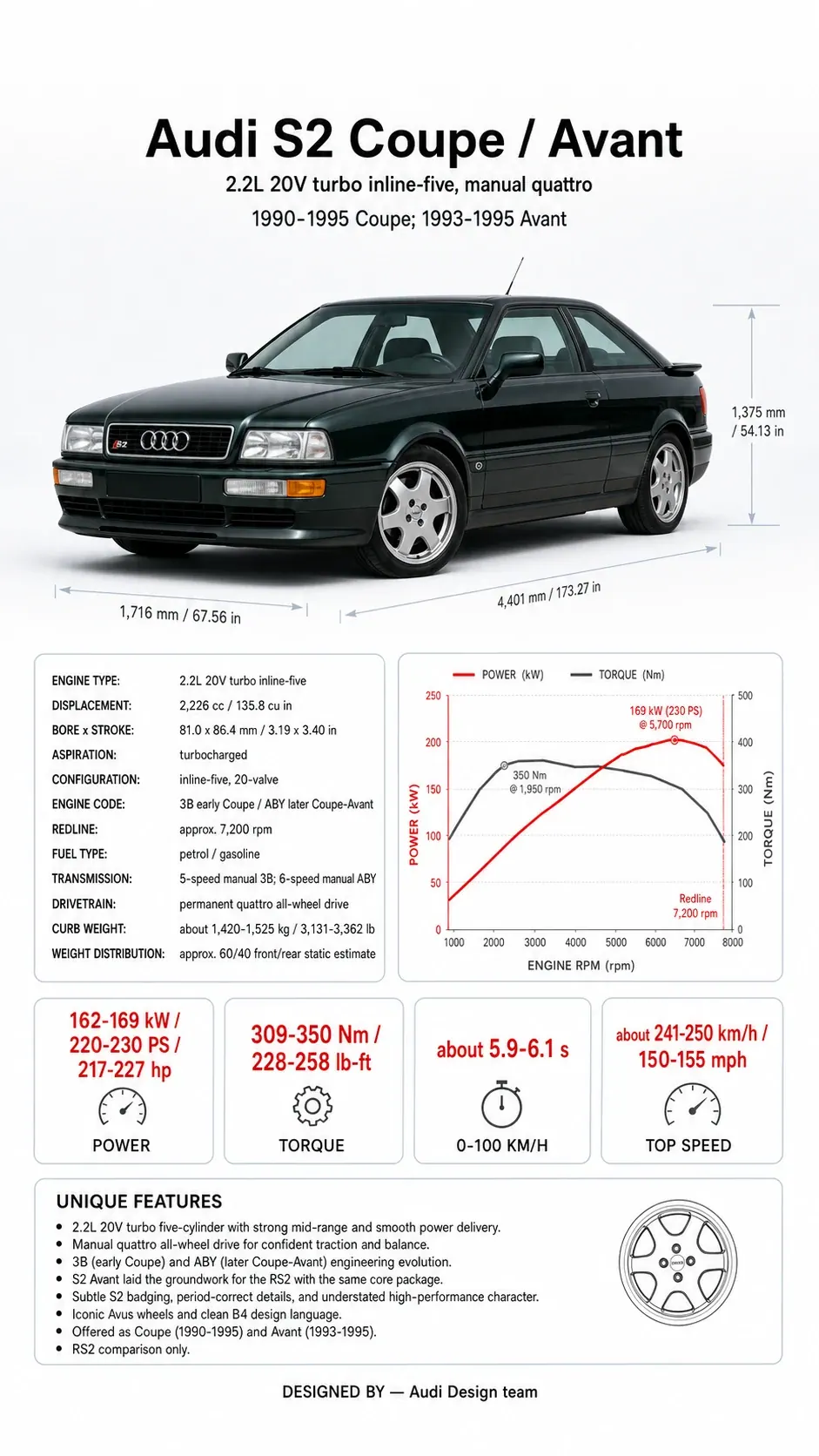
The S2 story changes depending on body style. The Coupe is the most obvious spiritual follow-up to the old quattro idea: two doors, compact proportions, and a shape that still has late-1980s Audi Coupe in its bones. Early cars use the 3B engine and five-speed manual, while later ABY cars bring the six-speed context and updated engine management details that many buyers prefer.
The Avant changes the ownership pitch. It is not just the same car with more cargo room. It sits closer to the RS2 story because the Porsche-assisted RS2 Avant grew from the same general B4 Avant world. That does not make an S2 Avant an RS2. It makes the S2 Avant the more practical and more directly RS2-shadowed S2 body style.
The sedan is rare enough that it should be mentioned carefully rather than treated as the article’s shopping default. Most real buyer decisions will be Coupe versus Avant, with the sedan functioning as context for how unusual the S2 range became. When a seller claims rarity, the buyer should ask which rarity: body style, engine code, market, color, history, or simply the fact that all real S2s are now uncommon.
3B, ABY, And The Five-Cylinder Reason
The S2’s engine is the center of the car. The early 3B and later ABY versions are not just trivia; they affect gearbox, drivability, service proof, parts conversation, and value. The reader should know whether the car being inspected is an early five-speed 3B Coupe or a later ABY car with the six-speed context. Seller listings often blur those details because “2.2 turbo quattro” sounds good enough. It is not good enough for a serious purchase.
The five-cylinder character is the S2’s emotional hook. The power numbers are modest by modern performance-car standards, but the combination of turbo shove, sound, manual gearbox, and all-weather traction remains special. A healthy S2 should feel strong, mechanical, and traction-rich rather than delicate or vague. A tired one can still look correct in photos while hiding boost, ignition, cooling, brake, or driveline issues.
Engine-code proof is also the simplest defense against converted cars. In markets where the original S2 was never common, ordinary Coupe quattro shells, later turbo swaps, and S2-look builds can create confusion. A conversion can be interesting, but it is not the same purchase as a factory S2. The article should tell the reader to verify the chassis, engine, paperwork, and equipment before paying factory-S2 money.
Performance Character
The S2 is quick in a way that still feels meaningful on real roads. Period-style acceleration numbers around the six-second 0-100 km/h range and top-speed figures in the 240 km/h range are not the whole story. The car’s charm is the way it delivers speed through traction and torque rather than through modern launch-control drama. It feels like a compact all-weather Audi with a serious engine, not a fragile weekend ornament.
That also means the buyer should not expect a lightweight sports coupe. The S2 is secure, dense, and planted. A good one communicates through boost response, steering weight, drivetrain feel, and old-Audi solidity. A poor one feels dull because maintenance has taken the edge off the engine, brakes, suspension, or tires. The test drive should be long enough to feel warm behavior, boost consistency, braking confidence, and whether the car tracks cleanly.
This is where the S2 still makes sense below the RS2. You get much of the five-cylinder quattro personality without the same collector fear. An owner can use the car more freely, especially if they bought a clean but not museum-grade example. The performance case is not that the S2 is objectively faster than newer Audis. It is that it gives a rare mechanical flavor newer Audis do not replicate.
The RS2 Shadow
The RS2 shadow helps and hurts the S2. It helps because enthusiasts understand that the S2 Avant lives near the foundation of Audi’s first RS estate legend. It hurts because sellers and buyers sometimes let RS2 aura leak into S2 claims. The S2 does not become a Porsche-built car because the RS2 exists. It does not inherit RS2 brakes, trim, wheels, or market value without proof.
Use the RS2 as a value and context reference only. If RS2 prices keep climbing, a real S2 Avant or strong S2 Coupe may look more attractive to people who want the five-cylinder quattro experience. That does not mean every S2 should be priced like the RS2’s understudy. Body style, history, originality, engine code, mileage, market, and maintenance still decide the number.
The best way to phrase it for readers is simple: the S2 is the car under the RS2 shadow, not the RS2 in disguise. If you want Porsche-assisted hardware and RS mythology, buy the RS2 and pay the RS2 price. If you want the earlier S-car recipe with more usable money and less collector pressure, the S2 is the smarter place to look.
Current Price Range
The current market is wide because the S2 crosses several categories at once. It is a youngtimer, an early S car, a turbo-five Audi, a manual quattro, an import-interest object, and in Avant form a car that gets pulled into RS2 conversations. European listings can show rougher or high-mile examples far below the strongest asks, while cleaner Coupe listings can climb into the high EUR40k to EUR50k zone. Auction results can sit lower when condition, mileage, paperwork, or buyer attention is weaker.
A practical good-buy range for a documented usable S2 is around EUR25,000 to EUR38,000 before exceptional color, mileage, body style, or history premiums. That range is not a guarantee. It is a working band for the reader to compare against live listings, recent auctions, and the inspection result. A very cheap car needs a reason. A very expensive car needs proof.
The RS2 should stay outside the S2 range. Its values can explain why S2 interest has risen, but they should not become the S2 price guide. A seller asking RS2-adjacent money for an S2 needs to show exceptional originality, condition, records, and body-style desirability. Otherwise, the buyer should remember that the S2’s appeal is usable rarity, not paying RS money without RS hardware.
Inspection And Reliability
The inspection starts with identity and records. Confirm the VIN, body style, engine code, gearbox, and service history before falling in love with the sound. A real S2 should have paperwork that supports its story. A car with missing records, unexplained repainting, inconsistent trim, weak engine-code proof, or seller confusion deserves a slower inspection and a lower offer.
Mechanically, focus on the turbo five-cylinder, cooling system, ignition and boost behavior, oil leaks, belts, hoses, mounts, clutch feel, gearbox behavior, and quattro drivetrain. The braking system also deserves attention. Specialist and owner notes often point out that the car’s speed can outrun tired original brakes, so worn discs, old fluid, lazy calipers, or cheap pads are not small details. They change whether the car is ready to enjoy or needs immediate sorting.
Rust and underside condition matter because many S2s lived real lives. Check sills, arches, jacking points, floor areas, suspension mounts, subframes, brake lines, and previous repair quality. High mileage is not automatically fatal if the car has been maintained well, but neglected age is expensive. The safest S2 is not always the lowest-mile car; it is the car whose paperwork and condition agree with each other.
Technical Checks That Matter
The 3B/ABY distinction should be written down during the inspection. Early and late cars have different supporting details, and the buyer should not rely on a listing headline alone. Ask for photos of the engine bay, data plates, service records, and any specialist invoices. If the car has been modified, ask exactly what changed, who did the work, whether original parts remain, and whether the tune is documented.
Electrical condition is another serious check. Older Audis can hide weak batteries, tired grounds, aged connectors, inoperative interior functions, instrument issues, and alarm or immobilizer oddities. A short test drive may not show these. Cold start, warm restart, fan operation, lights, windows, mirrors, gauges, heater controls, and warning lights should all be checked before price is discussed seriously.
The quattro driveline should feel smooth, not clunky or neglected. Listen for noises, feel for vibration, and check tire matching. A manual quattro car with mismatched tires, old suspension parts, and no driveline service evidence is telling the buyer something. It may still be worth saving, but the price needs to reflect the work.
Originality, Body Identity, And Parts
Originality is more valuable when it proves the car’s S2 identity. Correct body panels, bumpers, lights, wheels, interior pieces, badges, and market details all matter because ordinary Audi Coupe and 80 parts can blur the story. A tasteful driver does not have to be concours-correct, but it should be honest. A factory S2 with mild reversible updates is different from a conversion wearing S2 cues.
The buyer should be careful with RS2-style upgrades. Better brakes, wheels, or trim may improve the driving experience, but they should be described as modifications, not factory S2 proof. If the owner is asking a premium because the car has RS2-inspired parts, the buyer should separate the value of those parts from the value of the base car.
Parts availability is part of the ownership decision. Some ordinary service items are manageable, but S2-specific pieces, trim, engine hardware, and correct body details can be slow or expensive to source. That is another reason a complete car with records can be cheaper in the long run than a bargain that needs everything.
Ownership Fit
The S2 fits a buyer who wants to use a rare car. It is special enough to protect, but not so expensive that every mile feels like a financial decision. That is the best argument for the car. It lets an enthusiast own a real turbo-five quattro with early S-car meaning while staying below the RS2’s financial and emotional ceiling.
It is less ideal for a buyer who wants modern Audi ease. The S2 is old enough to need patience, specialist help, and parts planning. If the buyer expects newer S4 reliability, dealer convenience, or plug-and-play upgrade culture, the car may frustrate them. The S2 rewards people who enjoy the research and accept that the best examples are bought through evidence, not speed.
US buyers should also think about import and registration reality. A European-market S2 may be legal to import by age, but condition, paperwork, shipping, inspection, parts access, and insurance all affect the real cost. Those costs belong in the purchase plan before a buyer celebrates a low overseas ask.
Recommendation
Buy the S2 if you want a real five-cylinder turbo quattro that you can understand, inspect, and use. Prioritize factory identity, records, engine-code proof, rust condition, drivetrain health, and an honest seller. Choose the Coupe if you want the purer two-door shape and old-quattro flavor. Choose the Avant if practicality and RS2-adjacent context matter, while still remembering it is not an RS2.
Do not buy the cheapest S2 just because it looks like an access point into the RS2 story. A cheap car with weak proof can cost more than a mid-market car with records. Do not buy the most expensive one just because the seller mentions RS2 values. The right S2 price comes from the actual car in front of you.
The cleanest recommendation is to buy a documented, mostly original, mechanically sorted S2 in the body style you actually want. The RS2 shadow makes the S2 more visible, but the five-cylinder quattro experience is the reason to keep it.


FAQ
Is the Audi S2 an RS2?
No. The S2 is related to the RS2 story, especially in Avant form, but it is not the Porsche-assisted RS2 and should not be priced or described as one.
Which is better, 3B or ABY?
ABY cars are often preferred for the later six-speed and updated technical package, but a well-documented 3B Coupe can still be the right buy. Condition and proof matter more than forum shorthand.
Is an S2 conversion worth buying?
It can be interesting as a modified car, but it should not be priced like a factory S2 unless the buyer specifically wants a conversion. Verify the chassis and paperwork before paying factory-S2 money.
What should I inspect first?
Start with identity, engine code, records, rust, turbo behavior, cooling health, brakes, quattro driveline, electrical functions, and seller documentation. The sound is a bonus after the proof.
FAQ
Common questions
Is the Audi S2 an RS2?
No. The S2 is related to the RS2 story, especially in Avant form, but it is not the Porsche-assisted RS2 and should not be priced or described as one.
Which is better, 3B or ABY?
ABY cars are often preferred for the later six-speed and updated technical package, but a well-documented 3B Coupe can still be the right buy. Condition and proof matter more than forum shorthand.
Is an S2 conversion worth buying?
It can be interesting as a modified car, but it should not be priced like a factory S2 unless the buyer specifically wants a conversion. Verify the chassis and paperwork before paying factory-S2 money.
What should I inspect first?
Start with identity, engine code, records, rust, turbo behavior, cooling health, brakes, quattro driveline, electrical functions, and seller documentation. The sound is a bonus after the proof.
Sources and references
- Automotive content provider article packageImported provider package; source facts are recorded in article-workspaces/audi-s2-coupe-avant/source-notes.md.
- Automotive content provider visual handoff packageAccepted provider visuals and usage evidence are recorded in article-workspaces/audi-s2-coupe-avant/article-info.json.
Topic hubs
Tags

