


Quick Answer
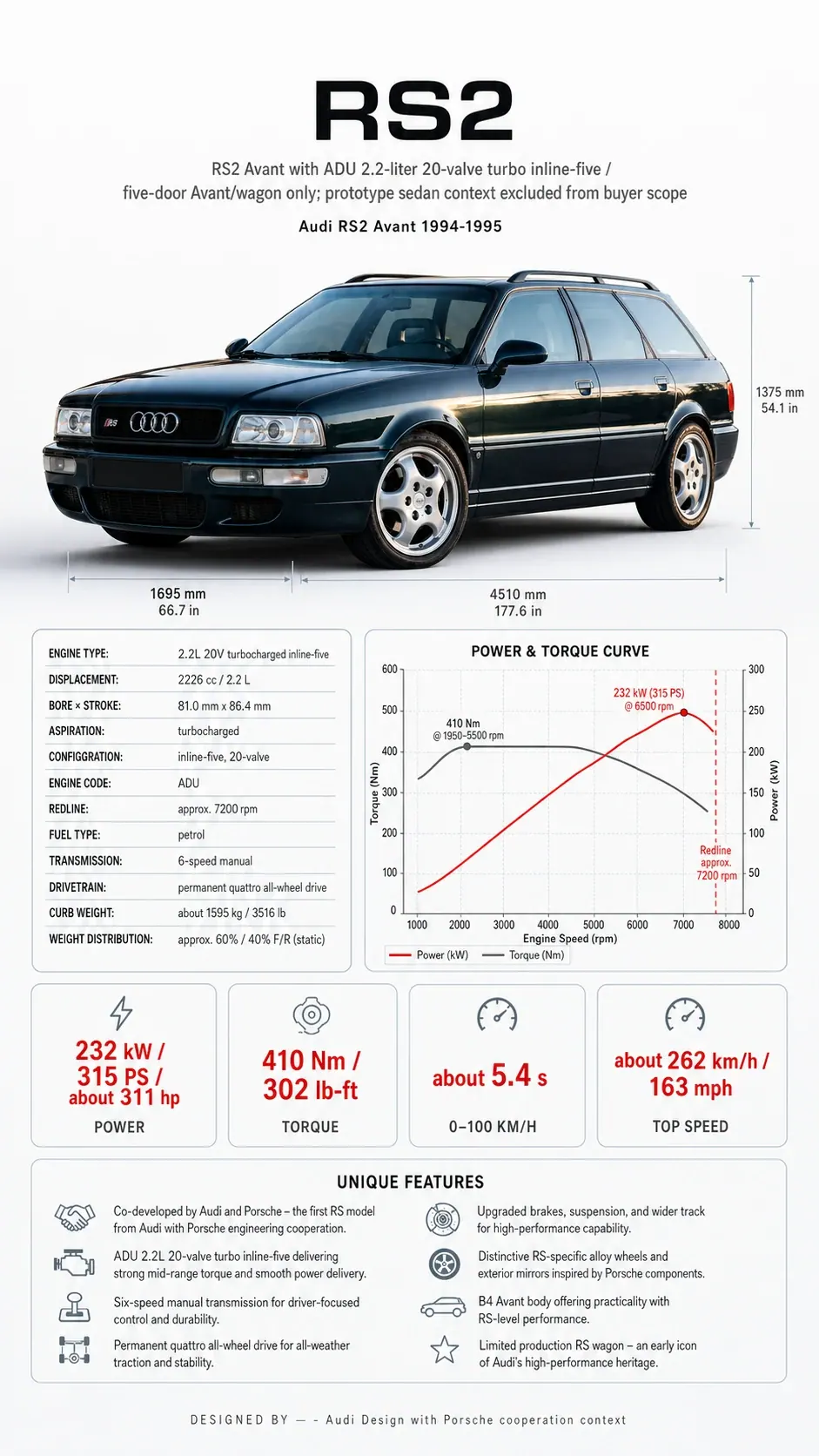
The Audi RS2 Avant is worth buying when the specific appeal is clear: a factory Porsche-assisted Audi wagon with a 2.2-liter 20-valve turbo inline-five, six-speed manual transmission, quattro traction, and the first real RS-car origin story. It is not just a quicker Audi 80 Avant and it is not a generic 1990s performance wagon. The value lives in the exact RS2 identity.
The best purchase starts with proof. Confirm that the car is a real RS2 Avant, not an S2, ordinary Avant quattro, RS2-look conversion, or badge story. Verify chassis identity, ADU engine proof, six-speed manual hardware, service records, brake condition, rust, turbo and cooling health, quattro driveline behavior, interior originality, and market paperwork before treating any seller claim as value.
For most readers, the smart buy is a complete, documented, mechanically sorted driver rather than the cheapest visible car or the most expensive collector ask. RS2 demand is narrow but strong because the car sits at the intersection of Audi RS history, Porsche involvement, manual turbo-five character, and wagon usability. Buy it for that exact combination, not because it is the only old fast Audi with a five-cylinder engine.
Why The RS2 Exists
The RS2 matters because it turned Audi’s rally-shaped five-cylinder quattro mythology into a Porsche-assisted road car that pointed directly toward the later RS brand. The Ur-quattro supplied the old legend. The RS2 translated that energy into a B4 Avant package with a stronger engine, wider visual stance, upgraded braking, manual transmission, and a level of factory specialness that ordinary Audi performance models did not have.
That origin story is the reason buyers keep paying attention. Later RS4 and RS6 wagons became faster and easier to understand, but the RS2 is the root. It carries the older Audi shape, the turbo-five sound, and the unusual Porsche connection in one car. That makes it emotionally different from a later, faster RS wagon.
The buying angle should stay precise. The RS2 is not valuable because every old Audi wagon is suddenly collectible. It is valuable because a small-production factory RS Avant with Porsche involvement, manual quattro hardware, and a documented ADU turbo-five remains hard to replace.
Avant Only, With Prototype Sedan Context
For normal buyers, the RS2 is an Avant story. The production car is the long-roof B4 wagon that made the Porsche-assisted package so memorable: useful shape, discreet stance, serious hardware, and enough rarity to feel special without looking like a modern supercar. Sedan examples belong in prototype or special-context discussion, not in the normal shopping lane.
That body style matters. The RS2 Avant is appealing because it can carry people and luggage while still giving the old turbo-quattro experience. The wagon is not a compromise in the RS2 story; it is the identity. A coupe, S2, ordinary 80 Avant, or later RS car can be interesting, but it is a different purchase.
When a seller leans on rarity, ask what kind of rarity is being claimed. A real RS2 Avant with matching identity evidence is already rare. A rare color, low mileage, complete history, or market-specific paperwork can add value. A vague “rare Audi” pitch without RS2 proof should not move the price.
ADU, Porsche Touches, And The Five-Cylinder Reason
The engine is the center of the RS2. A correct car uses the ADU 2.2-liter 20-valve turbo inline-five, tied to a six-speed manual and quattro driveline. Porsche-assisted development and hardware changes are part of why the RS2 feels different from lesser Audi five-cylinder cars. The buyer should not accept a listing headline as proof; engine-code evidence and supporting records matter.
The five-cylinder character is the emotional hook. A healthy RS2 should feel strong, mechanical, traction-rich, and slightly old-school rather than polished like a modern RS car. The sound, boost build, manual shift, and all-weather grip are the experience. A tired car can still photograph well while hiding boost leaks, ignition problems, cooling weakness, brake neglect, or driveline wear.
Converted cars require extra caution. An S2 or Audi 80 Avant with RS2-style parts may be fun, but it is not the same asset as a factory RS2. If the buyer wants a modified driver, the price should reflect the base car and build quality. If the buyer wants RS2 value, the car needs RS2 identity proof.
Performance Character
The RS2 is quick in a way that still feels meaningful on real roads. Period acceleration and top-speed numbers are not the whole point. The appeal is the way the car delivers speed through boost, traction, gearing, and compact old-Audi solidity. It is more textured than a modern performance wagon and less forgiving of neglect.
That also means the test drive matters. The car should pull cleanly under boost, stop confidently, track straight, warm up normally, idle properly, and feel mechanically consistent after more than a short loop around the block. Weak brakes, inconsistent boost, tired suspension, driveline vibration, or vague gear engagement should be priced as real work.
Do not buy an RS2 expecting modern launch-control theatre or new-car comfort. Buy it because the analog turbo-five quattro personality is the feature. The best examples feel usable, dense, fast enough, and special without turning every mile into a collector panic.
Porsche Touches And RS Origin
The Porsche connection is real, but it should be handled carefully. It supports the RS2 story through development, assembly context, upgraded hardware, and the car’s place in Audi performance history. It does not mean every Porsche-branded detail a seller mentions is automatically correct, original, or value-adding.
The best RS2 listings prove the details instead of leaning on folklore. Look for records, correct equipment, proper wheels and brakes, interior consistency, body identity, and specialist maintenance history. A seller who can explain the car clearly is worth more attention than one who only repeats “Porsche-built” as a price anchor.
The RS origin also affects future demand. Collectors understand firsts. The RS2 is the first Audi RS production legend in wagon form, and that keeps the car visible even when later RS models are faster. That visibility is valuable, but only when the car in front of you is actually what it claims to be.
Current Price Range
The RS2 market is thin, condition-sensitive, and international. Prices move with documentation, mileage, color, originality, country history, service depth, and whether buyers are chasing a collector-grade car or a usable driver. Public auction results and European listings can give a direction, but they should be refreshed close to the purchase date.
A sensible buyer should build a live comp set before making an offer. Separate rough cars, modified cars, high-mileage drivers, clean documented examples, and exceptional collector cars. Then compare the specific car against that set. A low ask may hide missing proof or expensive deferred maintenance. A high ask needs rare color, mileage, originality, records, and condition to justify itself.
The important rule is not one fixed number. The rule is discipline. Pay RS2 money only for RS2 evidence. If the car is incomplete, converted, weakly documented, rusty, heavily modified, or mechanically vague, the price needs to fall enough to cover both the work and the identity risk.
Use geography as part of the pricing check. A car that looks affordable in one country may become expensive after shipping, import paperwork, taxes, registration, inspection, and first-service work. A car that looks expensive may be the better buy if it already has correct documentation, recent specialist work, clean underside evidence, and a history that travels well across markets.

Inspection And Reliability
The inspection starts with identity and records. Confirm VIN, chassis details, engine code, gearbox, service history, import paperwork, ownership chain, and any specialist invoices. A real RS2 should have a story that the paperwork supports. Inconsistent trim, unexplained repainting, missing records, unclear engine identity, or seller confusion should slow the deal down.
Mechanically, focus on the turbo five-cylinder, cooling system, ignition, boost control, belts, hoses, oil leaks, mounts, clutch, gearbox, quattro driveline, and brakes. A well-sorted RS2 can be used and enjoyed. A neglected one can become expensive quickly because the car combines old Audi age, specialist RS2 details, and higher buyer expectations.
Rust and underside condition are just as important as the powertrain. Check sills, arches, jacking points, floors, suspension mounts, subframes, brake lines, and old repair quality. Mileage alone is not the deciding factor. The safest RS2 is the car whose condition, paperwork, and seller explanation all agree with each other.
The pre-purchase inspection should be RS2-aware, not just classic-Audi-aware. A normal shop can identify obvious leaks or worn brakes, but a specialist is more likely to catch incorrect parts, bad conversions, weak boost behavior, poor replacement trim, and signs that a car has been assembled from several stories. Paying for that inspection is cheaper than discovering after purchase that the car is neither as original nor as healthy as advertised.
Technical Checks That Matter
Engine and hardware proof should be written down during inspection. Ask for engine-bay photos, data plates, service invoices, specialist notes, and clear detail on any modifications. If the car has a tune, turbo change, brake change, suspension change, or non-original wheels, the seller should explain what changed, who did it, and whether original parts remain.
Electrical condition deserves time. Older Audis can hide weak grounds, tired connectors, interior-function failures, instrument problems, warning-light issues, fan problems, alarm oddities, and battery drain. Check cold start, warm restart, lights, windows, mirrors, gauges, heater controls, fans, and warning lights before discussing final price.
The quattro driveline should feel smooth and consistent. Listen for noises, feel for vibration, and check tire matching. A manual quattro car with mismatched tires, vague service history, worn suspension, and driveline clunks may still be worth saving, but it is not a premium example.
Documentation should also explain timing-belt service, fluid history, brake work, suspension refreshes, turbo-related repairs, and any engine-management changes. If a seller cannot explain when those jobs were done, price the car as if you will be doing them soon. The RS2 is strong when maintained, but it is still a 1990s performance car with rare-model expectations attached to every invoice.
Originality, Body Identity, And Parts
Originality is valuable because it supports the RS2 identity. Correct panels, bumpers, wheels, mirrors, lights, interior pieces, badges, brakes, trim, and market details all matter. A tasteful driver does not have to be concours-perfect, but it should be honest about what is original, what has been replaced, and what has been modified.
Be careful with RS2-style upgrades on non-RS2 cars and with undocumented upgrades on real RS2s. Better brakes, wheels, or suspension may improve a driver, but they should not be sold as factory proof unless the evidence supports that claim. Separate the value of useful modifications from the value of a factory-correct RS2.
Parts availability belongs in the buying decision. Some service items are manageable, but RS2-specific trim, hardware, brakes, body details, and correct interior pieces can be slow or expensive to source. A complete car with records can be cheaper in the long run than a bargain that needs rare parts.
Photographs should support the same story as the paperwork. Look for consistent panel gaps, correct exterior details, clean interior wear patterns, factory-looking engine-bay routing, and no unexplained mixture of model-year or market parts. One incorrect detail is not always fatal, but several unexplained details should push the buyer toward deeper verification before travel or deposit money.
Ownership Fit
The RS2 fits a buyer who wants to use a rare car thoughtfully. It is special enough to protect, but practical enough to drive when sorted. That balance is the best argument for the car: it combines collector meaning with real wagon usability.
It is less ideal for someone who wants modern Audi ease. The RS2 is old enough to need patience, specialist knowledge, and parts planning. If the buyer expects dealer convenience, modern diagnostics, or cheap plug-and-play upgrades, the car may frustrate them. The RS2 rewards people who enjoy research and buy from evidence.
US buyers should also think about import and registration reality. Age eligibility does not remove the cost of shipping, customs, inspection, title work, insurance, parts sourcing, and specialist support. Those costs belong in the purchase plan before a low overseas asking price looks like a bargain.
The best owner profile is someone who enjoys the car for what it is: an old, rare, manual, turbocharged Audi wagon with Porsche-assisted history. That buyer will maintain it carefully, document work, avoid irreversible fashion changes, and accept that the car’s value depends on preserving its identity. Someone who wants a cheap fast wagon, a modern daily driver, or a blank tuning canvas should probably buy something else.
Recommendation
Buy the RS2 Avant if you want the original Porsche-assisted Audi RS wagon experience and the specific car proves its identity. Prioritize ADU engine proof, factory equipment, records, rust condition, drivetrain health, brake condition, originality, and an honest seller. Walk away from vague conversions, missing-history cars, or sellers leaning on Porsche mythology without evidence.
Do not buy the cheapest RS2 just because it looks like an access point into the RS story. A cheap car with weak proof can cost more than a mid-market car with records. Do not buy the most expensive one just because it has the right badge. The right RS2 price comes from the actual car in front of you.
The clean recommendation is simple: buy a documented, mostly original, mechanically sorted RS2 Avant in the condition tier you can afford to maintain. The Porsche touch creates demand, but the turbo-five quattro wagon experience is the reason to keep it.
When two cars look similar online, choose the one with clearer evidence. Better records, honest photos, specialist invoices, rust transparency, and a seller who understands the model are worth real money. The RS2 is not a car to buy from vague enthusiasm alone. It is a car to buy when the documents, condition, and test drive all tell the same story.


FAQ
Is the Audi RS2 the same as an Audi S2?
No. The RS2 Avant is the Porsche-assisted RS model with ADU turbo-five hardware, six-speed manual quattro layout, RS2-specific identity, and its own market. The S2 is related context, not the same purchase.
Is the RS2 only an Avant?
For normal production and shopping purposes, yes: the RS2 is an Avant story. Sedan examples belong in prototype or special-context discussion and should not be treated as the normal buyer path.
Is an RS2 conversion worth buying?
It can be interesting as a modified driver, but it should not be priced like a factory RS2. Verify the chassis, engine, paperwork, and build quality, then value it as the car it actually is.
What should I inspect first?
Start with identity, engine-code proof, records, rust, turbo behavior, cooling health, brakes, quattro driveline, electrical functions, and seller documentation. The sound matters after the proof.
FAQ
Common questions
Is the Audi RS2 the same as an Audi S2?
No. The RS2 Avant is the Porsche-assisted RS model with ADU turbo-five hardware, six-speed manual quattro layout, RS2-specific identity, and its own market. The S2 is related context, not the same purchase.
Is the RS2 only an Avant?
For normal production and shopping purposes, yes: the RS2 is an Avant story. Sedan examples belong in prototype or special-context discussion and should not be treated as the normal buyer path.
Is an RS2 conversion worth buying?
It can be interesting as a modified driver, but it should not be priced like a factory RS2. Verify the chassis, engine, paperwork, and build quality, then value it as the car it actually is.
What should I inspect first?
Start with identity, engine-code proof, records, rust, turbo behavior, cooling health, brakes, quattro driveline, electrical functions, and seller documentation. The sound matters after the proof.
Sources and references
- Automotive content provider article packageImported provider package; source facts are recorded in article-workspaces/audi-rs2-avant/source-notes.md.
- Automotive content provider visual handoff packageAccepted provider visuals and usage evidence are recorded in article-workspaces/audi-rs2-avant/article-info.json.
Topic hubs
Tags

