


Quick Answer
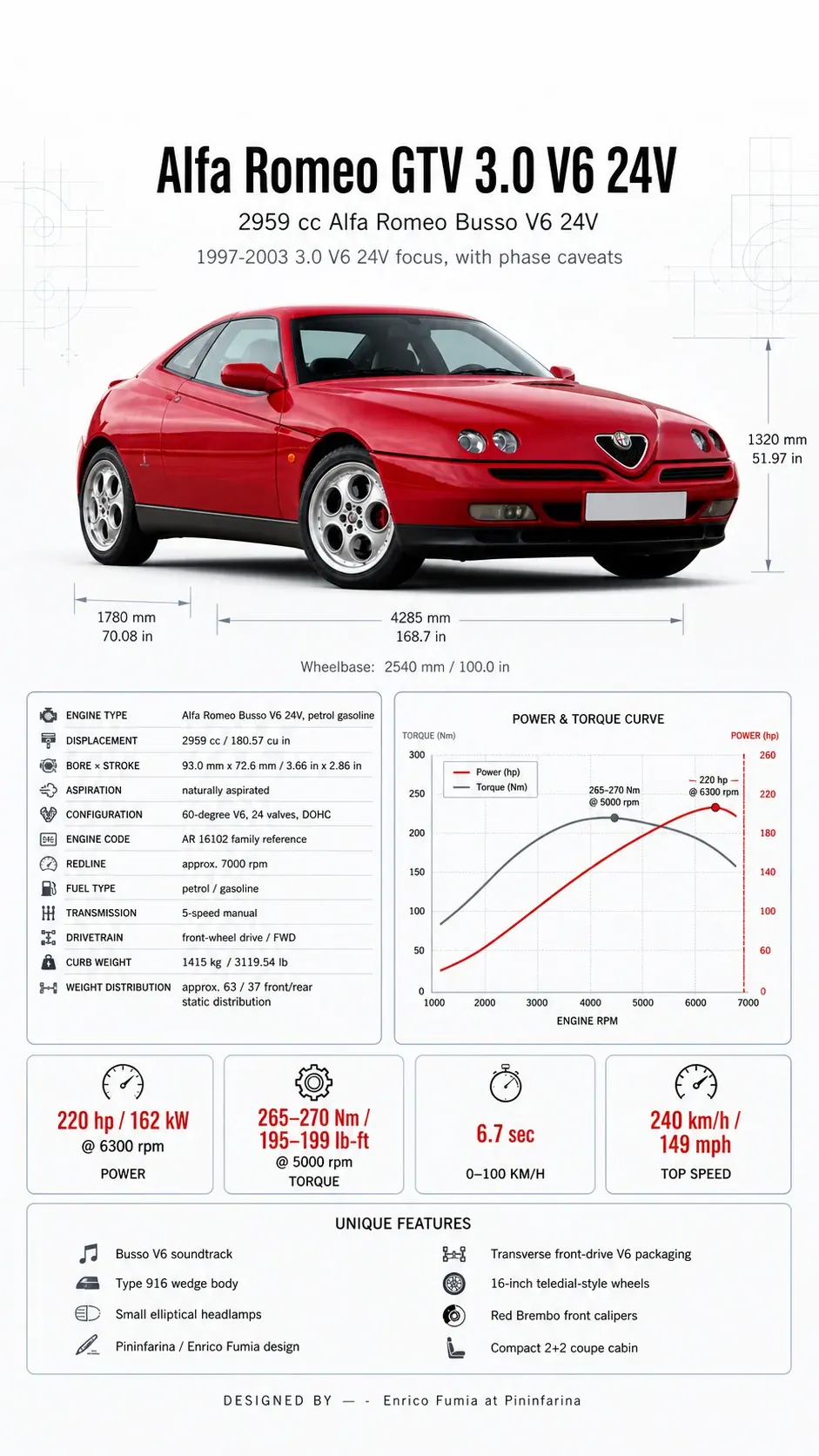
The Alfa Romeo GTV 3.0 V6 Busso is worth wanting for a very specific reason: it packages the 24-valve Alfa V6, a Type 916 Pininfarina-era coupe body, and a front-drive chassis into something that feels more emotional than its raw numbers suggest. It is not the rational performance coupe in the 1990s field. It is the car for a buyer who hears the Busso, sees the wedge shape, and still has enough discipline to demand belt records, suspension proof, cooling-system care, and a realistic parts plan. A cheap GTV V6 without that folder is usually just a deferred invoice with a better soundtrack.
The practical test is simple: keep the GTV tied to the saved Type 916 3.0 V6 evidence, ask what this exact car proves, and let the answer shape the recommendation. For this section, the important proof points are insight-01, insight-05, so the copy stays anchored to the Busso coupe instead of drifting into broad used-car advice. The reader should come away knowing what to check, why it matters, and which claim changes if the car is actually a Spider, 2.0 V6 Turbo, Twin Spark, 3.2 V6 or undocumented Cup-style example.
What the 3.0 V6 GTV is
The article car is the Type 916 Alfa Romeo GTV coupe with the naturally aspirated 3.0 24-valve Busso V6. That scope matters because the 916 family also includes Twin Spark four-cylinder cars, the Italian-market 2.0 V6 Turbo, Spider bodies, later 3.2 V6 cars, and Cup-style visual packages. The 3.0 V6 24V GTV is a compact two-door 2+2 coupe, front-wheel drive, and manual. Its identity is the engine and shape first, then the condition of the individual car. Treating it as a broad Alfa coupe guide hides the exact service and value questions that decide whether one is a keeper.
The practical test is simple: keep the GTV tied to the saved Type 916 3.0 V6 evidence, ask what this exact car proves, and let the answer shape the recommendation. For this section, the important proof points are insight-02, insight-04, so the copy stays anchored to the Busso coupe instead of drifting into broad used-car advice. The reader should come away knowing what to check, why it matters, and which claim changes if the car is actually a Spider, 2.0 V6 Turbo, Twin Spark, 3.2 V6 or undocumented Cup-style example.
Why the Busso is the headline
The Busso V6 is the reason this car keeps pulling people back. In 3.0 24-valve form it gives the GTV a vocal, mechanical personality that a spec sheet cannot fully explain. The appeal is not just horsepower. It is the intake note, the way the engine makes an old front-drive coupe feel expensive in one moment and gloriously Italian in the next, and the way that character survives even when modern cars are quicker. The same engine also sets the buying standard. If the belt service, water pump, oil leak, cooling and ignition evidence are weak, the very reason to buy the car becomes the reason to walk away.
The practical test is simple: keep the GTV tied to the saved Type 916 3.0 V6 evidence, ask what this exact car proves, and let the answer shape the recommendation. For this section, the important proof points are insight-01, insight-14, so the copy stays anchored to the Busso coupe instead of drifting into broad used-car advice. The reader should come away knowing what to check, why it matters, and which claim changes if the car is actually a Spider, 2.0 V6 Turbo, Twin Spark, 3.2 V6 or undocumented Cup-style example.
Why the design still works
The GTV 916 design still divides people because it never tried to be a quiet background shape. The tiny headlamps, the strong rear haunch, the low nose, the high tail and the almost concept-car side profile give it a different kind of presence from German coupes of the same era. That is why the visual package for this article has to preserve the correct body, not a smoothed modern Alfa fantasy. The car’s design story is part of the purchase logic: you buy a GTV because the form and engine create a memory before the spreadsheet gets a chance to talk you out of it.
The practical test is simple: keep the GTV tied to the saved Type 916 3.0 V6 evidence, ask what this exact car proves, and let the answer shape the recommendation. For this section, the important proof points are insight-03, insight-11, so the copy stays anchored to the Busso coupe instead of drifting into broad used-car advice. The reader should come away knowing what to check, why it matters, and which claim changes if the car is actually a Spider, 2.0 V6 Turbo, Twin Spark, 3.2 V6 or undocumented Cup-style example.
How it drives
A good GTV 3.0 V6 is an engine-led car. The front tires have to manage steering, braking and the V6’s pull, so this is not a rear-drive balance lesson. The reward is more sensory than surgical: the Busso builds the occasion, the compact coupe body keeps the road close, and the chassis asks you to drive with some respect for the front end. That honesty is important. If a buyer expects a precision rival to an M car, disappointment follows. If the buyer wants a charismatic road coupe that turns every tunnel and on-ramp into a small event, the GTV makes sense.
The practical test is simple: keep the GTV tied to the saved Type 916 3.0 V6 evidence, ask what this exact car proves, and let the answer shape the recommendation. For this section, the important proof points are insight-10, insight-02, so the copy stays anchored to the Busso coupe instead of drifting into broad used-car advice. The reader should come away knowing what to check, why it matters, and which claim changes if the car is actually a Spider, 2.0 V6 Turbo, Twin Spark, 3.2 V6 or undocumented Cup-style example.
Reliability reality
The right way to talk about reliability is not to repeat old Alfa jokes. The 3.0 Busso itself has a reputation for being strong when maintained, but the car around it is now old enough that neglect matters more than brand folklore. Timing-belt age, water pump work, cooling condition, oil seepage, tired bushes, spring-pan condition, electrical behavior, clutch feel, gearbox quality and trim condition all need proof. A high-mile car with careful records can be safer than a shiny low-use car that has aged in silence. The GTV is not impossible to own. It is simply intolerant of vague service stories.
The practical test is simple: keep the GTV tied to the saved Type 916 3.0 V6 evidence, ask what this exact car proves, and let the answer shape the recommendation. For this section, the important proof points are insight-05, insight-12, so the copy stays anchored to the Busso coupe instead of drifting into broad used-car advice. The reader should come away knowing what to check, why it matters, and which claim changes if the car is actually a Spider, 2.0 V6 Turbo, Twin Spark, 3.2 V6 or undocumented Cup-style example.
Parts and maintenance
Parts supply is the ownership filter that separates a romantic buy from a usable one. The 916 sits at an awkward age: too modern for every part to be reproduced as a classic, too old for dealer shelves to solve every problem quickly. V6 gaskets, rubber, suspension pieces, interior trim and model-specific body items should be checked before purchase. A specialist relationship matters. So does knowing where service parts come from in the buyer’s region. The article should not scare readers away from the car, but it should make the simple point that maintenance access is part of the buying price.
The practical test is simple: keep the GTV tied to the saved Type 916 3.0 V6 evidence, ask what this exact car proves, and let the answer shape the recommendation. For this section, the important proof points are insight-06, so the copy stays anchored to the Busso coupe instead of drifting into broad used-car advice. The reader should come away knowing what to check, why it matters, and which claim changes if the car is actually a Spider, 2.0 V6 Turbo, Twin Spark, 3.2 V6 or undocumented Cup-style example.
Production phases
Phase and production context should be handled as buyer guidance, not trivia. Early cars are tied to Alfa’s Arese story, later cars carry the Pininfarina production-transfer context, and equipment, trim and power-rating notes can vary by market and year. None of that should turn into a claim that one phase is automatically best. Instead, use it to check paperwork, market version, steering side, gearbox, badges, wheels, interior and the exact engine installed. The safe public line is that condition and proof beat phase mythology, while phase details help the buyer decode what is in front of them.
The practical test is simple: keep the GTV tied to the saved Type 916 3.0 V6 evidence, ask what this exact car proves, and let the answer shape the recommendation. For this section, the important proof points are insight-07, insight-09, so the copy stays anchored to the Busso coupe instead of drifting into broad used-car advice. The reader should come away knowing what to check, why it matters, and which claim changes if the car is actually a Spider, 2.0 V6 Turbo, Twin Spark, 3.2 V6 or undocumented Cup-style example.
Variants and options
The GTV name can hide several different cars. A 2.0 Twin Spark GTV is a different buy from a 3.0 V6 24V. The 2.0 V6 Turbo has its own market boundary. The Spider changes the body and some buyer priorities. The later 3.2 V6 and Cup-related cars bring their own value and visual identity. Factory wheels, leather, body kits and trim should be described as possible equipment unless the specific car has paperwork. That distinction matters because buyers often chase the look of the rare version while shopping cars that only carry a few borrowed visual cues.
The practical test is simple: keep the GTV tied to the saved Type 916 3.0 V6 evidence, ask what this exact car proves, and let the answer shape the recommendation. For this section, the important proof points are insight-04, insight-09, so the copy stays anchored to the Busso coupe instead of drifting into broad used-car advice. The reader should come away knowing what to check, why it matters, and which claim changes if the car is actually a Spider, 2.0 V6 Turbo, Twin Spark, 3.2 V6 or undocumented Cup-style example.
What to pay
The current market is condition-sensitive rather than simple. Recent UK and European listing evidence shows rougher or high-mile cars can appear in lower-price territory, while cleaner documented cars climb into mid or high teens depending on region, mileage, steering side, history and presentation. A very low-mile car can sit outside normal driver-car advice. A practical buy target is not the cheapest visible listing. It is the car with belt history, suspension proof, clean body, working electrics, good interior and a specialist path for future parts. Paying more for evidence is often cheaper than buying a cheap Busso twice.
The practical test is simple: keep the GTV tied to the saved Type 916 3.0 V6 evidence, ask what this exact car proves, and let the answer shape the recommendation. For this section, the important proof points are insight-08, insight-13, so the copy stays anchored to the Busso coupe instead of drifting into broad used-car advice. The reader should come away knowing what to check, why it matters, and which claim changes if the car is actually a Spider, 2.0 V6 Turbo, Twin Spark, 3.2 V6 or undocumented Cup-style example.

Inspection checklist
Start with the service file, then prove the car underneath matches it. Check timing-belt age and scope, water pump, auxiliary belts, cam-cover leaks, cooling health, cold start, idle, clutch behavior, gearbox shift quality, front suspension, rear suspension, spring pans, brakes, tire wear, electrical warnings, windows, locks, climate control and interior plastics. Look for accident repair and tired paint on a body with expensive-to-find trim. On a test drive, the engine should be the star, not a distraction from knocks, heat problems or warning lights. The best GTV V6 feels special and sorted at the same time.
The practical test is simple: keep the GTV tied to the saved Type 916 3.0 V6 evidence, ask what this exact car proves, and let the answer shape the recommendation. For this section, the important proof points are insight-12, so the copy stays anchored to the Busso coupe instead of drifting into broad used-car advice. The reader should come away knowing what to check, why it matters, and which claim changes if the car is actually a Spider, 2.0 V6 Turbo, Twin Spark, 3.2 V6 or undocumented Cup-style example.
Bad buys
The bad GTV V6 usually tells on itself if the buyer listens. A loud exhaust cannot replace belt proof. A polished exterior cannot erase weak suspension. Rare wheels do not solve oil leaks. A seller story about Alfa character does not explain electrical faults, overheating, weak brakes or missing parts. Be extra careful with cars presented as Cup-like, special, imported or upgraded unless documentation is clear. The danger is buying the emotion and only later discovering the car needs the budget that should have gone into a better example. The right GTV does not need excuses to be interesting.
The practical test is simple: keep the GTV tied to the saved Type 916 3.0 V6 evidence, ask what this exact car proves, and let the answer shape the recommendation. For this section, the important proof points are insight-13, insight-05, so the copy stays anchored to the Busso coupe instead of drifting into broad used-car advice. The reader should come away knowing what to check, why it matters, and which claim changes if the car is actually a Spider, 2.0 V6 Turbo, Twin Spark, 3.2 V6 or undocumented Cup-style example.
Final recommendation
Buy the Alfa Romeo GTV 3.0 V6 Busso if the engine sound, Type 916 design and Alfa character are the point of the purchase, and if the records are strong enough to make that emotion usable. Do not buy one as a cheap shortcut into classic performance. The GTV is best as a carefully chosen weekend coupe with a specialist-backed service plan, not as a bargain daily driver bought on hope. When the paperwork, condition and price align, it delivers something very few cars do: an attainable coupe that still feels like a special occasion because of the exact engine and body it carries.
The practical test is simple: keep the GTV tied to the saved Type 916 3.0 V6 evidence, ask what this exact car proves, and let the answer shape the recommendation. For this section, the important proof points are insight-14, insight-08, so the copy stays anchored to the Busso coupe instead of drifting into broad used-car advice. The reader should come away knowing what to check, why it matters, and which claim changes if the car is actually a Spider, 2.0 V6 Turbo, Twin Spark, 3.2 V6 or undocumented Cup-style example.


FAQ
Common questions
What should I verify first on an Alfa Romeo GTV 3.0 V6 Busso?
Start with belt records, water pump and cooling care, suspension proof, oil leaks, ignition and electrical behavior, clutch or gearbox feel, body condition, and a realistic parts plan.
Is the Alfa Romeo GTV 3.0 V6 Busso the rational coupe choice?
No. The source package frames it as an emotional Type 916 24-valve Busso coupe. It makes sense when records prove care; a cheap undocumented car is usually deferred maintenance.
Sources and references
- Automotive content provider article packageImported provider package; source facts are recorded in article-workspaces/alfa-romeo-gtv-3-0-v6-busso/source-notes.md.
- Automotive content provider visual handoff packageAccepted provider visuals and usage evidence are recorded in article-workspaces/alfa-romeo-gtv-3-0-v6-busso/article-info.json.
Topic hubs
Tags

