


Quick Answer
The Peugeot 306 GTI-6 is easy to underrate if you only read the badge hierarchy. A Volkswagen Golf GTI was the default name many buyers understood, but the 306 GTI-6 and its lighter UK Rallye derivative built their reputation in a different way. They are not about premium polish or a huge power number. They are about a rev-happy XU10J4RS engine, a six-speed manual gearbox, a compact body, a supple ride and a chassis that still feels alive when the car is healthy.
That last phrase matters. A good 306 GTI-6 can be brilliant. A tired one can feel like every old French-car cliche at once. The same rear beam, suspension compliance and steering feedback that make the car special also make condition critical. If the rear beam is worn, the front end is loose, the gearbox is tired or the cambelt record is vague, the badge does not save the car.
For most buyers, the right 306 is the car with proof: recent belt and water-pump history, a straight shell, a rear beam that sits and tracks correctly, a clean six-speed shift, working electrics, honest trim and a seller who understands the GTI-6/Rallye difference. Buy it because you want the Peugeot feel that the Golf never quite had, not because you found the cheapest 1990s hot hatch with a famous badge.
The XU10J4RS And Six-Speed Manual
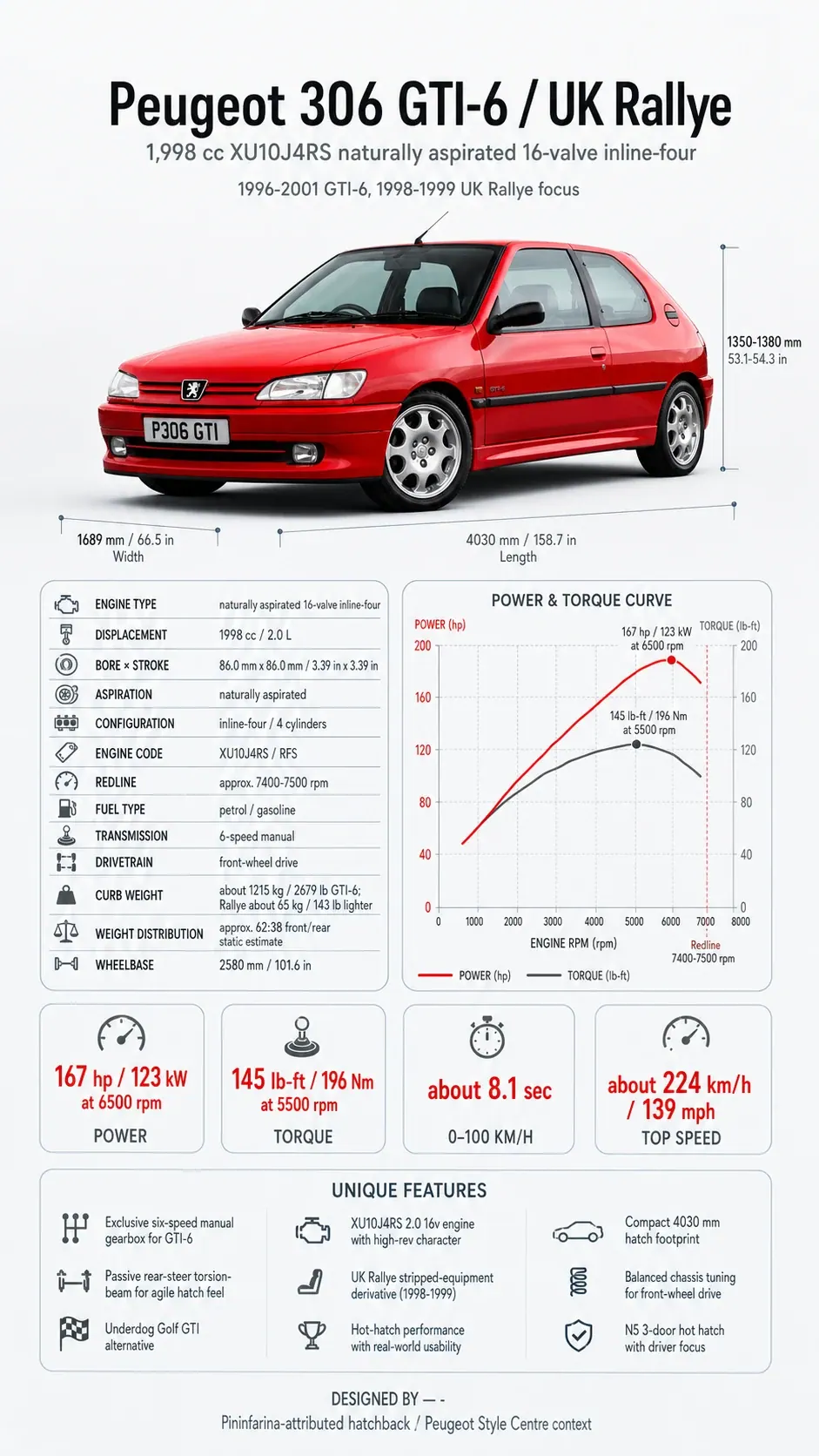
The GTI-6 name tells you two important things. It uses Peugeot’s 1,998 cc XU10J4RS 16-valve inline-four, and it sends power through a six-speed manual gearbox at a time when many rivals still used five speeds. The common public figure is around 167 hp, with torque a little under 150 lb-ft depending on source. Modern hot hatches dwarf that on paper, but the 306’s appeal is not modern boost.
The engine needs revs and rewards them. It is naturally aspirated, eager and mechanical in a way that makes a B-road feel faster than the numbers suggest. A good car pulls cleanly, idles properly, warms without drama and does not hide belt or valvetrain anxiety behind noise. A bad one can turn a cheap purchase into a head-off repair quickly.
The six-speed gearbox is part of the identity, not just a ratio count. It makes the car feel different from an ordinary 306 and gives the driver more to do. It should shift cleanly, especially when warm. Crunching, baulking or a sloppy linkage needs investigation. A seller who waves away gearbox symptoms because “they all do that” is asking you to fund their deferred maintenance.
Chassis, Steering, And The Rear Beam
The 306’s lasting reputation comes from its chassis. Period reviews and owner guides keep coming back to the same ideas: steering feel, ride quality, balance and the rear axle’s willingness to help the car rotate. That is why the car can sit under the Golf GTI shadow and still be the one enthusiasts defend after a proper drive.
The catch is that the chassis only feels magical when the parts are right. Rear beam wear, radius-arm bearing issues, tired bushes, droplinks, wishbones, top mounts, dampers, tires and alignment can all turn the car from fluid to nervous. A sagging rear, odd camber, clunks, scraping noises or instability under load should be treated as price-changing evidence, not character.
On a test drive, the car should feel like one piece. It can move around and communicate, but it should not wander, tramline wildly, knock over bumps or feel delayed when you turn in. If the car has track parts, polybushes or non-standard suspension, ask who fitted them and why. The 306 does not need to be made harsh to be good.
GTI-6 Versus Rallye
The UK 306 Rallye is often treated like the purist’s pick, but the reason must be stated correctly. It used the GTI-6 mechanical package and stripped weight by deleting comfort equipment such as air conditioning, electric windows and some sound-deadening. It was not a hotter engine tune. It was a lighter, simpler, rarer version of the same core idea.
That makes the Rallye desirable, but it also makes proof important. A genuine Rallye should be checked against its market, color, trim, equipment and history. Do not pay Rallye money for a normal GTI-6 with badges, and do not assume a Rallye is automatically the better buy if a cleaner GTI-6 has stronger history.
The GTI-6 is the better fit for someone who wants the same engine and gearbox with more comfort equipment. The Rallye is the sharper collector and driver story when it is real and solid. In both cases, condition beats mythology. A ropey Rallye is still a ropey old Peugeot; a sorted GTI-6 can be the better car to own.
Current Price Range
May 2026 visible market evidence shows a lumpy market rather than one neat value. A current Car and Classic GTI-6 listing sits at GBP 11,995, PistonHeads shows a similar GTI-6 ask and a Rallye advertised higher, Auto Trader shows a Rallye at GBP 10,000, and The Classic Valuer’s Rallye sold-price guide gives a lower normal sold-price band. Exceptional low-mile Rallye stories can go far beyond that, but those cars should be treated as collector outliers.
A practical normal range is roughly GBP 6,000 to GBP 15,995 depending on whether you are looking at sold-price guide context, a usable GTI-6, a real Rallye, or a dealer-advertised stronger car. A good-buy target for a documented, usable GTI-6/Rallye-class example is around GBP 10,000 to GBP 12,500 before rare Rallye identity, low mileage or exceptional originality pushes it higher.
The price only makes sense when it is tied to proof. Cambelt age, rear beam condition, rust, crash repairs, gearbox behavior, originality, phase, mileage, trim and current MOT history all matter. Do not overpay because supply is thin. Also do not expect the cheapest car to be cheap after the first round of belts, beam, brakes, tires, leaks and electrical sorting.

Inspection And Reliability
Start with the belt record. GTI-6/Rallye buyer guides repeatedly warn about cambelts, tensioners and water pumps because failure can be severe. If the seller cannot prove when the belt work was done, budget for doing it immediately and price the car accordingly. Listen from cold for persistent top-end ticking or suspicious noises that could point to previous belt trouble or poor repair.
Next, inspect the rear beam and suspension. Look at rear ride height, rear wheel angle, tire wear, knocks, clunks and the way the car settles after bumps. Check front wishbones, ball joints, droplinks, top mounts and dampers. The 306’s reputation was earned by healthy cars; worn parts can make it feel loose and imprecise.
Then check the body and electrics. These cars were enjoyed hard, and some were crashed, tracked, modified, stored badly or repaired cheaply. Look for panel mismatch, corrosion, poor jacking-point repairs, water in lamps, airbag warning lights, door-loom issues, tired seat wiring, damaged interior plastics and weak maintenance records. None of these is shocking on an old 306, but together they decide whether the asking price is brave or fair.
Size And Usability
The 306 GTI-6 is compact by modern standards. The commonly cross-checked dimensions are about 4030 mm long, around 1689 mm wide and on a 2580 mm wheelbase, with GTI-6 curb weight around 1215 kg depending on source and phase. The Rallye’s weight saving makes the car feel even more focused, but both cars are small enough to make modern hot hatches feel bulky.
The cabin is usable rather than luxurious. A GTI-6 can work as a weekend car that still carries people and luggage in a practical hatchback way. A Rallye asks you to accept less equipment for the sake of simplicity and rarity. The rear seats, hatch and compact footprint are part of why the car remains appealing, but this is still an old three-door performance hatch.
Interior condition matters because some parts are not as easy to find as service items. Seat bolsters, trim, switches, dashboard details, carpets and original equipment tell you how the car lived. A complete cabin can be worth more than a car with a louder exhaust and a box of missing pieces.

Phases, Equipment, And Originality
GTI-6 cars changed through the 306’s phase updates. The public buying job is not to memorize every trim screw, but to make sure the car’s lamps, bumpers, grille, dashboard, seats, wheels and equipment make sense for its year and claimed variant. Phase details can also reveal repairs when one end of the car looks like a different period.
Originality is not a religion, but it is valuable. The 306 does not need extreme modifications to feel good. Sensible maintenance, quality dampers, fresh tires, correct brakes and a careful alignment can do more for the drive than a random list of track parts. If a car is modified, the work should be documented and reversible enough for a buyer to understand the risk.
Rallye originality deserves extra care. Because the car’s value is partly tied to what Peugeot removed, not added, fake comfort upgrades or incorrect trim can change the story. A buyer should treat Rallye identity like any other claim: verify it through the car, paperwork and physical details rather than trusting the badge alone.
Auction And Modified Cars
Recent auction and listing examples show why history matters. A car with recommissioning, timing-belt work, good photos and documented refurbishment is not the same proposition as a tired car with similar mileage. A modified car can be enjoyable, but it shifts the question from “is this a clean GTI-6?” to “who changed it, how well, and what did that do to reliability and value?”
Track-day history is not automatically bad. These cars are fun enough that many were used hard. The problem is undocumented hard use. Look at brakes, tires, suspension, seats, harness holes, stripped interiors, non-standard engine work and signs of crash repair. A car can be a great driver and a weak collector buy at the same time.
If you want a factory-feeling road car, pay for one that still feels like Peugeot intended. If you want a track toy, pay track-toy money and inspect accordingly. The worst purchase is the car priced like a cherished original but maintained like a disposable weekend weapon.
What Makes A Good One Feel Right
A sorted 306 GTI-6 does not need to shout. The first good sign is that the car feels light in your hands before you start driving quickly. The steering should have clean weight, the engine should pick up without hesitation, and the gearshift should invite you to keep the car in the right part of the rev range. It should feel old in texture, not old in a way that makes you doubt every input.
The second good sign is consistency. The car should brake straight, steer the same left and right, settle after bumps, hold temperature in traffic and restart cleanly after a hot run. If it only feels impressive for five minutes, or only when the road is smooth, the buyer is probably feeling tired parts rather than Peugeot magic. The 306’s best trick is the way ride, steering and body control work together, so any single weak system can spoil the whole car.
The third good sign is restraint. A stock or lightly refreshed GTI-6/Rallye should still look like a modest 1990s Peugeot hatch with the right stance, wheels, trim and color. The car’s underdog appeal comes from that contrast: ordinary shape, unusually good controls, and enough engine to make the chassis work. A loud car can be fun, but a quiet, documented, phase-correct example usually tells a better long-term ownership story.
Also judge the car after the first excitement fades. The 306 should still make sense at normal speed: clutch take-up should be easy, the throttle should be progressive, the steering should not feel nervous in town, and the suspension should absorb rough roads without crashing. That everyday coherence is the point. If the car only feels special when it is being thrashed, it may be masking tired fundamentals instead of showing real GTI-6 quality.
This is why the best viewing is slow. Spend time around the car before the test drive. Look at ride height, panel gaps, tire age, dampers, brake condition, interior completeness, service invoices and whether the seller has kept old parts or records. A good 306 usually rewards a patient inspection because the proof is visible in small places. A bad one often asks you to stop looking and just believe the legend.
Recommendation
The Peugeot 306 GTI-6/Rallye deserves attention because it offers a kind of hot-hatch pleasure that is easy to lose in newer cars. It is compact, communicative, revvy and more subtle than its reputation suggests. It also has enough age-related traps that enthusiasm without inspection is expensive.
Buy the car with the strongest proof. Recent belt and pump history, rear beam health, clean gearbox behavior, straight body, sensible suspension, working electrics, correct variant details and honest documentation should matter more than color, forum folklore or a low advertised price. The best GTI-6 can be more satisfying than a rough Rallye; the best Rallye can be worth the extra only when its identity and condition are real.
Walk away from vague belt records, sagging rear beams, unexplained crash repairs, electrical neglect, bad modifications and sellers who use rarity as a substitute for maintenance. A sorted 306 GTI-6/Rallye is one of the great underdog hot hatches. A neglected one is just a list of overdue jobs wrapped in a good story.

FAQ
Is the Peugeot 306 GTI-6 better than a Golf GTI?
It depends on what you want. The Golf is easier to understand and often easier to explain. The 306 GTI-6 is the more tactile driver’s-car answer when the chassis, rear beam, gearbox and engine are healthy.
Is the Rallye faster than the GTI-6?
The UK Rallye used the same core GTI-6 mechanical package but removed equipment and weight. It feels more focused because it is lighter and simpler, not because it has a different factory engine tune.
What is the biggest reliability worry?
Cambelt and tensioner proof comes first, followed closely by rear beam/suspension condition, gearbox behavior, body/crash repair evidence, cooling health and age-related electrics.
What should I pay?
Use current evidence cautiously. Normal checked GTI-6/Rallye context runs from lower Rallye sold-guide numbers to current advertised cars around GBP 10,000-GBP 15,995, while exceptional collector outliers sit outside normal buyer advice.
FAQ
Common questions
Is the Peugeot 306 GTI-6 better than a Golf GTI?
It depends on what you want. The Golf is easier to understand and often easier to explain. The 306 GTI-6 is the more tactile driver's-car answer when the chassis, rear beam, gearbox and engine are healthy.
Is the Rallye faster than the GTI-6?
The UK Rallye used the same core GTI-6 mechanical package but removed equipment and weight. It feels more focused because it is lighter and simpler, not because it has a different factory engine tune.
What is the biggest reliability worry?
Cambelt and tensioner proof comes first, followed closely by rear beam/suspension condition, gearbox behavior, body/crash repair evidence, cooling health and age-related electrics.
What should I pay?
Use current evidence cautiously. Normal checked GTI-6/Rallye context runs from lower Rallye sold-guide numbers to current advertised cars around GBP 10,000-GBP 15,995, while exceptional collector outliers sit outside normal buyer advice.
Sources and references
- Provider article package
- Visual handoff package
Topic hubs
Tags

