


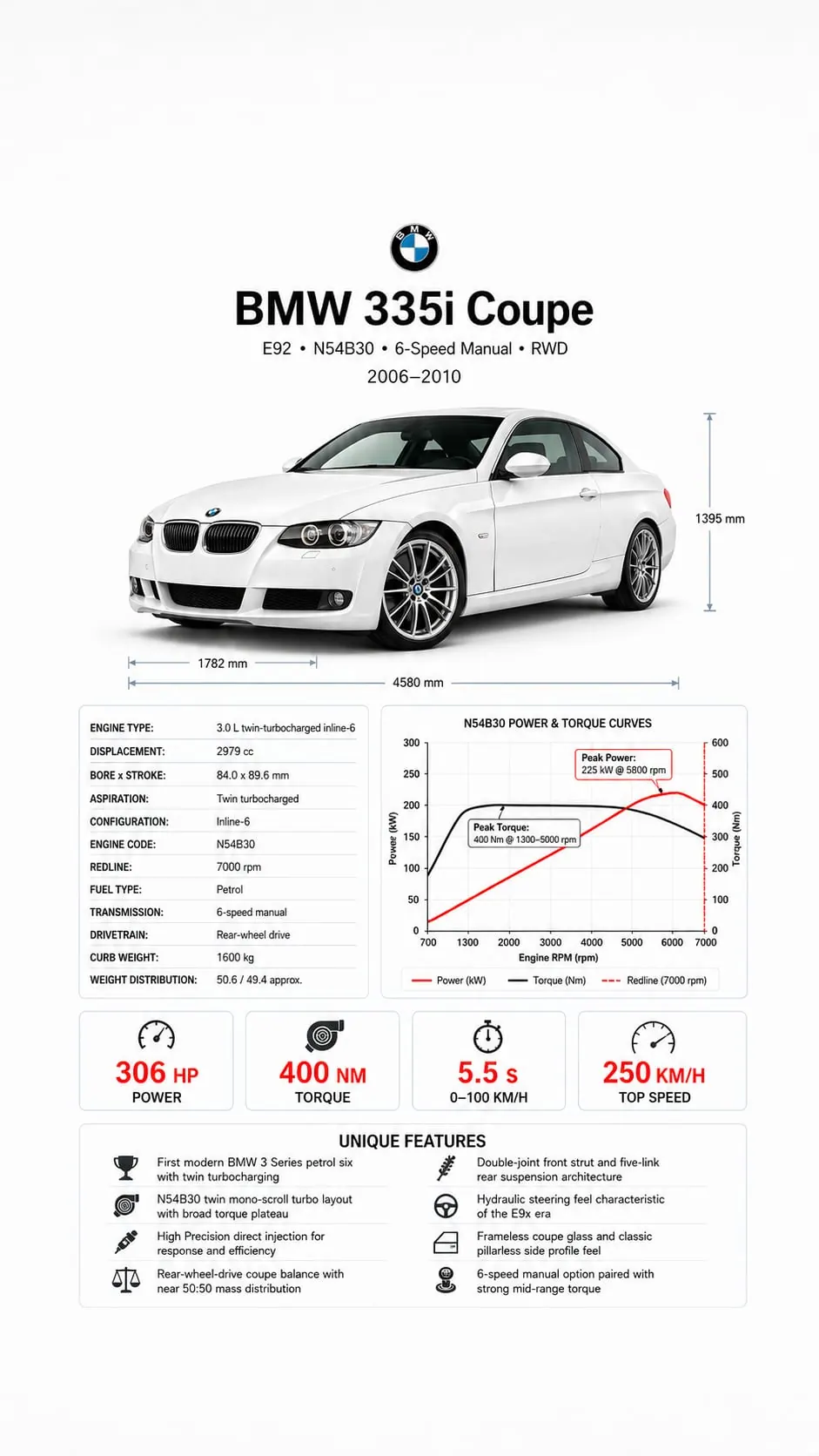
The BMW E92 335i is one of the clearest examples of why a stock-vs-tuned comparison needs more than a peak horsepower number. The car already has the right ingredients in factory form: a twin-turbo inline-six, rear-wheel drive, strong midrange torque, and enough chassis balance to make the power useful.
Tuning can make the same car feel much more urgent. It can also expose weak maintenance, tired cooling parts, poor tires, and rushed previous work. That is why the best question is not simply whether a tuned N54 is faster. It is whether the car, the owner, and the use case fit the tuned path.
Short Answer
A stock E92 335i is the cleaner choice for buyers who want the N54 character with the lowest extra risk. A carefully tuned car can be the more exciting choice if it has a documented maintenance baseline, conservative software, good fuel, healthy cooling, and supporting hardware that matches the tune.
The wrong tuned car is not a bargain. It is usually a maintenance backlog with more boost.
Scope of This Comparison
This guide treats “stock” as a mechanically standard E92 335i using the factory N54 output and normal service parts. It treats “tuned” as a sensible street setup, not a max-effort build. Stage labels vary by tuner, fuel, market, transmission, and hardware stack, so this article avoids universal Stage 1 or Stage 2 power claims.
That matters. A tune-only car on pump fuel, a car with upgraded cooling and intake hardware, and a car running more aggressive fueling are not the same comparison.
Decision Snapshot
| Question | Stock E92 335i | Sensibly tuned E92 335i |
|---|---|---|
| Main appeal | Factory balance and lower complexity | Stronger midrange and more urgent acceleration |
| Best buyer | Wants the N54 without chasing parts | Accepts maintenance and verification work |
| Proof needed | Service history and factory-spec condition | Service history, tune details, logs, and hardware list |
| Biggest risk | Age-related N54 maintenance | Added heat, boost, and unknown previous work |
| Daily-driver fit | Usually easier to live with | Good only when the setup is conservative and healthy |
| Buying rule | Buy condition | Buy documentation first, then condition |
The stock car wins when the goal is simple ownership. The tuned car wins only when the extra performance is supported by evidence.
What the Stock N54 Already Does Well
The factory E92 335i was quick because the N54 changed the shape of the torque curve. Instead of needing high rpm to feel strong, the car delivers a broad surge from normal road speeds. That is why the 335i can still feel modern in everyday driving.
The stock setup also keeps the car cohesive. The drivetrain, cooling system, brakes, tires, and suspension were designed around the original output. A clean stock car with good tires and fresh suspension often feels better than a modified car with more power and tired basics.
Stock does not mean maintenance-free. N54 ownership still needs attention to injectors, ignition parts, water pump, thermostat, gaskets, charge pipes, boost control, and turbo condition. The difference is that stock power gives the car fewer extra reasons to stress weak parts.
What a Tune Changes
The main difference is not just peak power. A tune usually changes the way the car responds in the middle of the rev range. The 335i can feel more muscular, more immediate, and more willing to accelerate from higher gears.
That is the appeal. It makes the car feel closer to a much more serious performance coupe without changing the basic E92 shape. The problem is that the extra torque arrives through more boost, more heat, and more demand on the supporting systems.
A good tuned car should have a clear story:
- What software is on the car.
- What fuel it was calibrated for.
- What hardware was required for that tune.
- What maintenance was done before tuning.
- Whether there are logs, dyno sheets, or invoices.
- Why the owner chose that setup.
If those answers are vague, the tune is not evidence. It is a warning sign.
Required vs Recommended Supporting Work
The clean way to think about N54 tuning is to separate required items from nice-to-have upgrades.
Required before any serious tune:
- Healthy ignition coils and correct spark plugs.
- No active boost leaks.
- Known injector and high-pressure fuel pump history.
- Working water pump and thermostat.
- No major oil leaks onto hot or rubber components.
- A charge pipe that is not brittle or cracked.
- Tires and brakes that match the added pace.
Often recommended depending on tune and use:
- Upgraded charge pipe.
- Better intercooler for repeated pulls or hot climates.
- Fresh fluids and shorter service intervals.
- Careful walnut blasting history where intake deposits are a concern.
- Transmission service where appropriate.
- Cooling and oil-temperature monitoring for harder use.
The key is sequence. Maintenance comes before power. Hardware follows the tune requirement. Cosmetic parts come last.
Dyno Evidence and Its Limits
Dyno charts can be useful, but they are not universal proof. A chart depends on dyno type, correction method, fuel, gear, temperature, hardware, tire setup, and how the car was tested. Wheel horsepower and crank horsepower should not be mixed casually.
For a tuned 335i, the useful evidence is not just the highest number. Look for the shape of the curve, how early torque comes in, whether power falls off with heat, and whether the setup looks repeatable.
A good dyno or log package should answer practical questions:
- Does boost control look stable?
- Does timing stay clean?
- Does the car recover after repeated pulls?
- Is the tune appropriate for the fuel used?
- Is the hardware list consistent with the claimed result?
Without that context, a number on a listing does not tell you enough.
Reliability Tradeoffs
The N54 already has known maintenance topics. Tuning does not create every issue, but it can make weak points appear sooner. More boost can reveal tired vacuum lines, marginal coils, brittle charge pipes, old cooling parts, and neglected plugs.
That does not mean tuning is always a bad idea. It means the ownership standard changes. A tuned car should be treated like a system. Fuel, temperature, software, hardware, tires, brakes, service intervals, and driver behavior all matter.
The most expensive tuned 335i is often the one that looks cheap because the previous owner already used up the easy life of the parts.
Daily-Driver Reality
A stock 335i is usually easier to recommend as a daily driver. It has enough speed, enough torque, and fewer tuning variables. It is still an older turbo BMW, but the decision is easier to evaluate.
A tuned 335i can daily drive well when it is conservative and maintained. It becomes harder to recommend when the tune is aggressive, the car lives in traffic or heat, the owner ignores small symptoms, or the tire and brake setup does not match the torque.
Daily-driver tuning should feel boring in the right ways. It should start cleanly, idle cleanly, pull consistently, cool down normally, and not need constant explanation.
Who Should Stay Stock
Stay stock if you want the 335i because of its shape, engine character, and rear-drive balance rather than maximum acceleration. Also stay stock if you are buying your first N54 and do not yet know what a healthy one feels like.
Stock is also the safer path for a car with weak records. If the service history is incomplete, assume the first budget goes to baseline maintenance, not software.
Who Should Tune
Tune only if the car is already sorted and you are prepared to maintain it as a tuned turbo car. That means you are comfortable reading service records, checking parts quality, asking about software, and walking away from a car with unclear claims.
The best tuned 335i owner is not chasing a badge or a stage label. They are building a balanced street car with enough proof to trust it.
How to Inspect a Tuned 335i
Start cold. Listen for rough idle, long cranking, misfires, wastegate rattle, odd smoke, coolant smell, and oil leaks. Check the engine bay for clean routing, proper clamps, cracked plastic, missing covers, and low-effort wiring.
On the drive, the car should pull smoothly and repeatably. Sudden hesitation, inconsistent boost, warning lights, drivetrain vibration, or vague shifting should slow the deal down. A tuned car that only feels good for one pull and then fades may have heat or calibration issues.
Ask for the parts list, tune name, fuel requirement, logs, invoices, and why each change was made. A seller who can explain the setup clearly is not automatically right, but vague answers make the risk much higher.
Verdict
The E92 335i N54 is strong enough in stock form to remain interesting. That is the baseline. Tuning can make it more exciting, but it should be treated as a complete workflow, not a single upload or stage label.
Buy the stock car if you want the cleanest version of the N54 experience. Buy the tuned car only when the maintenance, tune, hardware, and evidence all line up. The best tuned 335i feels quick because the whole car supports the power. The worst one feels quick once, then turns into a list.


