


Quick Answer
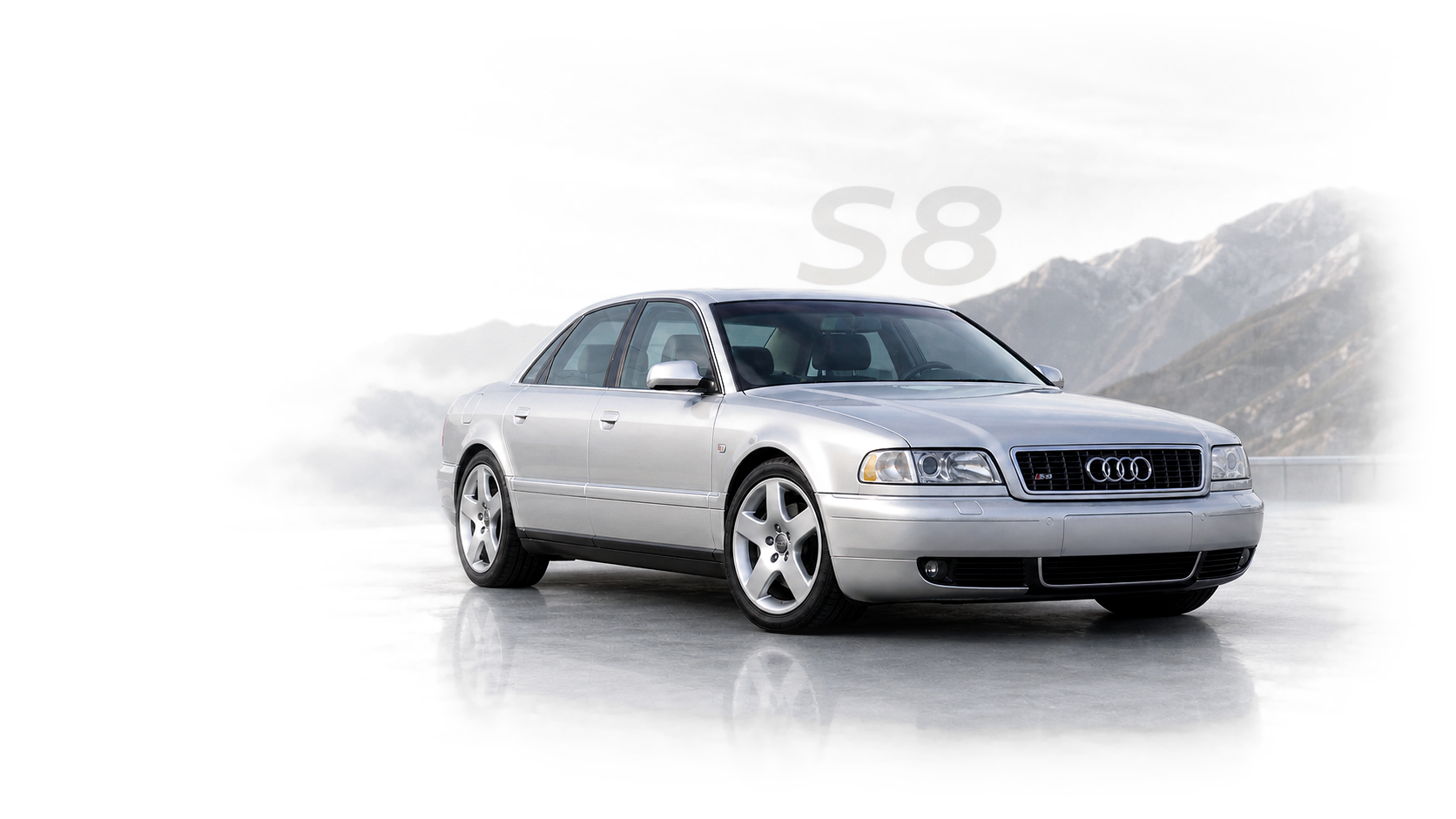
The 2001-2003 U.S.-market Audi D2 S8 is the rare performance flagship that hides in plain sight. Its aluminum Audi Space Frame body looks almost like an ordinary first-generation A8, but the S8 adds a 360-hp 4.2-liter 40-valve V8, lower and firmer suspension, 345 mm front brakes with four-piston calipers, aluminum mirror caps, 18-inch Avus wheels, and permanent Torsen quattro. Period testing put the car near 60 mph in the mid-five-second range. More important now, it combines a free-revving naturally aspirated engine, restrained design, all-weather traction, and a cabin that still feels thoughtfully made.
The purchase risk is not one mythical fatal flaw. It is the accumulated cost of deferred timing-belt, cooling, transmission, suspension, electronics, body, and trim work on a low-volume luxury car. Demand proof of a recent timing service, test the five-speed Tiptronic from stone cold to fully hot, scan every module, inspect the aluminum structure, and operate every seat motor, shade, window, display, and climate function. A cheap S8 with a stale belt and slipping transmission is not a budget super sedan.
Six exact U.S. public-auction observations checked through August 2026 stretch from a $6,200 reconstructed-title project to a $27,000 reserve-miss bid for a 40,000-mile car. Factory-automatic drivers and six-speed conversions are different markets. Roughly $10,000-$18,000 is a useful screening band for a clean-title, documented factory-automatic driver, with exceptional low-mile cars above it. Buy service history and completeness before color, mileage, or movie-car mythology.
Lock the Exact U.S.-Market S8 First
This guide covers the standard-wheelbase D2/Typ 4D S8 sold new in the United States for model years 2001 through 2003. Its defining factory combination is the AVP-code 4,172 cc V8, five-speed Tiptronic automatic, Torsen permanent all-wheel drive, left-hand drive, and short-wheelbase four-door body. Start with the VIN, federal labels, option-code sticker, build sheet or window sticker, title history, and dealer records. Make them agree before deciding what the badge is worth.
European-market D2 S8 information creates constant confusion. Audi sold six-speed manual S8s elsewhere, but the United States cars left the factory with the five-speed automatic. A U.S. example with three pedals is a conversion unless primary build documentation proves a different history. Conversions can be excellent and often sell at a premium, but gearbox code, flywheel, clutch, final-drive ratios, driveshaft, rear differential, coding, cruise operation, emissions equipment, and workmanship all become part of the valuation. It should never be priced as an untouched factory manual.
Do not blur the S8 with an A8 or A8 L wearing wheels and badges. The S8’s visual evidence includes aluminum-optic mirror housings, restrained S8 emblems, revised grille trim, twin polished outlets, sport seats, 18-inch Avus wheels, and the lower 1BD sport-suspension stance. Verify part numbers and build codes rather than relying on appearance alone. Also exclude the later D3 V10 S8 and every turbocharged generation. Those cars share a name, not this engine, body, transmission, or ownership profile.
Why the D2 S8 Still Matters
The D2 S8 comes from a brief period when a flagship could be fast without advertising the fact from three blocks away. Its body has straight shoulders, a low glasshouse, modest grilles, and only small S details. The aluminum structure kept mass below what a steel-bodied luxury sedan of similar size might have carried, while the 113-inch wheelbase and disciplined suspension make the car feel more compact from the driver’s seat than its 198-inch length suggests.
The AVP V8 is central to the appeal. It uses five valves per cylinder, variable intake-cam timing, a variable-length magnesium intake manifold, multi-point fuel injection, and an appetite for revs that differs sharply from a modern turbo engine’s early torque swell. Peak power arrives at 7,000 rpm and the 317 lb-ft torque peak is at 3,400. The result is progressive rather than explosive: muted and smooth in traffic, urgent when held in the upper half of the tachometer, and accompanied by a crisp mechanical note rather than synthetic cabin sound.
Torsen quattro contributes calm security. It is a permanent, mechanical center-differential system, not the on-demand Haldex layout used in transverse-engine Audis. A healthy S8 should launch without drama, feel planted through poor weather, and put power down without making its driver think about software modes. Period road tests found real grip and speed, but the enduring pleasure is cohesion. The controls, visibility, seats, ride, engine response, and compact-feeling chassis make normal trips satisfying. That is the reason to rescue a good one, not the possibility of winning a twenty-year-old acceleration comparison.
AVP 4.2-Liter V8 and Timing-Belt Proof
Audi’s AVP is an aluminum 90-degree V8 with 84.5 mm bores, 93.0 mm stroke, 11.0:1 compression, 40 valves, hydraulic lifters, electronic throttle, and sequential multi-point injection. The crankshaft drives the exhaust camshafts through a front timing belt, while short chains link the intake cams within the cylinder heads. This is not the rear-chain arrangement associated with later Audi V8 horror stories. It has its own non-negotiable rule: the belt system must be current and documented.
Ask for an invoice that names the timing belt, tensioner, rollers or idlers, water pump, thermostat where applicable, accessory belt, seals inspected or replaced, mileage, date, parts brands, and installer. A sticker under the hood is supporting evidence, not the entire record. If the seller says it was done recently, ask for the receipt. If the only proof is ten or fifteen years old, budget a complete service immediately regardless of the low miles covered since. An interference engine does not care that the car spent most of that interval in a garage.
Arrange a true cold start. The engine should catch promptly, settle evenly, and run without persistent ticking, chain noise from a cylinder head, misfire, smoke, fuel odor, or warning lights. Watch live misfire counts and fuel trims, then repeat the assessment fully warm and after a hot restart. Inspect valve-cover gaskets, cam and crank seals, front covers, oil-cooler area, valley, pan, and bellhousing edge. A cleaned engine bay can look reassuring for ten minutes; examine it again after the road test. Compression or leak-down results become especially valuable when a belt failure, replacement engine, overheating event, or unexplained misfire appears in the history.
Intake, Secondary Air, Fuel, and Exhaust
The variable-length intake system helps the V8 deliver both midrange grunt and high-rpm breathing. Its vacuum plumbing, changeover hardware, seals, and manifold mechanism should operate without rattles, vacuum leaks, or adaptation faults. Compare requested and actual throttle behavior, watch fuel trims at idle and under load, and smoke-test the intake if the numbers are abnormal. Crankcase-ventilation hoses and suction-jet components age in the heat and can create unstable idle, lean faults, oil mist, or brake-assist complaints.
Secondary-air injection and exhaust-gas recirculation faults appear repeatedly in service histories. They can involve pumps, combi or EGR valves, vacuum controls, passages, oxygen sensors, catalysts, or wiring. Do not accept a glowing malfunction light as an irrelevant old-car quirk. Record every stored and pending code, readiness monitor, and freeze-frame before anyone clears it. A manual-converted or modified car may also have secondary-air hardware deleted or coded out, which can create registration problems in emissions-testing states even when it drives well.
Inspect the fuel pump history, filter, injectors, rails, hoses, evaporative-emissions system, and the area around the tank. Slow starts, pressure loss, fuel smell, or wetness are stop conditions. The exhaust should hang squarely without cracked flex sections, failed catalysts, loose heat shields, or contact with the body. Aftermarket systems can give the V8 a richer voice, but highway drone and questionable catalyst work can spoil the car’s refined character. The best evidence is boring: stable trims, completed monitors, no leaks, documented repairs, and clean operation through cold start, full temperature, and hot restart.

Cooling System and Engine-Bay Age
A healthy cooling system should bring the V8 to temperature predictably, hold it there in traffic, activate the fans correctly, and restart hot without drama. Inspect the water-pump and thermostat history alongside the timing-belt invoice because access overlaps and good service planning combines the work. Examine the radiator, expansion tank and cap, auxiliary plumbing, heater hoses, hard pipes, clamps, fan assemblies, temperature sensors, and every area with pink or white dried residue. Pressure-test the system when the history or smell raises doubt.
Do not let a centered dashboard gauge end the diagnosis. Observe coolant temperature with a scan tool from cold through a long idle, air-conditioning operation, road speed, and heat soak after shutdown. Confirm strong cabin heat and stable temperature at both low and high fan speeds. Coolant odor after parking, repeated topping-up, fans that run unexpectedly, or a temperature that moves under load needs a cause before purchase. An aluminum engine that has overheated deserves compression, leak-down, cooling-pressure, and oil-condition evidence rather than optimistic interpretation.
Age also affects the ordinary engine-bay pieces: mounts, accessory tensioners, alternator, starter, vacuum lines, electrical connectors, grounds, battery cables, power-steering hoses, and brittle plastic fittings. Check charging voltage and voltage drop rather than blaming every module fault on a battery. Look for power-steering leaks at the reservoir, pump, hoses, rack, and cooler. A long invoice is not inherently frightening on a D2; it can prove that a careful owner has worked through predictable aging. A spotless bay with no dated records is less persuasive.
Five-Speed Tiptronic: Test It Cold and Hot
The U.S. D2 S8’s electronically controlled five-speed automatic is the largest single purchase variable after engine health. It should engage Drive and Reverse promptly, pull away smoothly, shift cleanly at light and heavy throttle, downshift without a flare, hold gears in Tiptronic mode, and remain composed after the fluid is fully hot. A short neighborhood loop proves almost nothing. Plan a road test long enough to include cold behavior, urban shifts, highway speed, repeated deceleration, kickdown, manual selection, tight turns, and a hot restart.
Before driving, scan the transmission controller and save codes, adaptation values, temperature, selector status, and any available slip data. Inspect the pan, cooler lines, output flanges, differential areas, driveshaft, mounts, and electrical connector for leaks or damage. Fluid history should identify the specification used, filter, pan gasket, mileage, shop, and reason for service. The old claim that sealed-for-life means never service is not a substitute for evidence, but neither is a blind power flush on an already failing unit.
Watch for delayed engagement, flare between gears, harsh bang shifts, shudder under light throttle, loss of reverse, limp mode, or behavior that worsens with temperature. Transmission interchange is more complicated than finding another unit that bolts to a D2. Codes, gear ratios, electronics, final drives, prop shaft, and calibration must agree. Price any questionable car using a specialist’s diagnosis and a real replacement or rebuild estimate. A $7,000 purchase with a weak gearbox can cost more than a sorted $15,000 example before it becomes dependable.
Torsen Quattro, Differentials, and Tires
The D2 S8 uses a longitudinal transaxle with a mechanically self-locking Torsen center differential, front and rear final drives, and Electronic Differential Lock intervention through the brakes. It should feel transparent on dry pavement and reassuring on a wet road. There is no Haldex pump or clutch service to invent here. The inspection instead focuses on fluid history, compatible ratios, seals, bearings, prop-shaft and CV condition, matched tires, and evidence of binding or noise.
Record the brand, model, size, pressure, tread depth, and date code of every tire. All four should match closely in rolling circumference and wear. Old premium tires are still old, and a low-mile S8 may be sitting on rubber that looks deep but has hardened. During slow full-lock turns, listen for clicking, grinding, hopping, or driveline windup. At road speed, separate tire roar from wheel-bearing, differential, and prop-shaft noise by varying load and direction safely.
Inspect inner and outer CV boots, front output flanges, axle seals, rear differential seals, mounts, and the center support or joints in the prop shaft. Fluid at one flange may look minor but can contaminate surrounding parts and reveal long neglect. On a manual conversion, verify front, center, and rear ratios as a system. Receipts should explain the gearbox code, differential choice, driveshaft modification, flywheel, clutch, coding, and cruise or reverse-light integration. Quattro is durable when the complete driveline agrees; mismatched hardware is not improved by enthusiasm.
Suspension, Steering, Brakes, and Avus Wheels
Audi’s four-link front suspension gives the D2 precise steering for a large sedan, but it contains multiple arms, ball joints, bushings, and fasteners that wear together. The rear uses a controlled-toe trapezoidal-link arrangement. Inspect the car on a lift with the suspension loaded where necessary, then drive over broken pavement, smooth sweepers, cambered roads, and low-speed steering inputs. Clunks, wandering, brake shimmy, poor self-centering, or uneven tire wear need measurements and component diagnosis.
Check every control arm, ball-joint boot, tie rod, sway-bar link, mount, spring, damper, bump stop, and wheel bearing. Factory S8 springs and correct replacement dampers may be difficult to source, so a car’s present setup matters. Bilstein dampers with sound factory-style springs can be a thoughtful repair; unknown coilovers at an arbitrary ride height can damage ride quality, alignment, axles, and tire clearance. Ask for part numbers, installation and alignment invoices, ride-height measurements, and removed original components.
The factory brake system uses 345 x 30 mm ventilated front discs with four-piston fixed calipers and 280 x 22 mm ventilated rears. Measure rotor thickness, inspect both pad edges, check caliper boots and hoses, confirm fluid history, and perform controlled stops after the car is safe. Steering shake, pedal pulse, pulling, or a soft pedal is not simply old-Audi character. Inspect the 18-inch Avus wheels inside and out for bends, cracks, repairs, peeling finish, and incorrect replicas. Correct wheels support completeness, but straight structure and fresh matched tires matter more than shine.
Aluminum Space Frame and Collision Inspection
The D2’s aluminum Audi Space Frame is a genuine engineering advantage and a serious inspection boundary. Aluminum does not behave like ordinary steel during collision repair, straightening, welding, corrosion, or paint preparation. A history report can reveal reported events, but it cannot show every curb strike, poor lift, cosmetic respray, or unreported structural repair. A car with accident history is not automatically disqualified; it needs stronger evidence and a price that reflects the repair.
Measure paint depth across every panel and compare readings by material. Inspect panel gaps, fasteners, seams, adhesives, spot repairs, underbody castings and extrusions, jacking points, front and rear structure, suspension pickup areas, floor, trunk, and door apertures. Look for cracks, distortion, improvised welds, mismatched finishes, missing shields, and alignment data that cannot be brought into specification. If anything is questionable, use a shop familiar with aluminum Audi bodies rather than a general visual inspection.
Cosmetic parts can also be scarce. Bumpers, grilles, aluminum mirror housings, exterior trim, acoustic glass, lights, seals, wheel-arch protection, and model-specific pieces may take time to find. Test the sunroof and inspect drains, windshield and cowl, trunk seals, lamp pockets, spare-wheel area, and floor insulation for water tracks. Corrosion on steel fasteners or exhaust pieces can coexist with an aluminum body. The right conclusion is not that the car cannot rust; it is that different materials, old seals, and previous repairs require different eyes.

Cabin, Climate, Displays, and Convenience Systems
The D2 cabin is one of the car’s strongest arguments. Supportive sport seats, clear analog instruments, a compact dashboard, real buttons, slim pillars, and high-quality materials create an environment that is easier to use than many newer flagships. Valcona leather, Alcantara inserts and headliner, wood or aluminum trim, heated front and rear seats, Bose audio, solar sunroof, rear shades, and acoustic glass made the S8 genuinely luxurious rather than merely fast.
Age turns that equipment list into a test plan. Operate every key, lock, handle, window, mirror, seat direction, memory position, heater, steering-column adjustment, sunroof, shade, light, wiper, washer, horn, parking sensor, cruise function, audio source, and climate-control mode. Check the center information display and radio or navigation screens for missing pixels. Confirm that the blower works at every speed, the air conditioner stays cold, heat responds on both sides, and air reaches the commanded vents. Repeated refrigerant charging without a repaired leak is not working air conditioning.
Inspect the headliner for sagging, door-card upholstery for lifting or staining, soft-touch surfaces for wear, switches for mismatched replacements, and seat bolsters for condition consistent with mileage. Scan the airbag, ABS, instruments, climate, convenience, seat, parking, and infotainment modules—not only the engine. Low voltage can create multiple faults, but a charged battery does not erase the need to diagnose them. Water around modules, aftermarket stereo wiring, alarms, phones, or amplifiers deserves particular care. Two working keys, manuals, tools, cargo pieces, original head unit, build sheet, and removed parts all add confidence.
Factory Options, 2001-2003 Differences, and Completeness
Condition and history matter more than memorizing an option list, but the build sheet still protects the buyer from invented rarity. Typical U.S. equipment included xenon headlights, automatic climate control, heated power-adjustable front sport seats, memory, Bose audio, speed-sensitive Servotronic steering, stability control, and the S8 chassis hardware. Premium-package cars can add heated rear seats, power rear shade, manual side shades, and related luxury equipment. Solar sunroofs, Parktronic, navigation, acoustic glass, trim choices, and upholstery combinations vary by car and year.
Do not assume every attractive combination is original. Compare paint and upholstery codes, option stickers, window sticker, build information, wheel part numbers, suspension codes, seat stitching, mirror housings, grille trim, lights, exhaust, and electronics. The visual target for this guide—Avus Silver with aluminum mirrors and six-spoke Avus wheels—is recognizable, not the only correct specification. Rare colors and Audi Exclusive interiors can add desirability after their authenticity and condition are proven.
The final 2003 model year can attract attention, but a neglected 2003 is not automatically better than a carefully serviced 2001. Verify changes using the exact car’s documents rather than forum recollection. Completeness becomes valuable because replacements are scarce: original wheels, center caps, airbox, exhaust pieces, navigation or Symphony unit, phone hardware, tools, shades, keys, manuals, and trim may be more difficult to reconstruct than expected. Pay a premium for a coherent, working car, not simply a longer feature list.
Current Prices and What a Good Buy Looks Like
The observed market is broad because condition categories are broad. A 144,300-mile 2001 with a reconstructed title, old tires, air-conditioning problems, sagging headliner, pixel wear, and timing evidence dating to 2011 sold for $6,200 in May 2025. A 104,000-mile 2001 with a replacement engine carrying higher mileage and a prior accident entry sold for $7,499 in December 2025. Those are project-grade reference points, not proof that every running S8 is a $7,000 car.
A 92,000-mile factory-automatic 2002 with fresh belt, water-pump, and transmission service but older tires and cosmetic or electrical needs sold for $10,000 in April 2025. At the other end, a 40,000-mile 2002 with long-term ownership and clean history reached a $27,000 high bid in July 2025 without meeting reserve. That bid shows the premium for unusually low mileage and preservation, but it is not a completed transaction.
Manual conversions form another category. A 155,000-mile converted 2001 sold for $14,750 in August 2024, while an extensively serviced 181,000-mile converted 2003 brought $15,869 in June 2025. Conversion quality, final-drive engineering, clutch, emissions legality, and documentation drive those results. For a factory automatic, roughly $10,000-$18,000 is a useful current shopping band for a clean-title documented driver. Add the immediate cost of belt, tires, transmission diagnosis, cooling, suspension, electronics, body, and missing trim to the purchase price. The cheapest hammer price rarely creates the cheapest first two years.
A Model-Specific Pre-Purchase Inspection
Begin before the appointment. Request the VIN, build sheet, title and history reports, timing invoice, transmission records, cooling and suspension work, tire photos with date codes, scan report, underside photos, cold-start agreement, and list of inoperative equipment. Ask the seller not to warm the car or clear codes. Confirm recall status by VIN with NHTSA and Audi; a model-year summary is not a substitute for a vehicle-specific result.
At the car, verify identity and cold-soak temperature, then save a full multi-module scan. Observe the first start, idle, exhaust, charging voltage, fuel trims, misfires, coolant temperature, and leaks. Inspect the timing evidence, intake and secondary-air systems, cooling circuit, power steering, mounts, and service materials. Lift the car for aluminum-structure, undertray, suspension, steering, brake, axle, seal, differential, prop-shaft, exhaust, tire, and wheel inspection. Measure paint and alignment where history or tire wear raises concern.
Drive long enough to bring the transmission and engine fully hot. Include every gear, manual mode, kickdown, steady cruise, deceleration, tight turns, rough pavement, straight braking, climate operation, and hot restart. Then inspect for fresh fluid, coolant smell, fan behavior, heat soak, and new codes. Exercise every cabin system while the car is stationary. A specialist should turn findings into a prioritized estimate with parts availability, not a generic pass/fail sheet. Negotiate from that estimate or walk away. Rarity does not make an unresolved transmission flare or questionable aluminum repair less expensive.
Best Buyer Fit
The D2 S8 suits an enthusiast who values subtle design, lively naturally aspirated response, permanent all-wheel drive, analog controls, and mechanical character more than modern screens or headline acceleration. It can serve as a weekend sedan, a fair-weather long-distance car, or even a daily driver when maintenance is current and alternative transportation exists. The best owner enjoys preserving original details, keeps organized records, and has access to an Audi specialist willing to diagnose an older low-volume platform.
It is a poor fit for someone shopping only by purchase price, someone who needs every part tomorrow, or anyone whose budget ends at registration. Fuel, premium tires, brakes, suspension arms, timing service, transmission work, air conditioning, electronics, and scarce trim can overlap. A meaningful repair reserve is part of the purchase. So is patience when a model-specific component must be rebuilt or sourced used.
A manual conversion makes sense for a buyer who understands modified drivetrains and can evaluate every engineering decision. It is not the automatic choice for someone merely afraid of the Tiptronic. A sorted factory automatic preserves the U.S. car’s identity and relaxed flagship nature. A well-built six-speed creates a more interactive machine but adds clutch, gearing, coding, fabrication, emissions, and resale questions. Choose the ownership experience deliberately rather than inheriting someone else’s experiment from the loudest listing.
Buying Verdict
A good D2 S8 feels special without trying hard. The AVP V8 starts cleanly, pulls smoothly to the top of the tachometer, the Tiptronic shifts consistently hot, the Torsen driveline stays quiet, the suspension controls the body without clunks, and the cabin equipment performs its small luxury rituals. Its paint, trim, wheels, and interior tell the same story as the paperwork. That coherence is worth paying for.
Buy when the exact U.S. identity is proven, the timing system is current, the engine and cooling system are dry and stable, the automatic passes a long hot test, the aluminum structure is sound, the tires match, the scan is explainable, and the service timeline makes sense. Treat a well-documented manual conversion as a separate modified-car decision. Walk when the seller substitutes rarity for records, warms the engine before arrival, clears codes, calls transmission flare normal, cannot date the belt, dismisses overheating or fuel smell, or expects shiny Avus wheels to erase structural and mechanical questions.
The D2 S8 is not a bargain because it was once expensive and is now cheap. It is compelling because the right example delivers a blend that is difficult to replace: understated aluminum-body design, a 7,000-rpm naturally aspirated V8, permanent quattro, real luxury, and usable sedan proportions. Buy the evidence first, and the quiet super-sedan magic can follow.


