


Quick Answer
The 2003 Audi C5 RS6 is still an arresting performance sedan because its numbers have not become quaint. Audi gave the U.S. car a 4,172 cc BCY twin-turbo V8 rated at 450 hp and 415 lb-ft, a five-speed Tiptronic automatic, quattro all-wheel drive, huge brakes, and Dynamic Ride Control. Audi’s U.S. technical material lists 0-60 mph in 4.6 seconds and an electronically limited 155-mph top speed. The body says mature C5 A6; the hardware says early-2000s super sedan.
That combination is also why a cheap RS6 can be a trap. The engine bay is tightly packaged, the automatic and torque converter have a long owner-reported problem history, DRC can leak or lose pressure, brake parts are substantial, and turbo or cooling work can involve serious labor. Twenty-three-year-old wiring, seals, plastics, displays, and hoses now matter as much as the headline components. The best car is not necessarily the lowest-mile one. It is the example with an exact factory identity, a coherent service file, a clean hot and cold road test, a complete scan, and no unexplained modification story.
The current public-auction sample spans $6,700 to $25,000 across six exact 2003 sedans observed from 2024 through 2026. That range mixes higher-mile factory automatics, low-mile cars, manual conversions, and a heavily modified reserve miss, so it is not a price guide by itself. A working target is roughly $12,000-$18,000 for a documented factory-automatic driver after specialist inspection; exceptional low-mile stock cars can sit higher.
Buy the C5 RS6 if you want the discreet shape, muscular midrange, mechanical quattro feel, and historical significance enough to fund proper upkeep. Walk away from missing timing-belt evidence, transmission slip, unresolved warning lights, coolant or fuel odor, improvised tuning, or a seller who treats model rarity as a substitute for maintenance.
Lock the Exact 2003 U.S. Sedan Identity
This guide covers the Audi RS6 sold in the United States for the 2003 model year: a four-door C5/Typ 4B sedan with the BCY twin-turbo 4.2-liter V8, factory five-speed Tiptronic automatic, and quattro. Start with the VIN, build label, original window sticker or Audi build information, and the emissions label. Confirm that the body, powertrain, model year, and equipment agree before assigning value.
Do not silently blend in European cars. Other markets received the C5 RS6 Avant, and Audi later built the 480-PS RS6 Plus. Neither defines a U.S. sedan. Six-speed manuals found in American auction listings are owner conversions, not factory U.S. specifications. A conversion may be enjoyable and well engineered, but it changes originality, emissions and inspection questions, driveline parts, calibration, service procedures, and resale comparables.
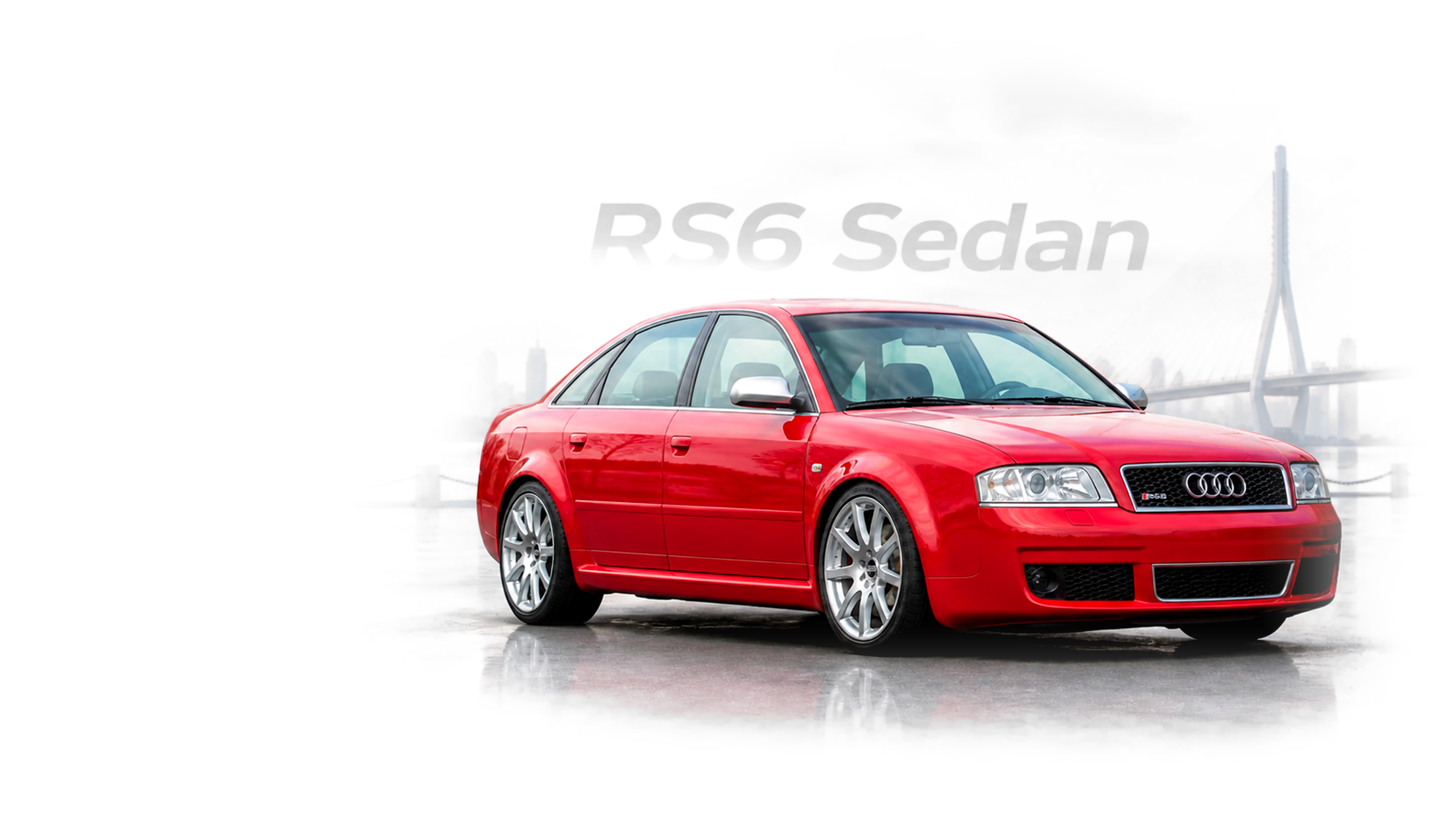
The factory visual identity is restrained but specific: wider arches, RS6 bumper covers and lower grilles, aluminum-finish mirrors, xenon lamps, a small trunk spoiler, twin oval exhaust outlets, and 18-inch nine-spoke wheels. Check for S6, A6, aftermarket, or reproduction parts where original RS6 pieces should be. Missing lower grilles, damaged headlamp trim, substituted wheels, and improvised undertrays appear in auction histories and can be awkward to replace.
Decode paint and interior trim as well. Misano Red, Mugello Blue, Avus Silver, Daytona Gray, and Ebony are all seen on U.S. cars, but a desirable color cannot excuse a weak structure or uncertain history. Measure paint depth, inspect panel gaps, verify glass dates, and look underneath for collision work and careless lifting. The identity test protects every later conclusion: if the car is not what the advertisement says it is, stop pricing options and solve that discrepancy first.
Why the C5 RS6 Still Works
Audi’s first RS6 was engineered as a wolf in a business suit. The manufacturer describes extensive hand finishing by quattro GmbH and a Cosworth-assisted twin-turbo engine that put the car at the top of its segment. That context matters because the C5 was not merely an A6 with software. Its wider body, cooling package, driveline, DRC suspension, brakes, wheels, cabin details, and assembly process belong to a complete performance program.
The appeal comes from accessible torque rather than a dramatic high-rpm event. Factory output arrives across a broad band, and quattro can turn that grunt into useful all-weather acceleration. At approximately 4,024 pounds, it is not light, but the long wheelbase and wide track support a planted grand-touring stance. The engineering inference is straightforward: a healthy car should build speed with calm authority, track cleanly, and feel cohesive rather than frantic.
Test that character only after basic mechanical checks. Start cold, watch for smoke, chain or valvetrain noise, unstable idle, warning messages, and unusual secondary-air behavior. Drive at light throttle before requesting full boost. Then evaluate medium load, kickdown, manual Tiptronic control, braking, tight turns, and a fully warm restart. The fast part of the test is short; the diagnostic part is the point.
A well-sorted RS6 can still feel special without shouting. A tired one often broadcasts several small disagreements at once: a delayed gear engagement, steering shimmy, boost leak, clunking damper, aged tire, dim display, or coolant smell. Do not average those symptoms into “old Audi character.” Each one needs a cause, a price, and evidence that the surrounding systems are sound.

BCY Twin-Turbo V8, Intake, and Cooling Checks
The BCY is an all-aluminum 90-degree V8 with five valves per cylinder, two turbochargers, twin charge-air coolers, and densely packed plumbing. Audi stretched the C5 front structure to create installation room, but service access remains a defining ownership issue. Inspect from above and below with the undertrays removed by a shop that knows the platform.
Look for oil at valve covers, cam-tensioner areas, turbo feed and drain connections, front seals, oil-cooler plumbing, and bellhousing edges. A clean engine can be reassuring only when it is dry after a full drive; fresh detailing may simply erase the first clue. Check crankcase ventilation, vacuum lines, diverter valves, intake boots, intercooler end tanks, charge hoses, clamps, and mass-airflow readings. A pressure or smoke test is stronger evidence than a short full-throttle pull.
Boost should arrive smoothly without a siren, flutter, heavy smoke, misfire, or sudden loss of power. Compare requested and measured boost with a capable scan tool while monitoring fuel trims, misfire counts, temperatures, and throttle behavior. Modified software, downpipes, intercoolers, turbochargers, or fueling require receipts, part numbers, calibration identity, and a legal-registration plan. “Stage 1” is not a diagnosis.
Begin the cooling inspection from cold. Examine the expansion tank, cap, radiator, auxiliary radiators, hoses, thermostat area, water pump history, electric fans, after-run system, and any dried residue inside the tightly packed nose. Confirm stable operating temperature, working fans, clean hot restart, and no coolant odor after shutdown. Auction records show cars with isolated repairs, but a new component proves only that the component was changed. The invoice should identify the original fault and the post-repair test.
Timing Belt, Front-Service History, and Big-Labor Risk
The RS6 uses a timing belt, and historical U.S. owner and service discussions repeatedly cite a 35,000-mile interval. Treat the car’s original maintenance schedule, dated invoices, mileage, and elapsed time as the governing evidence. A seller saying the belt “looks fine” is not enough. The useful record names the belt, tensioners, rollers, water pump, thermostat or related parts addressed, date, mileage, and shop.
Front-service work is an opportunity to inspect more than one belt. The nose is moved into service position, so an organized specialist can evaluate seals, cooling components, accessory drive, hoses, wiring, intercoolers, mounts, and previous fastener work. A vague invoice that lists only labor or a belt part number leaves too many questions. Photograph labels and ask the shop that performed the work what was actually replaced.
Turbocharger, alternator, oil-leak, and transmission jobs can carry large access costs on this platform. Some repairs lead owners and shops toward major drivetrain removal. That does not make every leak catastrophic, but it changes the purchasing rule: diagnose before negotiating. A $2,000 discount is meaningless if the unresolved repair requires many times that amount and exposes deferred work around it.
Listen to the engine both cold and fully warm. Check oil level and specification, service frequency, filter quality, oil pressure warnings, smoke behavior, and metal or debris only through appropriate professional inspection. Frequent documented oil service cannot guarantee the turbos or valvetrain, but a missing history removes an important layer of confidence. The right example makes expensive future work possible to plan; the wrong one delivers it as a surprise.
Five-Speed Tiptronic and Quattro
The factory five-speed automatic is central to the U.S. RS6 identity and one of its most important inspection areas. Owner archives repeatedly describe torque-converter trouble, slipping clutch packs, delayed engagement, harsh shifts, incorrect-ratio faults, and limp mode. Anecdotes cannot establish a failure rate, but they are strong reasons to conduct a disciplined hot and cold test.
Before moving, scan the transmission controller and record stored, pending, and recently cleared faults. From cold, test reverse and drive engagement without rushing the selector. On the road, evaluate light upshifts, steady-speed converter lockup, medium-load changes, kickdown, manual paddle commands, and coast-down behavior. Repeat the test at full operating temperature. A flare, shudder, bang, long delay, gear-display warning, or ratio code is a repair lead, not a trait to accept because the car is powerful.
Ask whether the gearbox or torque converter has been rebuilt, by whom, and with which updates. A fluid service is useful only if the correct fluid, level procedure, temperature, filter, pan condition, and findings are documented. Fresh fluid cannot repair worn friction material. Likewise, a transmission-control tune can change shift feel without proving mechanical health.
Quattro adds traction but not immunity from neglect. Record all four tire sizes, brands, models, tread depths, pressures, and date codes. Check for matched rolling circumference and test tight, low-speed turns in both directions on a suitable surface. Inspect front and rear differential leaks, driveshaft support and joints, axles, CV boots, mounts, wheel bearings, and load-reversal clunks. A manual-converted car needs an additional inspection of the transmission source, adapter, clutch, hydraulics, linkage, coding, differential ratios, driveshaft, fabrication, and emissions legality.
DRC Suspension, Steering, Brakes, and Tires
Dynamic Ride Control links opposing dampers hydraulically to resist pitch and roll without electronic actuators. It was a serious piece of chassis engineering in 2003, and a healthy system is part of the RS6 story. Age, leaks, lost pressure, replacement availability, and service knowledge make it equally important to inspect.
Look for oil at every damper and line, then assess ride height, bounce control, diagonal response, clunks, and stability over a sequence of bumps. Ask whether the DRC remains original, has been repaired and recharged, or has been replaced by coilovers. A conversion is not automatically a defect. It needs invoices, matched components, sensible spring and damper choice, clean installation, alignment data, and a road test that proves the car still works as a road-going super sedan.
Inspect the rest of the C5 chassis rather than blaming every noise on DRC. Front control arms, bushings, ball joints, tie rods, mounts, rear links, subframes, and wheel bearings all influence steering and braking. The car should not wander, follow grooves aggressively, shake under braking, or change direction when power is applied. Uneven tire wear can reveal alignment, damper, bushing, wheel, or structural problems.
The eight-piston front brakes and large rotors deliver the stopping hardware expected of a 450-hp sedan, but parts cost makes measurement worthwhile. Record pad thickness and rotor condition at every corner, inspect hoses and fluid history, verify parking-brake operation, and perform controlled stops. Check wheels for bends and cracks, confirm correct fasteners, and reject old or mismatched tires even when tread looks generous. Four fresh matched tires are both safety equipment and evidence that the owner understood quattro.

Body, Cabin, Electronics, and Completeness
The body deserves more than a glossy walk-around. Inspect the aluminum-finish mirrors, lower grilles, bumper mounts, belly pans, wheel-arch edges, rocker covers, trunk floor, jacking points, lamp housings, and windshield area. Check for corrosion where climate and repairs make it plausible. Compare paint depth across every panel and look for overspray, distorted seams, mismatched fasteners, or underbody impacts. A clean history report supports an inspection; it cannot replace one.
Inside, verify the exact RS6 seats, steering wheel and paddles, analog cluster, carbon-fiber trim, shifter, door cards, headliner, and factory labels. Test both keys, immobilizer, central locking, windows, mirrors, sunroof, seat motors and heaters, steering-column adjustment, climate control, Bose audio, navigation or replacement head unit, parking sensors, tire-pressure system, and every cluster display segment. A dead center display or sticky switch may look minor until the correct part and labor are priced.
Check the front passenger footwell, trunk sides, spare-wheel area, battery area, and electronic modules for moisture. Inspect sunroof drains and door membranes with the correct procedure rather than flooding the cabin. Aged C5 soft-touch coatings, plastics, pixels, and headliners are normal inspection territory, but a cluster of electrical faults can also point to low voltage, water intrusion, poor accessory wiring, or past disassembly.
Completeness has real value on a limited-production car. Original wheels, spare, tools, manuals, window sticker, keys, undertrays, grilles, exhaust pieces, suspension parts, and removed factory components help explain what the car is. Aftermarket audio, gauges, alarms, or lighting should have fused, reversible wiring. A rare badge does not make cut harnesses or unavailable trim any easier to repair.
Recalls, Fuel Odor, and Safety Verification
Two primary NHTSA records are directly relevant to the 2003 RS6 boundary. Campaign 04V133 addressed possible contact between the headlight-switch wiring harness and the driver’s-side crossmember, which could produce an electrical short and fire risk. Campaign 11V267 addressed aging and stress at the fuel-tank rollover-valve nipple, which could crack and leak fuel.
Applicability and remedy completion are VIN-specific. Run the exact VIN through the current NHTSA lookup and ask an Audi dealer to check campaign history. Save dated results with the purchase file. A seller’s memory, a Carfax line, or a sticker without supporting dealer data is weaker evidence. If a recall remains open, confirm parts and repair availability before money changes hands.
Treat any fuel odor as a stop condition. Inspect the tank area, filler and vent system, rollover-valve repair area, lines, rails, injectors, and engine bay with professional safety procedures. Do not road-test a car with an active leak. Likewise, unresolved airbag, ABS, stability-control, brake, or lighting warnings require diagnosis before purchase.
The recall check should sit inside a broader safety inspection: tires, brakes, restraint lamps, lighting, wipers, windshield, battery mounting, fluid leaks, and underbody damage. Performance does not lower the standard. It raises it because speed exposes weak tires, brakes, suspension, and repairs more quickly.
What Owner Reports Actually Add
Owner discussions consistently praise the RS6’s discreet styling, broad torque, highway confidence, all-weather traction, and ability to feel special without theatrical bodywork. Long-term owners also emphasize that a sorted car is deeply rewarding. That enthusiasm is useful because it explains why people accept the maintenance burden and keep solving problems that would retire an ordinary sedan.
The same archives repeat transmission and torque-converter failures, DRC leaks, timing-belt service, expensive brakes, turbo access, oil leaks, control-arm wear, intercooler issues, alternator labor, old wiring, and small trim failures. These are anecdotal themes, not incidence data. Problem cars naturally create more forum posts. Use each theme to build an observable check instead of predicting that every car will fail the same way.
Ownership history changes the meaning of mileage. A 120,000-mile car with one long-term owner, current front service, a documented transmission, working suspension, matched tires, and complete invoices may be easier to judge than a 55,000-mile car that sat, changed hands repeatedly, and received only emergency repairs. Ask how the car was stored, exercised, warmed, modified, and serviced.
Specialist access is part of the buying decision. Identify the shop that will scan, inspect, and maintain the car before purchase. Ask about parts sourcing and labor for the specific findings on this example. An RS6 can be a bargain compared with its original price and performance, but it never became a cheap car to repair. The recurring owner lesson is simple: pay for the best evidence you can afford, not the lowest entry ticket.
Current Market and Buying Context
Six exact-vehicle public auction observations checked August 6, 2026 produced this working evidence band: $6,700-$25,000 across six exact-sedan public observations from 2024-2026; mileage, factory automatic versus manual conversion, service history, modifications, DRC status, and cosmetic condition explain the spread. It is not a universal appraisal. A real car still needs to be placed inside the band by mileage, condition, specification, originality, modifications, documentation, and whether the observation was a completed sale or a reserve-miss bid.
The evidence-backed good-buy target is roughly $12,000-$18,000 for a documented factory-automatic driver with current timing-belt, transmission, DRC or suspension, brake, tire, and recall evidence; exceptional low-mile stock cars can justify more. Treat that as a screening range before a model-specialist inspection, not permission to average away a major fault. Cooling, structural, powertrain, emissions, battery, chassis, tire, brake, and provenance findings must be priced separately where they apply.
The sample needs these caveats: The $25,000 result is a 39k-mile factory-automatic example; Two observations are six-speed manual conversions, and the $22,250 result was a reserve-miss bid rather than a completed sale; The $6,700 and $8,900 sales were higher-mile cars and should not anchor a well-documented low-mile example. Refresh the comparison when negotiating because public results and inventory can move after the check date.
Buying Verdict
The 2003 C5 RS6 deserves its reputation. It combined 450 hp, quattro, DRC, massive brakes, subtle bodywork, and a hand-finished quattro GmbH production process before the modern super-sedan formula became familiar. Its restrained shape has aged gracefully, and the twin-turbo V8 still delivers real punch. As an object, it is significant. As a used car, it is evidence-dependent.
Buy one when the exact U.S. sedan identity is clear, the timing-belt and cooling work are dated, the factory automatic behaves correctly cold and hot, DRC or its replacement is documented, the boost system is tight, recalls are confirmed, and the body and electronics tell the same coherent story as the invoices. Keep a meaningful repair reserve and establish a relationship with a platform specialist.
Pass when the seller cannot explain transmission behavior, front-service history, suspension changes, warning lights, fuel odor, tuning, missing pieces, or recent code clearing. A manual conversion deserves its own engineering and legality audit rather than an automatic premium. A low odometer cannot compensate for years of storage and missing work.
The best C5 RS6 is not the loudest, fastest, or cheapest listing. It is the one that still behaves like a complete Audi performance sedan and can prove why. Find that car, and the sleeper shape plus twin-turbo shove make sense. Settle for a mystery, and the first repair can erase every apparent saving.
FAQs
Is the 2003 Audi C5 RS6 worth buying?
It combined 450 hp, quattro, DRC, massive brakes, subtle bodywork, and a hand-finished quattro GmbH production process before the modern super-sedan formula became familiar.
What does current market evidence say about the 2003 Audi C5 RS6?
A real car still needs to be placed inside the band by mileage, condition, specification, originality, modifications, documentation, and whether the observation was a completed sale or a reserve-miss bid.
Selected Sources
- Current exact-vehicle auction evidence from Bring a Trailer, and Cars & Bids, checked August 6, 2026


