


Quick Answer
For a UK daily driver, start with a well-documented standard GTi or Prestige and try the driving position before chasing a particular badge. Choose the GTi by Peugeot Sport—BPS below—or a genuine 30th Anniversary if you specifically want the focused chassis and can live with its ride. Walk away when the seller refuses an independent inspection, cannot explain significant modifications or cannot support an expensive repair claim.
Choose another model if you need rear doors, cannot read the instruments from a safe driving position, or are unwilling to take on unresolved THP-history questions.
The best fit combines the right version with a clear service record and manageable immediate work.
Who this guide is for
An ordinary Peugeot 208 GTi and a GTi by Peugeot Sport can look close enough in an advert to invite a quick price comparison. The differences go beyond paint and a badge. Before deciding whether the more focused version is worth pursuing, establish what the car was built as, what has changed and whether its driving position and ride suit you.
A documented standard GTi that suits your everyday use deserves consideration alongside a more desirable specification with unanswered maintenance questions.
Before you start: identify the first-generation petrol GTi
This guide covers first-generation petrol 208 GTi examples from the 2013–2018 period, rather than an ordinary 208, GT Line, a 207 or 308 GTi, or a later electric 208. Peugeot’s original German launch release describes a 1.6-litre THP turbocharged petrol engine producing 147 kW, printed as 200 PS, with a six-speed manual gearbox. Use a year-specific UK equipment list when checking a car advertised here. Peugeot’s May 2013 launch release
Keep the units attached when comparing power figures. Find the manufacture date and engine revision in the build information, then compare the original specification with the advert.
Peugeot’s 2015 Spanish announcement describes both the updated GTi and BPS with an engine output of 208 CV. The output figure alone therefore cannot identify the chassis version. Use original vehicle information and supporting records to clarify an advert. Peugeot’s 2015 GTi range announcement
Follow the specification changes
The launch and update announcements describe three useful stages:
| Announcement | Published engine figure | Buying distinction |
|---|---|---|
| May 2013 German launch | 1.6 THP, 147 kW (200 PS), six-speed manual | Early specification; check the UK equipment list |
| June 2014 international 30th Anniversary | 1.6 THP, stated 208 hp | Torsen differential, specific chassis and Brembo front brakes form a focused package |
| June 2015 Spanish update | Both GTi and BPS stated at 208 CV | The engine figure is shared; BPS adds the focused hardware |
Sources: 2013 launch, 30th Anniversary, 2015 update.
The announcements show the move from the early GTi to an updated everyday model and the more focused BPS. Their markets and dates differ, so use the car’s build information to settle its specification. Service history and condition should decide whether a later example merits the extra money.
Peugeot’s UK model-year 2016.75 guide lists 0–62 mph in 6.5 seconds in both the THP 208 GTi and separate Peugeot Sport columns. The shared figure puts the distinction back on controls, chassis and condition: assess clutch operation and try each version on ordinary roads. December 2016 specification
Understand what the Peugeot Sport versions add
Peugeot’s June 2014 announcement describes the 30th Anniversary model with a Torsen limited-slip differential, specific suspension and steering settings, a six-speed manual transmission and front Brembo four-piston callipers with 323 mm discs. The release lists white and red paint alongside the distinctive two-tone finish. Peugeot’s 30th Anniversary announcement
The subsequent BPS announcement also identifies the Torsen differential, revised suspension and larger Brembo front brakes. Authenticate the factory version through its records, then compare the complete fitted package with those details. Swapped wheels and painted callipers deserve a closer check. Peugeot’s BPS details
Ask for original specification information, alterations and relevant parts invoices. Establish Prestige equipment separately from Peugeot Sport running gear.
When the inspection identifies work, request an estimate naming the fitted brake and suspension components. That makes the version-specific job clear before you compare costs.
Use the variant name to ask better questions
| Advertised version | Evidence to seek | What should decide your shortlist |
|---|---|---|
| Standard GTi | Original specification, dated servicing and fitted parts | Everyday fit and condition; verify the differential specification |
| Prestige | A year-specific equipment list and working cabin equipment | Useful comfort features demonstrated on the actual car; check Sport chassis identity separately |
| 30th Anniversary | Factory identity plus the correct differential, brakes and chassis details | The focused package and its condition; white and red are also listed factory colours |
| BPS | Factory version and invoices for its specific brake/suspension parts | Whether you want the sharper setup enough to accept its ride and maintenance needs |
Use replacement parts and badges as clues to check against the build records.
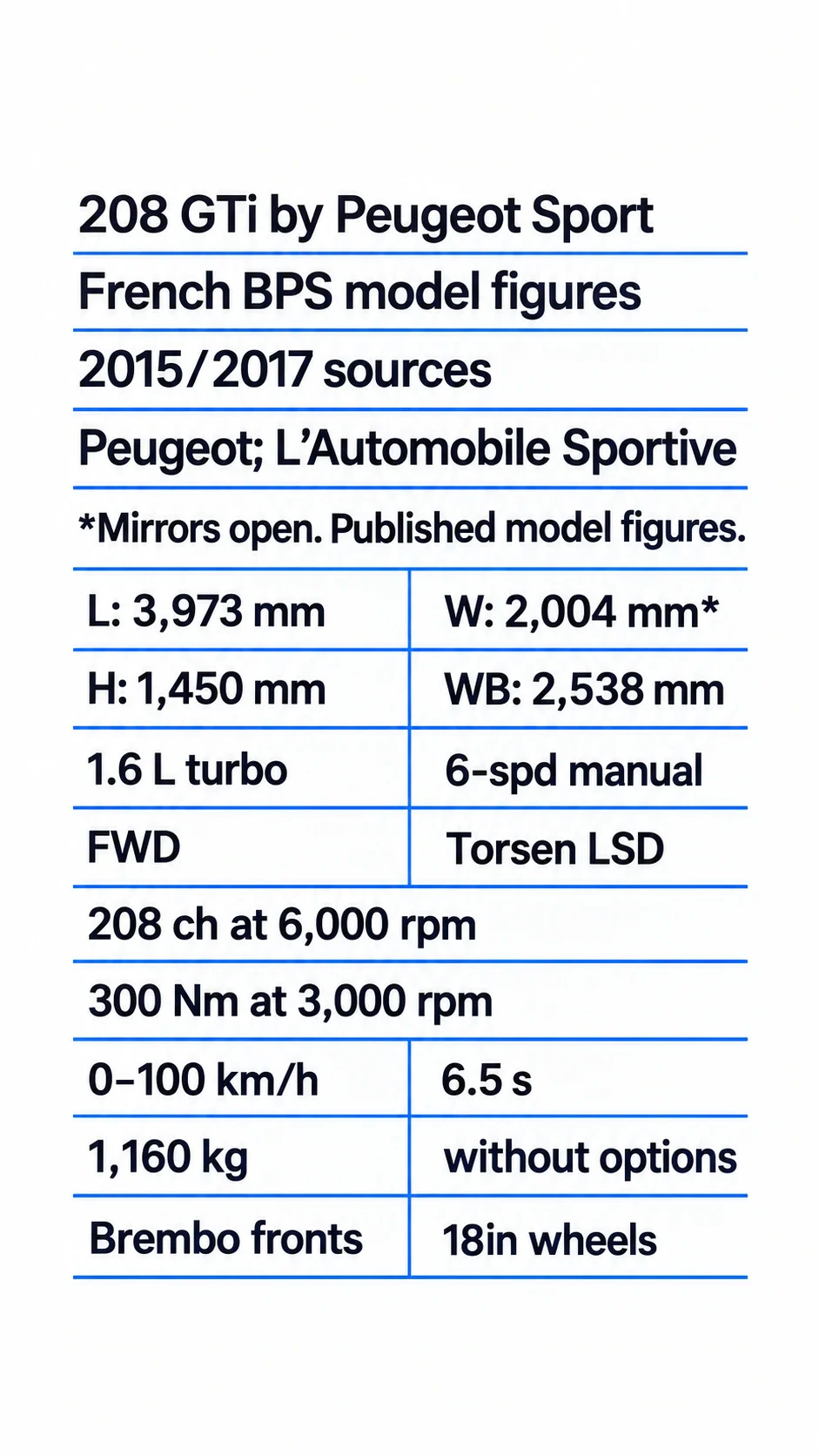
Dated French-market manufacturer and specialist figures; verify the actual car rather than treating this source summary as its specification.
This graphic presents technical tables and contains no vehicle illustration. The appearance description below identifies the model covered by the dated documents; it does not describe a car pictured on this graphic.
Illustrative 2015 French-market, left-hand-drive Peugeot 208 GTi by Peugeot Sport appearance: a first-generation facelift, three-door hatchback with a matte-black front and red rear Coupe Franche finish. The technical values below use Peugeot’s French guide applicable from 3 July 2017, with the EP6FDTX engine designation and bore/stroke taken from the 2015 L’Automobile Sportive road-test table. These source dates and definitions remain distinct; this is not a VIN-linked specification or a measured result for a used car.
The model has a turbocharged petrol 1.6-litre THP engine: 1,598 cc and four cylinders inline. The AS15 road-test table identifies EP6FDTX and a 77.0 × 85.8 mm bore and stroke. The selected French BPS specification gives 208 ch at 6,000 rpm and 300 Nm at 3,000 rpm, a six-speed manual transmission and front-wheel drive with a Torsen limited-slip differential. Only the published power and torque annotations are shown; no continuous curve, test trace, axis limit or redline is inferred.
Peugeot’s July 2017 French BPS column lists length 3,973 mm, width 2,004 mm with mirrors open, height 1,450 mm and wheelbase 2,538 mm. Its mass is 1,160 kg without options. The stated 0–100 km/h time is 6.5 seconds and top speed is 230 km/h. These published figures do not establish the condition, capability or fit of an individual car.
The source-backed features include a Torsen front differential, Brembo four-piston front brakes, 18-inch Lithium wheels, specific lowered suspension, a small steering wheel with high-mounted instruments, Peugeot Sport bucket seats, round twin exhaust outlets and the Coupe Franche two-tone finish. They describe a model-level package; build records and an inspection are needed to authenticate a car’s factory version and fitted equipment.
Redline: Not in reviewed sources. Static weight distribution: Not in reviewed sources. Designer credit: Not in reviewed sources. Each statement is limited to the actual selected FR17, AS15 and UK16 passages. It does not mean the information was never published elsewhere.
The UK December 2016 range guide has a common 1,460 mm height row; it is not substituted for the explicit 1,450 mm French BPS column. AS15 describes 1,160 kg as running order, whereas the selected Peugeot table says without options; the poster retains the latter definition without asserting that they are equivalent. AS15 also gives 300 Nm over 1,700–3,000 rpm. The displayed 3,000 rpm annotation follows the selected Peugeot table and does not resolve that difference for every market or year.
No individual VIN, installed engine, engine stamp, factory originality, exact paint code, complete options or vehicle condition has been verified. This source summary provides no personal performance measurement, reliability forecast or numerical buying recommendation.
Display abbreviations: L means length, W means width, H means height and WB means wheelbase. The asterisk identifies width with mirrors open. FWD means front-wheel drive and LSD means limited-slip differential. “18in” means 18-inch wheels; “Brembo fronts” refers to the front brakes, “lowered ride” to the specific lowered suspension and “twin outlets” to the round twin exhaust tailpipes. The 1,160 kg figure retains the explicit “without options” definition.
“6-spd manual” means a six-speed manual transmission.
Sources: https://www.forum-peugeot.com/wp-content/uploads/2016/06/prix208gti17c.pdf; https://www.automobile-sportive.com/guide/peugeot/208gtibypsp.php; https://xr793.org/wp-content/uploads/2022/12/2016-Peugeot-208-Hatchback-Prices-Specs-12-2016-UK.pdf.

Factory records must confirm the version.
Peugeot Sport checks. 2015 Spanish model announcement. Torsen differential. Brembo front brakes. Specific suspension. These are three features described in Peugeot’s Spanish30June2015 BPS announcement, not a complete all-year UK equipment list. Shared output figures, fitted parts and badges cannot authenticate a factory chassis version. Factory records must confirm the version. Establish the individual car’s build specification and modifications before paying a version premium. No test, diagnosis, superiority, current condition or individual factory originality is established.
Sources: Peugeot, 2015.
Myth or Real?

Claim
Social paraphrase: Factory equipment differs between the GTi and GTi by Peugeot Sport versions.
Verdict
REAL
Facts
Dated manufacturer documents describe different version equipment. Appearance can provide clues, but the documents do not authenticate an individual used car.
Keep the dated Spanish and French model scopes distinct. A badge or fitted part is not a factory record or an inspection.
The archived original asks how to distinguish the versions; it does not assert a universal false belief. A selected reply suggests visual equipment clues. REAL refers only to the model-level equipment differences described by Peugeot, rather than treating the reply or any photograph as authentication of an individual car. The2015Spanish announcement and2017French equipment guide describe different model equipment, but their markets, dates and definitions remain distinct. These two primary documents come from the same manufacturer and reuse the main article corpus; they are not independent product trials or a new factual source count. Check original specification records and inspect the actual car, especially when badges or components may not establish the factory version. No VIN, original equipment, installed part compatibility, service history, condition, safety, comfort, mechanical outcome, asking-price fairness or buying target is certified. An optional checklist does not replace a suitable independent inspection. Waiting when essential records or access are missing remains a valid decision. The social question supplies context only, not fresh demand or a verified personal result.
Takeaway
Confirm original specification and inspect fitted equipment; wait when essential records or checks remain incomplete.
Sources
Claim discussion: Archived r/peugeot: Estetic difference between the GTI and the Peugeot Sport.
Evidence: Peugeot: Gama deportiva Nuevo Peugeot 208: GTi y GTi by Peugeot Sport; Peugeot French GTi/GTi by Peugeot Sport equipment guide, applicable3July2017.
Checked 2026-10-20. Scope: First-generation petrol208GTi/GTi by Peugeot Sport version-level equipment in the selected2015Spanish and2017French manufacturer documents. No current price, individual-car authentication, fitment compatibility, condition, roadworthiness, reliability or suitability approval.
Try the cockpit and ride before choosing
The 208 asks you to look over its small steering wheel at a high-mounted instrument panel. Seat height, wheel adjustment and your posture make this a personal decision: settle into a safe driving position and check every dial before setting off.
Peugeot’s December 2016 UK guide lists a 3,973 mm length, 1,739 mm width including handles and 2,004 mm with mirrors open, plus a 285 dm³ VDA boot. Those figures give you a starting point for measuring parking access; luggage and rear-seat access are better tried in person. All three GTi variants in that edition have three doors. Dated UK dimensions
Prestige adds heated seats and a Cielo panoramic glass roof in that guide, while Peugeot Sport receives 18-inch wheels and specific seats and chassis equipment. Match the edition to the build and check that the equipment works. December 2016 equipment
The ride is the other daily-use test. In his original 2015 BPS review, Matt Robinson describes firm damping with a balance he found usable over longer distances. Owners in the linked discussion disagree about how well the focused version fits everyday life. An insured, agreed drive over familiar roads is more useful than trying to settle that argument in the showroom. Car Enthusiast road test, daily-use discussion
A desirable differential cannot compensate for a driving position that never feels comfortable.

The illustration shows a left-hand-drive cabin. Try the seating and instrument visibility in the actual car.
The source-scoped French left-hand-drive illustration shows the small steering wheel below the raised instruments, the dashboard and manual gear lever. It illustrates the control relationship discussed here. It does not authenticate every trim detail, an individual car’s fitted equipment or inner paint finish, or establish that the driving position suits a particular driver.
Sources: L’Automobile Sportive.
Compare the controls with the alternatives
Tony Middlehurst’s 2021 PistonHeads guide describes the standard 208 as the calmer everyday choice beside a more insistent Fiesta ST, and credits its chassis with a substantial improvement over the 207. Use those driving impressions to choose your test-drive shortlist. PistonHeads buying guide
For commuting, put a standard GTi or Prestige ahead of BPS on your viewing list if you prioritise a less demanding ride. If sharper responses matter more, try BPS and Fiesta on similarly ordinary roads. The purchase trade-off is the experience you will use every day versus the extra focused hardware you must maintain. Either preference remains conditional on the individual inspection.
What changes when moving from a 207 GTi?
The shared THP name conceals differences worth checking before moving up a generation. Peugeot’s Australian 207 GTi launch kit specifies a 128 kW 1.6-litre turbo engine and five-speed manual; the 2013 German 208 GTi release specifies 147 kW and six speeds. The 207 kit also describes a five-dial instrument panel, while the 208 release places the instruments above its smaller steering wheel. Australian 207 GTi press kit; German 208 GTi launch.
| Change described in those period sources | What to compare in a viewing |
|---|---|
| Five-speed 207 GTi versus six-speed launch 208 GTi | Clutch take-up, shift action and ordinary-road gearing; confirm the actual engine and gearbox before sourcing parts |
| Five-dial 207 panel versus the 208’s wheel-below-instruments layout | Set seat and wheel in both cars and check instrument visibility from your normal driving position |
The 207 kit concerns the August 2007 Australian launch and the 208 release concerns Germany in 2013. For a UK purchase, confirm each car’s specification in its records. Compare its service history, clutch and shift action, seating and inspection findings before paying to change generation.
Auto Express’s May 2013 UK road-and-track test compared the standard 208, Fiesta ST-2 and Clio 200 EDC Lux with optional Cup chassis. Its findings help choose what to try. Original comparison
| Candidate | Testers valued | Trade-off they identified |
|---|---|---|
| Fiesta ST | Steering, manual controls and enjoyment at ordinary speeds | Firm ride |
| Standard 208 GTi | Cabin, refinement and engine | Instrument visibility; less low-speed excitement |
| Clio 200 EDC | Dual-clutch usability and five-door access | Paddle response and involvement |
That ranking concerns the 2013 test cars, before 30th/BPS. Put rear-door access and your transmission preference ahead of its historical placing; use current offers for price comparisons.
If the 208’s wheel-and-instrument layout never feels right, include a Fiesta ST in the same viewing schedule rather than hoping you will adapt after paying.
The Clio R.S. 200 EDC offers a more fundamental control choice: Renault’s 2013 announcement specifies a 1.6-litre turbo engine and six-speed dual-clutch EDC transmission. Compare that operation with the Peugeot’s manual gearbox before drawing up a shortlist. The announcement covers France; check UK equipment and current offers separately. Renault’s original Clio R.S. announcement
Peugeot’s later E-208 GTi was revealed as an all-electric car. Its battery, charging and ownership questions differ from this petrol/manual guide. Peugeot’s E-208 GTi announcement
Actions in order: build the service-history timeline
A stamped book is a start; the detail is in the invoices. Lay them out by date and mileage, connecting major work to the car’s identity. Gaps and vague descriptions are questions for the seller, not proof that a job was done.
Peugeot’s UK servicing guidance directs owners to their handbook intervals and makes the recommended service level dependent on age and mileage. Use the handbook schedule applicable to the car when judging this history. Peugeot servicing guidance
An engine or timing-system repair needs a diagnosis, parts record and any follow-up recommendation. The independent specialist should explain what remains to be checked. Neither an engine revision nor the evidence in this guide supplies a universally safe build year or fixed timing-replacement interval.
Inspect the actual condition and modifications
This is where a familiar specialist earns their place in the budget. Give them the history and your observations, then commission written findings on the engine, leaks and cooling, clutch and transmission, suspension, brakes, tyres, structure and previous repairs. They should choose the appropriate tests and explain unresolved symptoms.
Modifications change the inspection brief. Software, intake and exhaust work, different wheels or altered suspension need fitting records and an insurer’s response. A track project belongs in a different comparison from a standard road car. Modified BPS ownership thread
During the viewing, use the touchscreen, phone connection, ventilation, air conditioning, locks, windows and supplied keys through a normal startup and shutdown. Intermittent trouble may take longer to appear than a seller’s quick demonstration. GTi ownership experiences
Questions grounded in the model’s history
PistonHeads and RAC give the following inspection leads. Their reported symptoms are starting points for diagnosis; neither establishes a fault rate or the cost of fixing the car on your shortlist.
| Area | Reported concern | Question for the inspection |
|---|---|---|
| Fuel delivery and ignition | PistonHeads links stuttering with the high-pressure fuel pump and misfires with plugs or coils | Which cause fits the symptoms and test findings? |
| Boost control and clutch | The same guide mentions wastegate-actuator complaints and clutch-pedal clicking | When does the symptom occur, and what needs investigation? |
| Cooling and clutch hydraulics | RAC describes one owner’s thermostat, clutch slave-cylinder and oil/coolant heat-exchanger trouble, plus a coolant-cap seal issue | Is there a leak, contamination or another cause? Keep this account’s single-owner scope in view. |
| Steering and electronics | RAC mentions cold steering creaks, engine lights, display freezing and Bluetooth issues | What explains the warning or noise, and do the equipment tests reproduce it? |
PistonHeads engine and gearbox discussion; RAC inspection section.
What the owners add
The value of an owner thread is often in its detail and later updates. A standard-GTi owner posting as 2172cc described a high clutch bite and occasional squeal after nearly four years; LG9k reported touchscreen reboots on a leased car. Those accounts put clutch behaviour and a longer equipment check on the viewing list, without diagnosing another car. Individual reports
Fastlane found the BPS hard at low speed, while Prestige owners Greg 172 and Tannedbaldhead differed over wheel-and-dial fit. Their disagreement reinforces the case for trying the controls and ride yourself. Daily-use thread
Poc854’s initial three-month trouble-free report was followed by an update about replacing a front shock. Zephyr Speedshop’s BPS already had software and hardware changes. Follow the timeline and separate modified setups when using these experiences to frame questions. Poc854’s updates, BPS build thread
These self-reports are not a failure-rate sample. The purchase turns on explaining poor running, warning lights, repeated oil top-ups or a knock, pull or uneven tyre wear through the inspection. Intended firm suspension is a different matter from wear or damage.

Model-level engine-bay illustration; commission a diagnosis and inspection of the actual car.
This illustration follows the reviewed Peugeot Sport engine-bay references. It shows the broad arrangement of a front-mounted transverse inline-four engine and the surrounding intake, reservoirs, battery and wiring. It does not identify an individual engine, authenticate its stamp, certify every hose or clip, establish condition or provide a repair procedure.
Sources: Benzin; AutoEasy; Power Automotive Magazine; Supersprint; Cjp24 / Wikimedia Commons.
Keep MOT and recall checks alongside the inspection
GOV.UK’s used-vehicle guidance covers the identity checks: compare the seller’s information with DVLA records, the log book and identifying numbers. The MOT history adds recorded mileages, failures and advisories; recurring items should have an explanation and supporting repairs. Used-vehicle checks, MOT history
GOV.UK states that the test does not cover the condition of the engine, clutch or gearbox. A fresh certificate therefore sits alongside the mechanical inspection. MOT scope
Use the official recall service and ask Peugeot to clarify inclusion and completion for the car. Follow any manufacturer safety instructions. These checks remain to be performed for the car you choose. Recall service
Costs, risks and stop criteria
Budget separately for the inspection, transport, insurance and any work identified in writing. Ask the relevant businesses for current quotes: the time and cost depend on access, distance and the actual findings. Allow time for records, a proper viewing and an agreed test drive; do not schedule payment around a rushed seller deadline.
This guide gives no numerical good-buy price or fair-value range for the 208 GTi family. The saved Prestige advertisements are asking-price observations with different mileages, years, fees and unverified condition; they do not establish completed-sale values or a condition-adjusted buying target. Compare current like-for-like offers and obtain an independent inspection and written estimates for the actual car before deciding whether its complete cost fits your budget.
Before a deposit, complete this checklist:
- Match the registration, VIN, log book and advertised version; resolve inconsistencies before paying.
- Obtain the service timeline and inspect the invoices behind major engine or suspension claims.
- Try the seating, instruments, clutch and cabin equipment; agree a safe, insured test drive.
- Get an independent written condition report and estimates for identified work.
- Clarify modifications and insurance; keep the risk of someone else’s experiment visible in the budget.
- Pause if inspection access is refused, material records are missing or a warning light remains unexplained.

A checklist cannot establish condition.
Before a deposit. Questions for a208GTi inspection. Compare handbook and invoices. Use the build-specific Peugeot maintenance schedule and actual service records; no universal timing-system interval is prescribed. Ask for a written diagnosis. An appropriate specialist should choose tests for unresolved symptoms and provide findings and current estimates; anecdotal reports do not establish failure rates or a diagnosis. Check modification records. Request the fitted-parts information, installation and repair records and clarify relevant insurance details; a changed part or badge does not authenticate the factory version or repair quality. Do not rely on the MOT alone. GOV.UK states that the MOT does not cover engine, clutch or gearbox condition; obtain the separate mechanical assessment appropriate to the car. A checklist cannot establish condition. No account, booking, test drive, inspection, legal determination, repair procedure, personal suitability or completed purchase was performed.
Displayed optional checks: Compare service records. Ask for a written diagnosis. Check modifications and MOT limits.
Sources: Peugeot; PistonHeads; GOV.UK.
How to assess the result: compare the complete purchase
Put the written inspection findings beside the asking price, insurance, collection and immediate maintenance costs. Add the version-specific equipment you value and your driving notes. The question is whether the complete purchase works for you, including the uncertainty that remains.
| Check | Record for each candidate |
|---|---|
| Factory version and modifications | Supporting documents and gaps |
| Seating and ordinary-road ride | Your test notes |
| Inspection and immediate work | Written findings and estimate |
| Asking price, insurance and collection | Car-specific figures |
| Proceed, investigate or walk away | The condition that must be met |
For a fictional example, Priya prefers a Peugeot Sport car to a Prestige for commuting, but the Sport wears replacement wheels and has no clear invoice for recent suspension work. She postpones the deposit until the version and repair questions are answered, keeping the Prestige on her inspection shortlist. The organiser is a way to expose that trade-off, not a guarantee of a good purchase.
A punchy drive can be persuasive. The sweet spot is a car that suits the week as well as the weekend, with costs you can carry. A bargain needs that complete picture; missing essential records or refused inspection access is a reason to continue looking.
Frequently Asked Questions
Does an advertised 208 power figure prove it is a Peugeot Sport version?
The output figure alone therefore cannot identify the chassis version.
Should I buy the Peugeot Sport version because reviewers prefer it?
A desirable differential cannot compensate for a driving position that never feels comfortable.
Does a fresh MOT prove the engine and gearbox are healthy?
GOV.UK states that the test does not cover the condition of the engine, clutch or gearbox.
Are all 30th Anniversary cars two-tone?
The release lists white and red paint alongside the distinctive two-tone finish.
Sources
The manufacturer announcements linked above establish the stated version differences. Peugeot’s UK servicing guidance and GOV.UK explain the relevant official checks. The road test and individually linked owner discussions describe their authors’ experiences. Keep those roles separate when deciding what applies to the actual car.
-
Tony Middlehurst, PistonHeads used buying guide (23 May 2021). Attributed driving impressions and component questions for the inspection.
-
Jonathan Crouch, RAC used review. Inspection observations, including the specifically single-owner cooling account used above.
-
Auto Express team, UK three-car road and track test (15 May 2013). Firsthand observations of standard208GTi, FiestaST-2 and Cup-equipped Clio200EDCLux. Use its period driving comparison alongside current offers, condition and your own viewing.
FAQ
Common questions
Does an advertised 208 power figure prove it is a Peugeot Sport version?
The output figure alone therefore cannot identify the chassis version.
Should I buy the Peugeot Sport version because reviewers prefer it?
A desirable differential cannot compensate for a driving position that never feels comfortable.
Does a fresh MOT prove the engine and gearbox are healthy?
GOV.UK states that the test does not cover the condition of the engine, clutch or gearbox.
Are all 30th Anniversary cars two-tone?
The release lists white and red paint alongside the distinctive two-tone finish.
Topic hubs
Tags


